Agentic websites are websites designed for AI agents that retrieve information, execute actions, and complete tasks autonomously. The concept of an agentic website explains how website architecture is evolving beyond human navigation toward machine-readable interaction. This evolution changes how websites expose content, functionality, and services to autonomous systems operating on behalf of users.
Agentic websites matter because AI agents increasingly influence how information is discovered, evaluated, and acted upon across the web. Autonomous systems retrieve structured information, compare options, and complete workflows without relying on traditional browsing behavior. This shift changes how websites earn visibility because AI agents prioritize resources that provide machine-readable content, structured entities, and executable functionality. Websites that expose these signals become easier for agents to discover and use during task execution.
Agentic websites create measurable opportunities and risks for organizations operating in search, commerce, software, and digital services. Agent-ready websites increase accessibility for AI systems that drive research, recommendations, purchases, and customer interactions. Websites that lack structured data, callable endpoints, and agent-compatible infrastructure become harder for autonomous systems to access and evaluate. This difference affects visibility, retrieval, and participation in emerging AI-driven ecosystems.
Agentic websites require preparation through structured data implementation, machine-readable documentation, and agent-accessible functionality. Organizations that adopt Schema.org markup, OpenAPI specifications, llms.txt files, MCP infrastructure, and authenticated endpoints create environments that AI agents understand and interact with efficiently. The ability to expose information and actions in machine-readable formats ensures that websites remain accessible, discoverable, and useful as agent-driven traffic continues to expand across the web.
What Is an Agentic Website?
An agentic website is a website designed for autonomous AI agents rather than only human visitors. Agentic websites expose data, actions, and workflows through machine-readable systems that AI agents access directly. These systems allow agents to retrieve information, complete tasks, and execute multi-step processes without navigating visual interfaces. Agentic websites connect website functionality to autonomous software agents, which shifts website design from human interaction toward machine interaction.
What does an agentic website enable AI agents to do? Agentic websites enable AI agents to discover information, compare alternatives, submit requests, complete transactions, and execute workflows. These workflows often contain multiple steps that occur without human intervention between actions. The website provides structured access to functions, while the agent determines how to accomplish the assigned objective. This structure turns the website into an operational environment for autonomous systems rather than a destination for human browsing.
Why are agentic websites becoming important? Agentic websites are becoming important because autonomous AI traffic is growing rapidly across the web. Autonomous traffic changes how information gets discovered, evaluated, and consumed. According to HUMAN Security’s 2026 benchmark report, traffic from AI agents and agentic browsers increased 7,851% year over year. Imperva’s Bad Bot Report 2026 found that automated traffic accounted for 53% of all web traffic during 2025, compared with 51% the previous year. These numbers show a measurable shift from human-driven interactions toward machine-driven interactions.
How do agentic websites fit into the future of the web? Agentic websites function as the infrastructure layer for AI agent interactions. This infrastructure exposes information and actions in formats that autonomous systems understand directly. AI agents retrieve data, make decisions, and execute tasks through these interfaces. The result is a web environment where websites communicate with both people and autonomous agents, creating a parallel layer of machine-to-machine interaction across the internet.
What Are the Core Characteristics That Define an Agentic Website?
Agentic websites are defined by five core characteristics that allow autonomous AI agents to discover information, execute tasks, and complete workflows without relying on traditional website navigation. These characteristics create a machine-readable environment where agents retrieve data, make decisions, and perform actions through structured interactions rather than visual interfaces.
The 5 main characteristics that define an agentic website are listed below.
1. Tool callable endpoints enable direct agent interaction. Tool callable endpoints expose APIs, MCP servers, and action interfaces that AI agents invoke directly to retrieve data, submit requests, or complete transactions. Agents access these endpoints without navigating menus, forms, or page layouts. Direct access reduces friction, increases execution speed, and allows autonomous systems to complete multi-step workflows through structured requests rather than browser interactions.
2. Structured metadata communicates capabilities to machines. Structured metadata communicates content, functions, and available actions in formats that machines interpret natively. Schema.org markup, OpenAPI specifications, and llms.txt files provide explicit instructions about what information exists and what tasks the website supports. Clear metadata improves discoverability, increases retrieval accuracy, and allows agents to select the correct resources without guessing intent.
3. Agent identity verification establishes trust and access control. Agent identity verification authenticates autonomous systems before granting access to protected resources or actions. OAuth 2.0, OAuth 2.1, token-based authentication, and session inheritance frameworks verify agent permissions and identity. Verified access protects sensitive operations, prevents unauthorized activity, and creates trusted communication between websites and autonomous systems.
4. Workflow recovery enables reliable task completion. Workflow recovery provides structured error handling, status reporting, and retry instructions when failures occur. Endpoints return explicit responses that tell agents why an action failed and how to continue the workflow successfully. Clear recovery mechanisms reduce abandoned tasks, improve completion rates, and allow agents to resolve interruptions without human intervention.
5. Semantic content architecture improves information retrieval. Semantic content architecture organizes information around intent, entities, and tasks rather than traditional page hierarchies. Agents retrieve information based on the objective they need to accomplish instead of navigating multiple pages to locate relevant content. An intent-driven organization improves retrieval precision, reduces unnecessary processing, and increases the likelihood that agents select the correct information at the correct stage of a workflow.
What Is the Difference Between a Traditional Website and an Agentic Website?
The difference between a traditional website and an agentic website lies in the primary interaction model. A traditional website is built for human visitors who navigate pages, click links, and complete actions through visual interfaces. An agentic website is built for autonomous AI agents that retrieve information and execute tasks through machine-readable systems. This distinction changes how information is accessed, how actions are performed, and how websites expose functionality.
The core differences between a traditional website and an agentic website are below.
| Aspect | Traditional Website | Agentic Website |
| Primary audience | Human visitors interacting through browsers and visual interfaces. | AI agents interacting through APIs, MCP servers, and machine-readable protocols. |
| Navigation model | Uses menus, links, buttons, and page hierarchies. | Uses endpoints, tools, workflows, and task-oriented actions. |
| Content structure | Organizes information around pages and user journeys. | Organizes information around tasks, entities, and machine-readable resources. |
| Data access | Requires users to browse pages and manually retrieve information. | Provides direct access to structured data and callable functions. |
| Action execution | Relies on human clicks and form submissions. | Relies on automated tool calls and workflow execution. |
| Communication format | Prioritizes visual design and human-readable content. | Prioritizes structured metadata and machine-readable content. |
| Authentication | Authenticates human users through login interfaces. | Authenticates agents through tokens, OAuth, session inheritance, and protocol-based access. |
| Primary outcome | Guides people through information and conversion journeys. | Enables agents to retrieve information and complete tasks autonomously. |
What does a traditional website do? A traditional website presents information and functionality through a visual user experience. Visitors navigate pages, compare options, complete forms, and make decisions through direct interaction with the interface. This model places humans at the center of every action and requires manual input at each step of a workflow.
What does an agentic website do? An agentic website exposes data, tools, and actions in formats that AI agents access directly. Agents retrieve information, evaluate options, and execute workflows without navigating visual interfaces. This architecture allows autonomous systems to complete complex tasks through structured interactions rather than browser-based navigation.
Why is an agentic website different from a traditional website? An agentic website changes the interaction layer from human-driven navigation to machine-driven execution. Traditional websites expect a person to interpret information and decide what action to take next. Agentic websites expose actions directly, which allows agents to move from decision to execution without intermediate navigation steps.
How do traditional websites and agentic websites work differently in practice? Traditional websites and agentic websites complete the same objectives through different processes. A traveler booking a flight on a traditional website searches manually, reviews comparison pages, selects an option, and completes checkout through a browser interface. An AI agent performing the same task on an agentic website calls a search endpoint, evaluates structured results, selects an option based on predefined criteria, and submits a booking request through another endpoint. The outcome remains the same, but the interaction model changes from human navigation to autonomous execution.
How Do AI Agents Interact With Websites?
AI agents interact with websites through structured machine-to-machine communication rather than traditional browser navigation. AI agents retrieve information, execute actions, and complete workflows through crawling systems, APIs, MCP servers, and WebMCP environments. These interaction methods allow agents to access website resources directly without relying on visual interfaces, clicks, or manual user input.
The 4 main ways AI agents interact with websites are listed below.
1. Crawling discovers and retrieves website content. Crawling allows AI agents to access, analyze, and index information published on websites. GPTBot from OpenAI, ClaudeBot from Anthropic, and similar crawlers request pages and evaluate content for retrieval and answer generation. These crawlers respect robots.txt directives and increasingly evaluate llms.txt files to determine which content is available for AI systems. Structured crawling improves content discovery and increases the likelihood that AI platforms reference a website during answer generation.
2. API calls provide direct access to website functionality. API calls allow AI agents to retrieve data and execute actions through structured endpoints. REST APIs expose functions that agents invoke directly without loading web pages or interacting with browser interfaces. OpenAPI specifications describe available operations, parameters, and outputs in a standardized format. Direct API access increases execution speed, improves reliability, and allows agents to complete tasks through predictable machine-readable workflows.
3. MCP servers expose tools for runtime execution. MCP servers make website functions discoverable and callable through the Model Context Protocol. AI agents connect to MCP servers and identify available tools dynamically during task execution. OpenAPI specifications convert into MCP-compatible tools, which allow agents to invoke website capabilities through a standardized interface. This standardization improves interoperability and enables a single website integration to work across multiple MCP-compatible agent ecosystems.
4. WebMCP enables authenticated browser-based actions. WebMCP enables AI agents to interact with website tools inside an authenticated browser session. The framework gives agents access to existing session cookies, identity providers, and single sign-on environments without requiring separate authentication flows. Shared session context reduces friction during task execution and allows agents to perform authenticated actions while maintaining the user’s existing permissions and security controls.
How Are Agentic Websites Changing Traffic Patterns and User Behavior?
Agentic websites are changing traffic patterns and user behavior because AI agents consume information and complete tasks differently than human visitors. Human visitors browse pages, compare options, and build context across multiple interactions. AI agents arrive with a specific objective, retrieve structured information, and execute actions directly. This shift changes how traffic reaches websites, how conversions occur, and how businesses compete for visibility.
Agentic websites are changing traffic patterns because automated traffic now represents a majority of web activity across many industries. Imperva’s 2026 report found that 53% of all web traffic during 2025 came from automated sources. AI-driven traffic increased 187% from January to December 2025, which reflects rapid growth in autonomous systems accessing websites. This growth changes traffic composition and increases the importance of machine-readable website infrastructure.
Agentic websites are changing conversion paths because AI agents follow task completion workflows rather than browsing journeys. Human visitors often arrive through organic search, evaluate multiple pages, and convert after several interactions. AI agents arrive with predefined objectives and request only the information required to complete the task. This behavior reduces page views, shortens decision cycles, and shifts website optimization toward direct access to data and functionality.
Agentic websites are changing competitive dynamics because AI agents prioritize accessibility and efficiency. Websites that require multiple navigation steps create friction for autonomous systems. An agent searching for pricing information, product specifications, or availability data evaluates how easily that information is retrieved. Competitors that expose the same information through structured endpoints gain an advantage because agents retrieve the required data immediately without unnecessary navigation.
Agentic websites are changing how businesses think about visibility because accessibility now extends beyond human audiences. Traditional optimization focused on attracting visitors and guiding those visitors through conversion funnels. Agentic optimization focuses on exposing information and actions in formats that autonomous systems understand directly. This shift changes website architecture from a navigation-first model to an accessibility-first model for both humans and machines.
Agentic websites are changing user behavior because consumers increasingly delegate research and decision-making to AI systems. Booking.com’s agentic commerce research found that 30% of travelers used AI for trip planning in 2025. This behavior reduces the number of websites people visit directly because AI systems consolidate research across multiple sources. The average traveler previously visited 277 websites before making a booking decision. Agent-driven research compresses those interactions into a single workflow, which concentrates decision-making inside AI systems rather than across hundreds of website visits.
Agentic websites do not eliminate human visitors, but they change how information flows between businesses, AI systems, and consumers. Human audiences continue to browse, compare, and evaluate options. AI agents increasingly handle discovery, research, and task execution. Organizations that expose information and functionality in agent-friendly formats gain greater search visibility as autonomous traffic continues to grow.
Why Are Agentic Websites Becoming the Default Web Architecture?
Agentic websites are becoming the default web architecture because AI agents require structured discovery, callable tools, and programmatic task execution. Traditional websites were designed for human navigation through pages and interfaces. Agentic websites expose information and functionality in machine-readable formats that autonomous systems access directly. This shift aligns website architecture with how AI systems retrieve information, make decisions, and complete tasks.
Why is infrastructure maturity accelerating agentic website adoption? Infrastructure maturity is accelerating agentic website adoption because the underlying protocols reached production readiness during 2025 and early 2026. MCP, WebMCP, and the A2A protocol provide standardized frameworks for tool discovery, authentication, and agent communication. These standards reduce implementation complexity and create interoperability across platforms. Cloudflare’s Agents Week in April 2026 marked a significant milestone because major technology providers began treating agent communication as a core internet capability rather than an experimental feature.
Why are enterprises investing heavily in agentic architectures? Enterprises are investing heavily in agentic architectures because autonomous systems increasingly perform operational tasks across software environments. Gartner projected that up to 40% of enterprise applications will contain task-specific AI agents by the end of 2026. Enterprise interest reflects this transition. Between the first quarter of 2024 and the second quarter of 2025, inquiries about multi-agent systems increased by 1,445%. This growth demonstrates that organizations view agents as operational components rather than standalone productivity tools.
Why are product builders shifting toward agent-based systems? Product builders are shifting toward agent-based systems because AI agents create new interaction models for software and web applications. Survey data found that 51% of product builders created agents during 2025, compared to 21% during the previous year. This increase reflects growing demand for systems that perform tasks autonomously instead of waiting for continuous user input. Agent adoption expands as organizations build products around execution, automation, and workflow completion.
Why do AI agents prefer agentic websites over traditional websites? AI agents prefer agentic websites because agentic architectures expose information and actions directly. Traditional websites require navigation through pages, menus, and interface elements that were designed for people. Agentic websites expose APIs, structured data, tools, and workflows that autonomous systems access immediately. Direct access improves retrieval efficiency, reduces execution friction, and allows agents to complete objectives without unnecessary navigation steps.
Why are traditional websites becoming less effective for AI-driven interactions? Traditional websites are becoming less effective for AI-driven interactions because they often hide functionality behind interfaces that machines do not use efficiently. AI agents evaluate resources based on accessibility, structure, and task completion capability. Websites that expose machine-readable content and callable actions fit naturally into agent workflows. Websites that rely exclusively on visual navigation appear as opaque resources that require additional interpretation. This difference increasingly affects visibility, accessibility, and participation within AI-driven ecosystems.
Why will agentic websites become the standard web architecture? Agentic websites will become the standard web architecture because AI agents are becoming a primary consumer of digital information and services. Human visitors continue to browse websites directly, but autonomous systems increasingly handle discovery, research, comparison, and task execution. Agentic architecture provides the structured environment that these systems require. As AI agents become more common across consumer and enterprise workflows, websites that expose information and functionality through agent-friendly protocols gain a structural advantage in the evolving web ecosystem.
What Role Does Structured Data Play in Making a Website Agent-Ready?
Structured data plays a critical role in making a website agent-ready because it gives AI agents a machine-readable representation of content, entities, and available actions. Structured data removes ambiguity, improves retrieval accuracy, and allows agents to understand information without relying on visual interpretation. AI agents use structured data to identify what a page contains, what actions are available, and how website resources connect to a specific task or objective.
The 3 main structured data formats that make a website agent-ready are listed below.
1. Schema.org JSON-LD provides machine-readable entity information.
Schema.org JSON-LD embeds structured metadata directly within a webpage and describes entities in a format that AI agents parse efficiently. Product pages expose information about names, prices, availability, ratings, and reviews through standardized fields. Agents retrieve this information directly instead of extracting it from unstructured page elements. Direct access improves data accuracy, reduces interpretation errors, and increases confidence in retrieved information.
2. OpenAPI specifications expose website functionality to AI agents.
OpenAPI specifications describe what API endpoints do, what parameters they accept, and what responses they return. Agents use these specifications to understand available actions and generate tool definitions dynamically during execution. Structured endpoint documentation allows agents to interact with website functionality programmatically rather than relying on page navigation. This structure transforms website capabilities into callable actions that autonomous systems execute directly.
3. llms.txt prioritizes content for AI retrieval and inference.
llms.txt provides a structured map of important website resources for AI systems. The file resides at the website root and identifies which pages contain the most valuable information for retrieval and reasoning. Agents use this guidance to locate authoritative content more efficiently and reduce unnecessary crawling. Prioritized retrieval improves content selection and increases the likelihood that AI systems reference the correct information during answer generation. Research from dev5310.com found that llms.txt reduced AI hallucinations about website content by 30% to 70% because agents retrieved information from verified sources rather than fragmented HTML content.
Why does structured data improve AI agent performance? Structured data improves AI agent performance because AI systems process structured information more reliably than unstructured content. HTML pages often require interpretation, extraction, and inference before an agent understands the underlying meaning. Structured formats define entities, relationships, and actions explicitly. Explicit definitions reduce ambiguity, improve retrieval precision, and allow agents to execute tasks with greater confidence.
Why is structured data essential for agent-ready websites? Structured data is essential for agent-ready websites because agent interactions depend on machine-readable information. Human visitors interpret layouts, images, and navigation elements visually. AI agents rely on structured representations of content and functionality. Websites that expose information through structured formats become easier to discover, understand, and interact with. This accessibility increases compatibility with autonomous systems and improves performance in agent-driven environments.
How Do AI Crawlers Index Agentic Websites Differently From Search Bots?
AI crawlers index agentic websites differently from search bots because they prioritize semantic understanding, factual retrieval, and task execution rather than keyword matching and document ranking. Search bots build searchable indexes that rank pages for queries. AI crawlers build knowledge representations that agents use to retrieve facts, evaluate entities, and complete actions. This difference changes which signals matter during content discovery and retrieval.
AI crawlers index agentic websites differently because search bots focus on ranking documents. Search bots evaluate keywords, backlinks, anchor text, crawl depth, and page authority to determine where a page appears in search results. These signals help search engines understand relevance and popularity across the web. The primary goal is to rank documents for a user’s query rather than execute tasks or retrieve structured actions.
AI crawlers index agentic websites differently because AI systems focus on semantic meaning and factual relationships. GPTBot, ClaudeBot, and similar crawlers extract entities, facts, relationships, and available actions from websites. These systems collect information that becomes part of retrieval and reasoning workflows. The primary goal is to understand what information exists and how that information connects to a specific task or question.
AI crawlers index agentic websites differently because structured data carries greater importance than traditional ranking signals. A strong backlink profile improves authority signals for search engines, but backlinks alone do not verify factual accuracy for AI systems. AI crawlers place greater emphasis on structured metadata, entity definitions, schema markup, and verifiable information sources. These signals improve confidence in retrieved information and reduce ambiguity during answer generation.
AI crawlers index agentic websites differently because they evaluate callable functionality in addition to content. Search bots primarily analyze pages and links. AI crawlers analyze APIs, OpenAPI specifications, MCP tools, and other machine-readable actions that agents execute directly. This evaluation allows AI systems to understand not only what a website says, but what a website enables an agent to do.
AI crawlers index agentic websites differently because retrieval depends on machine-readable accessibility. Websites that expose structured entities, factual content, and actionable endpoints become easier for AI systems to understand and use. Websites that rely exclusively on visual navigation require additional interpretation and provide fewer signals for autonomous systems. This difference affects how efficiently AI agents retrieve information and complete tasks.
AI crawlers do not replace searchbots because both systems perform different functions. Search bots improve visibility through rankings and search results. AI crawlers improve visibility through retrieval, citations, and task execution. Agentic websites optimize for both systems by combining traditional SEO signals with structured data, entity clarity, and machine-readable functionality.
How Do You Build a Website That Works for AI Agents?
Building a website that works for AI agents requires designing every layer of the website around machine-readable discovery, retrieval, and task execution. AI agents do not browse websites the same way people do. AI agents retrieve information, evaluate structured data, and execute actions through APIs, protocols, and callable tools. A website that exposes information and functionality in agent-friendly formats increases compatibility with autonomous systems and improves visibility across agent-driven workflows.
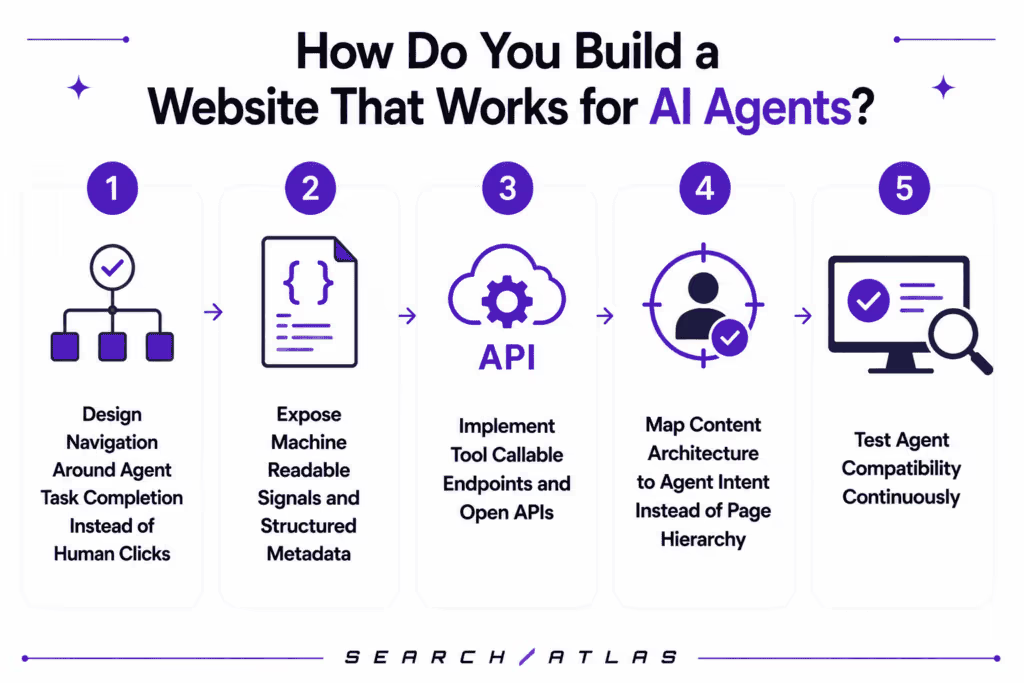
The 5 ways to build a website that works for AI agents are listed below.
1. Design Navigation Around Agent Task Completion Instead of Human Clicks
Agent task completion means organizing website interactions around objectives rather than browsing paths. AI agents arrive with specific goals that often involve retrieving information, comparing options, checking availability, or completing transactions. Task-oriented navigation reduces the number of steps required to reach the desired outcome. Businesses apply this approach by mapping common agent tasks and exposing the shortest path to each action. A practical takeaway is to organize resources around tasks instead of forcing agents to navigate through multiple page layers.
2. Expose Machine Readable Signals and Structured Metadata
Machine-readable signals provide explicit information about content, entities, and available actions. Structured metadata reduces ambiguity because agents retrieve facts directly rather than interpreting unstructured page elements. Businesses implement this approach through Schema.org JSON-LD markup, llms.txt files, and structured content definitions across all important resources. A practical takeaway is to expose every important entity and content type in a format that agents can parse without interpretation.
3. Implement Tool Callable Endpoints and Open APIs
Tool-callable endpoints allow AI agents to retrieve information and execute actions programmatically. Open APIs define available functionality through structured specifications that agents understand automatically. Businesses implement this approach through REST APIs, OpenAPI specifications, MCP servers, and WebMCP integrations that expose functionality beyond traditional webpage interactions. A practical takeaway is to treat website functionality as callable services rather than features hidden behind interfaces.
4. Map Content Architecture to Agent Intent Instead of Page Hierarchy
Agent intent reflects the objective that an autonomous system is trying to accomplish. Content architecture organized around intent allows agents to retrieve direct answers without traversing multiple documents. Businesses implement this approach by structuring content around questions, tasks, policies, products, and decision points that align with common retrieval requests. A practical takeaway is to answer a single question or task clearly within each resource instead of distributing information across multiple pages.
5. Test Agent Compatibility Continuously
Agent compatibility testing verifies that structured data, APIs, endpoints, and retrieval systems function correctly after updates. Compatibility testing prevents failures that reduce accessibility for autonomous systems. Businesses perform this validation through agent simulation tools, endpoint testing, structured data audits, OpenAPI verification, and llms.txt reviews. A practical takeaway is to validate agent accessibility after every major content, infrastructure, or architecture change.
Why does building for AI agents require a different website architecture? Building for AI agents requires a different website architecture because AI systems interact through structured retrieval and task execution rather than visual navigation. Human visitors interpret layouts, menus, and design elements. AI agents interpret structured data, APIs, and callable tools. This difference changes how websites expose information and functionality.
Why does agent readiness matter for future website visibility? Agent readiness matters because autonomous systems increasingly participate in research, comparison, discovery, and transaction workflows. Websites that expose machine-readable content and executable actions become easier for agents to access and use. This accessibility increases the likelihood that AI systems retrieve information, reference content, and complete tasks through the website instead of selecting competing resources.
What Are The Best Practices for Optimizing an Agentic Website?
Optimizing an agentic website requires maintaining accurate machine-readable signals, reliable tool access, and predictable interactions for AI agents. Agentic website optimization focuses on retrieval accuracy, task completion, and interoperability across agent ecosystems. Strong optimization practices improve how agents discover information, execute actions, and interact with website functionality.
The 6 best practices for optimizing an agentic website are listed below.
1. Validate Structured Data Continuously. Structured data validation ensures that AI agents interpret website content correctly. Errors in Schema.org markup create missing entities, incorrect relationships, and retrieval failures that reduce agent confidence. Businesses implement continuous validation through automated testing during deployment workflows. A practical takeaway is to verify every structured data update before publication to prevent retrieval and interpretation errors.
2. Keep llms.txt updated. An accurate llms.txt file directs AI agents toward the most important and authoritative website resources. Outdated references reduce retrieval quality because agents access archived, incomplete, or irrelevant content. Businesses maintain retrieval accuracy by reviewing and updating llms.txt whenever content architecture changes. A practical takeaway is to treat llms.txt as an actively managed retrieval resource rather than a one-time configuration file.
3. Implement Agent-Aware Rate Limiting. Agent-aware rate limiting distinguishes legitimate agent activity from abusive automated traffic. AI agents often generate bursts of parallel requests while completing tasks, which differs from typical human browsing behavior. Businesses optimize access by identifying trusted agent traffic patterns and applying policies that accommodate task execution workflows. A practical takeaway is to align rate-limiting rules with agent behavior rather than human session behavior.
4. Return Structured Error Responses. Structured error responses provide clear instructions that allow agents to recover from failures. Generic server errors create uncertainty because agents receive no guidance about what happened or what action to take next. Businesses improve reliability by returning standardized error codes, retry guidance, resolution instructions, and retry-after headers. A practical takeaway is to design error handling as part of the workflow rather than treating it as an exception.
5. Maintain Accurate OpenAPI Documentation. OpenAPI documentation defines how agents interact with website functionality. Inaccurate specifications create mismatches between expected behavior and actual endpoint responses, which lead to failed tool execution. Businesses maintain compatibility by updating OpenAPI specifications whenever APIs change. A practical takeaway is to manage OpenAPI documentation as a live operational asset instead of static technical documentation.
6. Configure Agent Compatible CORS Policies. CORS policies control how external systems access website resources across origins. Agent frameworks frequently operate across multiple domains and execution environments, which makes restrictive configurations block legitimate requests. Businesses improve interoperability by defining approved origins, enforcing HTTPS, and aligning policies with agent execution environments. A practical takeaway is to review CORS configurations regularly as agent ecosystems evolve.
Why do optimization best practices matter for agentic websites? Optimization best practices matter because AI agents depend on accuracy, consistency, and accessibility throughout the interaction process. Retrieval errors, authentication failures, outdated documentation, and blocked requests reduce an agent’s ability to complete tasks successfully. Consistent optimization improves reliability and increases successful task completion rates.
Why does agentic website optimization require ongoing maintenance? Agentic website optimization requires ongoing maintenance because content, APIs, protocols, and agent ecosystems change continuously. Structured data becomes outdated, APIs evolve, and retrieval priorities shift over time. Continuous maintenance preserves compatibility and ensures that AI agents interact with current information and functionality instead of outdated resources.
What Tools and Frameworks Support Agentic Website Development?
Agentic website development relies on protocols, frameworks, and infrastructure that enable AI agents to discover information, execute actions, and coordinate tasks across systems. These technologies provide the foundation for machine-readable communication, tool invocation, authentication, and workflow execution. Organizations building agentic websites use these frameworks to expose functionality in formats that autonomous systems understand and interact with directly.
The 6 main tools and frameworks that support agentic website development are listed below.
1. Model Context Protocol (MCP) supports agent-to-tool communication. Model Context Protocol supports agentic website development by defining how AI agents discover and invoke tools at runtime. MCP creates a standardized communication layer between agents and website functionality, which removes the need for custom integrations across different agent ecosystems. Tools (FastMCP, Speakeasy Gram, openapi-mcp-generator) simplify MCP implementation by converting existing APIs into agent-accessible tools. This standardization improves interoperability and makes website functionality available to a wider range of AI systems.
2. WebMCP supports browser-native agent interactions. WebMCP supports agentic website development by allowing websites to register callable tools inside authenticated browser sessions. This framework gives agents access to existing session state, authentication tokens, and user permissions without requiring separate credential workflows. Shared authentication improves usability because agents execute actions within the same security context as the user. This architecture simplifies authenticated interactions across agent-driven workflows.
3. A2A Protocol supports agent-to-agent coordination. A2A Protocol supports agentic website development by enabling communication between multiple AI agents. Agent ecosystems frequently divide complex tasks into smaller subtasks that specialized agents handle independently. A2A manages task delegation, status updates, and result transfers between participating systems. This coordination improves scalability because multiple agents collaborate on workflows that exceed the capabilities of a single agent.
4. OpenAPI supports machine-readable endpoint definitions. OpenAPI supports agentic website development by describing API functionality in a structured and standardized format. Agents use OpenAPI specifications to understand available endpoints, accepted parameters, authentication requirements, and expected responses. This documentation transforms website functionality into machine-readable actions that autonomous systems execute directly. Accurate OpenAPI specifications improve compatibility and reduce implementation complexity across agent frameworks.
5. Langflow supports visual agent workflow development. Langflow supports agentic website development by providing a visual environment for building agent workflows. Developers connect actions, decision points, and integrations through graphical workflow builders instead of writing every interaction manually. Completed workflows become callable REST endpoints that agents invoke programmatically. This approach accelerates workflow creation and simplifies the deployment of complex agent-driven processes.
6. HUMAN Security supports agent-aware traffic management. HUMAN Security supports agentic website development by distinguishing legitimate AI agent traffic from malicious automation. Traditional bot detection systems often treat all automated traffic as suspicious activity. HUMAN Security analyzes traffic patterns and classifies automated interactions based on behavior and intent. This analysis allows organizations to permit trusted agent activity while blocking malicious requests, which improves security without disrupting legitimate agent workflows.
Why are protocols becoming important in agentic website development? Protocols are becoming important because agent ecosystems depend on standardization across platforms, applications, and services. Standardized protocols reduce integration complexity and improve interoperability between agents and websites. This consistency allows organizations to expose functionality once and make it accessible across multiple AI systems rather than maintaining separate integrations for each platform.
How Do AI Agents Authenticate and Navigate Website Infrastructure?
AI agents authenticate and navigate website infrastructure through standardized identity frameworks and machine-readable access patterns. Authentication verifies permissions before agents access protected resources. Navigation allows agents to discover endpoints, retrieve information, and execute actions through structured interactions instead of visual interfaces.
AI agents authenticate through OAuth 2.1 when accessing protected data on behalf of users. OAuth 2.1 provides authorization, token management, and identity verification for enterprise-grade agent deployments. ChatGPT custom MCP integrations rely on this framework to maintain secure access across workflows.
AI agents authenticate through token-based authentication when websites expose APIs to trusted systems. API keys identify agent instances and define what resources they access. This approach simplifies implementation while maintaining controlled access to website functionality. AI agents authenticate through WebMCP session inheritance when operating inside an authenticated browser session. Agents inherit existing cookies and single sign-on context without requiring separate login flows. This approach reduces friction because the user is already authenticated.
AI agents authenticate through role-based access control in enterprise environments. RBAC restricts which actions specific agent identities perform and records those actions through audit logs. These controls improve security, governance, and compliance. AI agents navigate website infrastructure through predictable endpoint structures and consistent resource organization. Clear URL patterns, standardized responses, and stable APIs improve retrieval efficiency. Redirect chains, inconsistent URL structures, and fragmented architectures create friction that reduces successful task completion.
What Are Real-World Examples of Agentic Websites in Use Today?
Real-world examples of agentic websites demonstrate how organizations expose services, data, and actions directly to AI systems instead of relying exclusively on human navigation. These implementations allow AI agents to retrieve information, complete transactions, manage workflows, and execute customer requests through structured interactions. The result is a shift from traditional browsing experiences toward autonomous task completion.
The 4 main examples of agentic websites in use today are listed below.
1. Booking.com enables AI-driven travel discovery and booking. Booking.com demonstrates agentic website functionality through direct integration with AI platforms and autonomous travel assistance features. The company launched Smart Messenger and Auto Reply to automate customer interactions and streamline travel support workflows. Booking.com became one of the first travel platforms integrated into ChatGPT, which allows travelers to discover accommodations and complete bookings directly from the conversational interface. This integration reduces friction by moving travel planning and booking into a single AI-driven workflow.
2. Navan automates travel disruption management. Navan demonstrates agentic website functionality through real-time travel assistance for business travelers. The platform monitors airline status changes, analyzes available alternatives, and identifies replacement travel options when disruptions occur. Automated decision support reduces the time required to evaluate alternatives manually. This workflow improves responsiveness because travelers receive actionable recommendations immediately after cancellations or schedule changes.
3. Sabre, PayPal, and MindTrip created an end-to-end agentic travel workflow. Sabre, PayPal, and MindTrip demonstrate agentic website functionality through a unified travel planning and booking ecosystem. Their implementation combines conversational trip planning, real-time inventory access, and payment execution inside a single workflow. AI agents manage multiple stages of the travel process without requiring users to switch between separate platforms. This architecture shows how agentic systems coordinate planning, purchasing, and transaction completion within one connected experience.
4. Malaysia Airlines automates customer service through Mavis. Malaysia Airlines demonstrates agentic website functionality through Mavis, an AI customer service agent deployed in February 2026. Mavis manages customer requests that previously required human representatives to complete multiple steps manually. The system handles inquiries, processes requests, and guides customers through service workflows autonomously. This implementation improves operational efficiency by allowing routine customer interactions to move through structured agent-driven processes.
What percentage of web traffic is projected to come from AI agents?
AI agent traffic is projected to become one of the largest sources of internet activity during the next several years. Exact projections vary because AI traffic evolves rapidly and measurement methodologies differ across providers. Current industry data shows that automated traffic already exceeds human traffic across many environments, while AI-specific traffic continues to grow at an exceptional rate. These trends indicate that AI agents will account for a significant share of total web traffic as agent adoption accelerates.
Automated traffic already represents the majority of web traffic across the internet. Imperva’s Bad Bot Report 2026 found that automated traffic accounted for 53% of all web traffic during 2025. This milestone is significant because it marks a shift where automated systems generate more activity than human visitors across large portions of the web. AI agents represent one component of this broader automation trend, which continues to expand as organizations deploy autonomous systems at scale.
AI agent traffic is growing substantially faster than overall internet traffic. HUMAN Security’s 2026 benchmark report found that traffic from AI agents and agentic browsers increased by 7,851% year over year. This growth reflects the rapid adoption of autonomous systems that retrieve information, complete tasks, and interact directly with websites. The scale of this increase demonstrates that AI agents are moving from experimental tools into mainstream digital infrastructure.
AI-driven traffic continued accelerating throughout 2025. HUMAN Security reported that AI traffic increased by 187% between January and December of that year. This growth rate shows that agent adoption is not stabilizing but continuing to expand as more businesses integrate AI agents into customer experiences, operational workflows, and digital services. Continued growth increases the likelihood that AI systems will become a primary source of website interactions during the coming years.
Industry leaders project that automated systems will dominate internet traffic in the near future. Cloudflare CEO Matthew Prince projected that bot traffic will exceed human traffic across the entire internet by 2027. This projection reflects the combined growth of AI agents, autonomous browsers, automation platforms, and machine-to-machine interactions. The prediction highlights how rapidly internet usage patterns are shifting away from exclusively human-driven activity.
The exact percentage of future web traffic generated by AI agents remains uncertain because adoption rates, measurement standards, and agent capabilities continue evolving. Current traffic data, growth rates, and industry forecasts point toward a future where AI agents represent a substantial share of all web interactions. Organizations that optimize websites for autonomous systems position themselves to benefit as agent-driven traffic becomes a larger component of the digital economy.
Does optimizing for AI agents require a different SEO strategy than Google?
Optimizing for AI agents requires a different SEO strategy than Google because AI agents and search engines evaluate websites for different purposes. Google SEO focuses on ranking pages in search results, while AI agent optimization focuses on retrieving information and executing tasks. Both approaches share foundational requirements around content quality and entity clarity, but they diverge significantly in technical implementation and infrastructure requirements.
Google SEO prioritizes ranking signals that determine where a page appears in search results. Search engines evaluate backlinks, keyword relevance, internal linking, page experience, crawlability, and content quality to determine visibility. These signals help search engines understand authority, relevance, and user value across billions of webpages. Strong performance in these areas improves rankings and increases organic search traffic.
AI agent optimization prioritizes machine-readable signals that improve retrieval and task execution. AI agents evaluate structured data, entity definitions, OpenAPI specifications, llms.txt guidance, and callable endpoints to determine whether a website contains reliable information and executable functionality. These signals allow agents to retrieve facts, understand relationships, and complete actions without relying on traditional navigation patterns. Strong performance in these areas improves agent accessibility and increases visibility within autonomous workflows.
Content quality remains important across both optimization strategies. Search engines and AI agents evaluate expertise, factual accuracy, clarity, and topical relevance when determining whether content deserves visibility. High-quality content improves rankings in search engines and increases confidence during AI retrieval. This overlap means that strong content remains a shared foundation across both approaches.
Entity clarity remains important across both optimization strategies. Search engines use entities to understand topics, relationships, and intent. AI agents use entities to retrieve information accurately and connect facts across knowledge systems. Clear entity definitions improve interpretation for both environments and reduce ambiguity during retrieval and ranking processes.
Technical infrastructure creates the largest difference between Google SEO and AI agent optimization. Search engines primarily need pages to crawl, index, and rank. AI agents need structured resources and executable functionality that they access directly. A webpage that ranks highly in Google but lacks Schema.org markup, OpenAPI documentation, llms.txt guidance, or callable endpoints provides limited value to an autonomous system attempting to complete a task. Strong agent visibility depends on exposing information and functionality in formats that machines access directly.
AI agent optimization does not replace Google SEO because both systems generate visibility through different mechanisms. Google SEO increases visibility through rankings and search traffic. AI agent optimization increases visibility through retrieval, citations, recommendations, and task execution. Organizations achieve the strongest results by combining traditional SEO signals with structured data, entity optimization, and agent-ready infrastructure that satisfies both search engines and autonomous systems.
Can an existing website become agentic without a full rebuild?
An existing website becomes agentic without a full rebuild because agent readiness is an incremental process rather than a complete architectural replacement. Most websites already contain content, APIs, and functionality that AI agents use. Agentic enhancements expose those resources in machine-readable formats and make them accessible through standardized protocols. This approach allows organizations to improve agent compatibility gradually while preserving existing infrastructure.
An existing website becomes agentic by adding structured data that AI systems interpret reliably. Structured data provides explicit information about entities, products, services, policies, and content relationships. JSON-LD Schema.org markup improves machine understanding, while llms.txt files guide AI systems toward important resources. These additions increase retrieval accuracy without requiring changes to the website’s core architecture.
An existing website becomes agentic by publishing OpenAPI documentation for existing APIs. Many organizations already expose functionality through APIs but lack machine-readable documentation that AI agents use directly. OpenAPI specifications describe available actions, accepted parameters, and expected responses in a standardized format. This documentation transforms existing functionality into resources that agents discover and use more efficiently.
An existing website becomes agentic by deploying the MCP infrastructure that exposes APIs as agent-callable tools. Model Context Protocol creates a standardized communication layer between AI agents and website functionality. Existing endpoints become accessible through MCP without requiring organizations to rebuild applications from the ground up. This approach expands compatibility across multiple agent ecosystems while preserving current systems and workflows.
An existing website becomes agentic by prioritizing the resources that agents access most frequently. Product information, pricing pages, support documentation, booking systems, and account management functions often represent the highest-value starting points. Organizations gain faster results by improving machine accessibility for these resources before expanding agent capabilities across the rest of the website. This prioritization creates measurable improvements without requiring large-scale redevelopment projects.
A full rebuild is not necessary because agent readiness builds on top of existing infrastructure rather than replacing it. Structured data, OpenAPI specifications, llms.txt files, and MCP integrations function as additive layers that improve accessibility for AI systems. This incremental approach reduces implementation complexity and allows organizations to expand agent capabilities over time. The result is a website that serves both human visitors and AI agents without requiring a complete architectural restart.
What is the difference between an agentic website and a chatbot embedded on a page?
The difference between an agentic website and a chatbot embedded on a page lies in their function within the AI ecosystem. A chatbot embedded on a page provides conversational interactions for visitors on the website.
An agentic website provides a machine-readable infrastructure that AI agents access directly to retrieve information and execute tasks. This distinction defines whether AI operates within the website experience or interacts with the website as an external system.
The core differences between an agentic website and a chatbot embedded on a page are below.
| Aspect | Chatbot Embedded on a Page | Agentic Website |
| Purpose | Provides conversational assistance to website visitors. | Exposes information and functionality to external AI agents. |
| Primary audience | Human users interacting through a website interface. | AI agents interacting through protocols and APIs. |
| Interaction model | Uses conversations within a browser session. | Uses machine-readable requests and tool execution. |
| Core technology | Chat interfaces, language models, and conversational workflows. | APIs, structured data, MCP servers, OpenAPI specifications, and callable tools. |
| Access method | Requires users to visit the website and engage with the chatbot. | Allows external AI systems to access functionality directly. |
| Information retrieval | Responds to user questions through dialogue. | Provides structured resources that agents retrieve programmatically. |
| Task execution | Assists users during website interactions. | Enables autonomous systems to complete tasks directly. |
| Direction of interaction | Bring AI into the website experience. | Makes website capabilities available to AI systems outside the website. |
What does a chatbot embedded on a page do? A chatbot embedded on a page answers questions and guides visitors through conversational interactions. The chatbot operates inside the website environment and assists users with information retrieval, support requests, and navigation. This interaction model keeps the user inside the website while AI acts as a conversational assistant.
What does an agentic website do? An agentic website exposes information, actions, and workflows that external AI systems access directly. AI agents retrieve structured information, invoke tools, and execute tasks through machine-readable interfaces rather than conversational interfaces. This architecture allows autonomous systems to interact with website functionality without requiring a human visitor to navigate the site.
Why is a chatbot not the same as an agentic website? A chatbot is not the same as an agentic website because the chatbot represents an interface, while the agentic website represents infrastructure. Chatbots focus on conversations between people and AI. Agentic websites focus on interactions between systems and AI agents. The chatbot exists inside the website experience, while the agentic website exists as a resource that external AI systems access.
How do agentic websites and chatbots work together in practice? Agentic websites and chatbots often complement each other within the same ecosystem. The chatbot provides conversational experiences for human visitors. The agentic website exposes structured information and executable functionality for autonomous systems. A business that deploys both approaches simultaneously allows people to interact through conversations while AI agents interact through APIs, structured data, and callable tools.
Is llms.txt enough to make a website visible to AI agents?
No. llms.txt is not enough to make a website visible to AI agents because visibility depends on multiple layers of machine-readable infrastructure. llms.txt improves content discovery and retrieval guidance, but it does not provide structured entities, executable actions, or callable functionality. AI agents require additional signals to retrieve information accurately and complete tasks successfully.
llms.txt improves retrieval accuracy by directing AI systems toward important content. The file identifies priority resources and provides a structured path to authoritative information across a website. This guidance reduces retrieval inefficiencies and increases the likelihood that agents access relevant content first. Better retrieval improves content accessibility, but retrieval alone does not create full agent compatibility.
llms.txt does not replace structured data because AI agents need explicit entity definitions and content relationships. Schema.org JSON-LD markup provides information about products, organizations, services, reviews, events, and other entities in machine-readable formats. Structured data reduces ambiguity and improves understanding. Websites that rely exclusively on llms.txt still force agents to interpret large amounts of unstructured content.
llms.txt does not replace OpenAPI specifications because AI agents need machine-readable descriptions of available functionality. OpenAPI documentation explains what actions exist, what parameters those actions accept, and what responses they return. This documentation transforms website functionality into resources that agents discover and execute. Websites without OpenAPI specifications provide information but limit agent interaction capabilities.
llms.txt does not replace MCP servers because AI agents need standardized methods for discovering and invoking tools. Model Context Protocol exposes APIs and services as agent-callable resources. This protocol allows autonomous systems to execute actions directly instead of stopping at information retrieval. Websites without MCP-compatible functionality provide knowledge but restrict task completion.
llms.txt does not replace authenticated endpoints because many agent workflows require secure access to protected resources and actions. Booking systems, account management features, payment workflows, and customer service functions depend on authentication and authorization controls. Secure endpoints allow agents to complete these workflows while maintaining user permissions and security requirements.
llms.txt functions best as one component of a broader agent-readiness strategy. As of July 2025, OpenAI, Google, and Anthropic had not implemented native llms.txt support across their primary products, while GPTBot and ClaudeBot primarily relied on robots.txt directives. Websites that combine llms.txt, Schema.org markup, OpenAPI specifications, MCP infrastructure, and authenticated endpoints create a stronger foundation for AI agent visibility and interaction. An llms.txt file alone provides an index of resources. A complete agent-ready architecture provides both resources and actions.