Google PageRank is the link analysis algorithm Google uses to estimate how important a page is from the number and quality of links pointing to it. Larry Page and Sergey Brin developed it at Stanford starting in 1996, and it treats each link as a vote, with links from important pages counting for more.
Google removed the public PageRank score in 2016, but PageRank itself is still in use. Google's own guide to its ranking systems (updated December 2025) lists PageRank as one of its core ranking systems and says it has evolved substantially since launch. This guide covers how PageRank is calculated, what changed, and how to raise the PageRank of your own pages with backlinks and internal links.
What is Google PageRank (PR)?
Google PageRank (PR) is a link analysis algorithm that evaluates the importance of web pages based on their link structure, treating each link as a vote of confidence from one page to another. PageRank assigns a numerical value to every webpage in Google’s index, reflecting its relative importance on the web. Pages with more high-quality backlinks are considered more important and receive a higher PageRank score.
PageRank is named after Larry Page, Google’s co-founder. The PageRank algorithm works by distributing “link equity” (sometimes called “link juice” by SEOs) across the web, with each page passing a portion of its authority to the pages it links to.
PageRank was the core of Google’s original ranking system. Earlier search engines relied mainly on on-page text, while PageRank used the web’s link structure as a signal of which pages other sites endorse.
Google once displayed a public PageRank score from 0 to 10 in the Google Toolbar. It removed that score in 2016.
What is the History of Google PageRank?
The history of Google PageRank begins at Stanford University, where Larry Page and Sergey Brin started the research project behind it in 1996. In 1998 they published “The Anatomy of a Large-Scale Hypertextual Web Search Engine,” which described PageRank, and founded Google. Page’s patent, “Method for node ranking in a linked database” (US 6,285,999), was filed in January 1998 and granted in 2001.
Google launched the Google Toolbar in 2000 with a public PageRank score between 0 and 10 for any page. The score became a target in itself: SEOs and site owners chased higher numbers, and a market for PageRank-passing links grew around it.
Google kept refining the algorithm. A 2004 patent application introduced the “reasonable surfer” model (US 7,716,225), which weights each link by how likely a user is to click it, so a prominent link in the main content counts for more than a footer link. A 2006 application (US 9,165,040, granted 2015) ranks pages by their distance in the link graph from a set of trusted seed pages.
For SEOs who want to read the primary sources instead of secondhand summaries, Patent Brain is a custom GPT trained on verified Google Search, Maps, and YouTube patents that surfaces the relevant filings and explains their claims with citations.
Google stopped updating public PageRank scores in December 2013 and confirmed in March 2016 that it was removing Toolbar PageRank entirely (Search Engine Land). Google’s John Mueller said the score had become less useful to users as a single, isolated metric.
What is the PageRank Algorithm Formula?
The first term gives every page a baseline value. The second term passes authority through links, weighted by each linking page’s current score and number of outbound links.
- d
- damping factor, commonly modeled as 0.85
- N
- number of pages in the network
- PR
- current PageRank value
- Tᵢ
- a page linking to page A
- C(Tᵢ)
- number of outbound links from Tᵢ
The PageRank algorithm formula calculates a probability distribution, representing the likelihood that a person randomly clicking on links will arrive at any particular page.
The mathematical expression of the basic PageRank formula is outlined below.
PR(A) = (1-d)/N + d(PR(B)/L(B) + PR(C)/L(C) + PR(D)/L(D) + …)
- PR(A) is the PageRank of page A.
- d is the damping factor.
- N is the total number of pages in the network.
- PR(B), PR(C), and PR(D) are the PageRank values of pages that link to page A.
- L(B), L(C), and L(D) are the number of outbound links from pages B, C, and D, respectively.
The formula is recursive: a page’s PageRank depends on the PageRank of the pages linking to it. In this basic version, each page splits its PageRank equally among all the pages it links to.
How Does Google PageRank Algorithm Work?
The Google PageRank algorithm works by modeling the behavior of a hypothetical random surfer who browses the web by following links at random. The more likely the random surfer is to land on a page, the higher its PageRank.
Each link acts as a vote, but votes are not equal. A link from a page with high PageRank passes more than a link from a page with low PageRank, and a page with many outbound links splits its PageRank among all of them, so each link passes less.
PageRank is calculated iteratively across the entire web. Initially, each page starts with an equal share of PageRank. Then, through multiple iterations of the algorithm, PageRank values are redistributed based on the link structure until they converge to stable values. Google recalculates PageRank scores each time it rebuilds its index.
Three link scenarios change how PageRank flows.
- Pages with no outbound links (called “sinks” or dangling pages) would trap PageRank. The standard formulation treats them as if they linked to every other page, spreading their PageRank evenly.
- Links marked “nofollow” were long excluded from PageRank. Since September 2019, Google treats nofollow as a hint rather than a directive (Google Search Central), so it may or may not count them.
- Internal links within a website pass PageRank as well, which means a strategic internal linking structure can help distribute authority throughout your site.
Because PageRank depends on the whole link graph, a single page cannot raise its own score by linking out.
What is the Damping Factor in PageRank?
The damping factor in PageRank is a mathematical component that models the probability of a web user continuing to click on links rather than starting a new browsing session elsewhere. Brin and Page’s 1998 paper describes the damping factor as usually set to 0.85.
The damping factor has three functions.
-
The damping factor prevents PageRank from being trapped in loops or dead ends in the web’s link structure. Without a damping factor, pages in circular link patterns could artificially accumulate PageRank.
-
The damping factor creates a more accurate model of real user behavior. Actual web users don’t click links indefinitely. They eventually start new sessions, and the damping factor accounts for this behavior.
-
The damping factor makes the PageRank calculation converge to stable values. With d below 1, each iteration shrinks the change from the one before, so the values settle.
A value of 0.85 means that at each step there is an 85% chance the surfer follows a link on the current page and a 15% chance they jump to a random page instead.
How the damping factor influences PageRank calculations can be seen in the formula PR(A) = (1-d)/N + d(PR(B)/L(B) + PR(C)/L(C) + PR(D)/L(D) + …).
The term (1-d)/N represents the minimum PageRank a page can have, providing every page has at least some PageRank value, even if it has no incoming links. The term multiplied by d represents PageRank passed through links, which is proportionally reduced by the damping factor.
How Google PageRank Score is Calculated?
Google PageRank score is calculated through an iterative process that determines each webpage’s relative importance based on its link profile. While the exact methods Google uses are proprietary, the fundamental approach follows the mathematical principles outlined in the original PageRank patent and academic papers.
The Google PageRank computation process is listed below.
-
Initial Distribution. Each page in Google’s index is assigned an equal starting PageRank value. For a web of N pages, each page would start with a PageRank of 1/N.
-
Iterative Calculation. Google performs multiple iterations of the PageRank formula, redistributing values based on the link structure of the web. In each iteration, the formula acts as listed below.
- Each page divides its current PageRank equally among all the pages it links to.
- Each page receives PageRank from all the pages that link to it.
- A portion of PageRank (determined by the damping factor) is distributed among all pages.
-
Convergence. The calculation repeats until the PageRank values stop changing meaningfully between iterations.
PageRank can be computed either iteratively or algebraically. The iterative method incrementally refines the PageRank values through successive calculations. The algebraic method solves the PageRank equation directly using linear algebra, treating PageRank as the principal eigenvector of the web’s normalized link matrix.
At the scale of the web, the calculation runs as a distributed computation across many machines. Google has not published how it computes PageRank today.
The resulting PageRank values follow a power-law distribution, with relatively few pages having very high PageRank and most pages having modest values.
PageRank Algorithm Calculation Example
Try it
Explore one PageRank iteration
Change the inputs to see how the damping factor, incoming authority, and link count affect one page’s score.
This is a simplified teaching model, not Google’s live ranking calculation.
To illustrate how the PageRank score calculation works in practice, let’s walk through a simplified example with a small network of four web pages (A, B, C, and D) and calculate their PageRank values.
The setup of our example is below.
- Page A links to Pages B and C.
- Page B links to Page C.
- Page C links to Page A.
- Page D links to all three pages (A, B, and C).
We’ll start by giving each page an equal initial PageRank value. With 4 pages total, each page starts with: PR(A) = PR(B) = PR(C) = PR(D) = 0.25.
For our calculation, we’ll use the standard damping factor (d) of 0.85.
Let’s calculate the new PageRank for each page using the formula: PR(page) = (1-d)/N + d × (sum of PR(linking page)/number of outlinks from that page).
For Page A, the calculation is below.
- Page A receives links from Page C (which has 1 outlink) and Page D (which has 3 outlinks).
- PR(A) = 0.15/4 + 0.85 × (0.25/1 + 0.25/3).
- PR(A) = 0.0375 + 0.85 × (0.25 + 0.0833).
- PR(A) = 0.0375 + 0.85 × 0.3333.
- PR(A) = 0.0375 + 0.2833.
- PR(A) = 0.3208.
For Page B, the calculation is below.
- Page B receives links from Page A (which has 2 outlinks) and Page D (which has 3 outlinks).
- PR(B) = 0.15/4 + 0.85 × (0.25/2 + 0.25/3).
- PR(B) = 0.0375 + 0.85 × (0.125 + 0.0833).
- PR(B) = 0.0375 + 0.85 × 0.2083.
- PR(B) = 0.0375 + 0.1771.
- PR(B) = 0.2146.
For Page C, the calculation is below.
- Page C receives links from Page A (which has 2 outlinks), Page B (which has 1 outlink), and Page D (which has 3 outlinks).
- PR(C) = 0.15/4 + 0.85 × (0.25/2 + 0.25/1 + 0.25/3).
- PR(C) = 0.0375 + 0.85 × (0.125 + 0.25 + 0.0833).
- PR(C) = 0.0375 + 0.85 × 0.4583.
- PR(C) = 0.0375 + 0.3896.
- PR(C) = 0.4271.
For Page D, the calculation is below.
- Page D doesn’t receive any links, so it only gets the minimum PageRank.
- PR(D) = 0.15/4 = 0.0375.
For the next iteration, we use the PageRank values we calculated in the first iteration.
For Page A, the calculation is below.
- PR(A) = 0.15/4 + 0.85 × (0.4271/1 + 0.0375/3)
- PR(A) = 0.0375 + 0.85 × (0.4271 + 0.0125)
- PR(A) = 0.0375 + 0.85 × 0.4396
- PR(A) = 0.0375 + 0.3737
- PR(A) = 0.4111
We would continue this process for Pages B, C, and D until the values converge (the changes between iterations become minimal).
After several iterations, the PageRank values converge to the values below.
- PR(A) ≈ 0.373.
- PR(B) ≈ 0.207.
- PR(C) ≈ 0.383.
- PR(D) ≈ 0.038.
The four values add up to 1, because PageRank is a probability distribution. The example shows four properties of the algorithm.
- Authority distribution. Page C has the highest PageRank because every other page links to it.
- Value of links. Page D links to all three other pages but has the lowest PageRank, because nothing links to it. It keeps only the minimum share, (1-d)/N.
- Quality over quantity. Pages A and B each receive links from two pages, but A ends up far higher. C, which links to A, has high PageRank and passes all of it through a single outbound link, while B’s links come from A (split two ways) and D (split three ways, with little PageRank to give).
- Iterative convergence. The values settle after repeated iterations. Page A, for example, moves from 0.25 to 0.321, then 0.411, before settling at about 0.373.
The same process, run across billions of pages, gives each page on the web a relative importance score.
What are the Variations of PageRank?
Variations of PageRank change how links are weighted or where the random surfer jumps. Some come from academic research, some from Google patents, and some from names in Google’s leaked internal documentation.
The main variations of PageRank are listed below.
- Topic-sensitive PageRank. Proposed by Taher Haveliwala at Stanford in 2002 (WWW 2002), it computes a set of PageRank vectors, each biased toward a topic, instead of one score per page. The topic scores help with queries whose meaning depends on context.
- Personalized PageRank. The random surfer jumps to a chosen set of pages instead of to any page, which biases the scores toward that set, such as pages that match a user’s interests.
- TrustRank. Starts from a manually reviewed set of trusted seed pages and passes trust outward through links, to separate reputable pages from link spam.
- Nearest-seed PageRank. Described in Google’s 2006 patent application (US 9,165,040), it scores pages by their link-graph distance from trusted seed pages. The leaked documentation includes an attribute named pagerankNs, which analysts read as this nearest-seed score.
- Reasonable Surfer Model. From Google’s 2004 patent application (US 7,716,225), it weights each link by the probability it is clicked, based on features such as position and anchor text.
- Weighted PageRank. A research variant that gives more of a page’s PageRank to the more important pages it links to, instead of splitting it evenly.
Does Google Still Use PageRank?
Yes, Google still uses PageRank. Its ranking systems guide lists PageRank among its core ranking systems and notes it has evolved substantially since Google launched.
Google’s Gary Illyes said the same in 2017: “after 18 years we’re still using PageRank (and 100s of other signals) in ranking.”

Google’s internal API documentation, published in 2024 after it was accidentally made public, includes several PageRank-named attributes, including rawPagerank, pagerank2, pagerankNs, and firstCoveragePagerank. The documentation lists fields, not their weights, so it shows these attributes exist without showing how much each affects rankings.
What is the Importance of Google PageRank for SEO?
PageRank matters for SEO because links still decide much of how Google judges a page’s importance, and site owners can influence those links. Three effects follow from how the algorithm works.
- Backlinks raise a page’s PageRank. Each link from another site passes a share of that site’s PageRank, so earning links from well-linked pages raises yours.
- Internal links decide where PageRank goes. Once PageRank reaches your site, your own links pass it between pages, so internal linking controls which pages get the most.
- Link quality outweighs link count. One link from a page with high PageRank and few outbound links can pass more than many links from weak or crowded pages.
PageRank works together with Google’s other ranking systems, so a page with high PageRank still needs relevant, useful content to rank. For the wider picture, see our guide to search engine optimization.
What are the Factors That Impact Google PageRank in SEO?
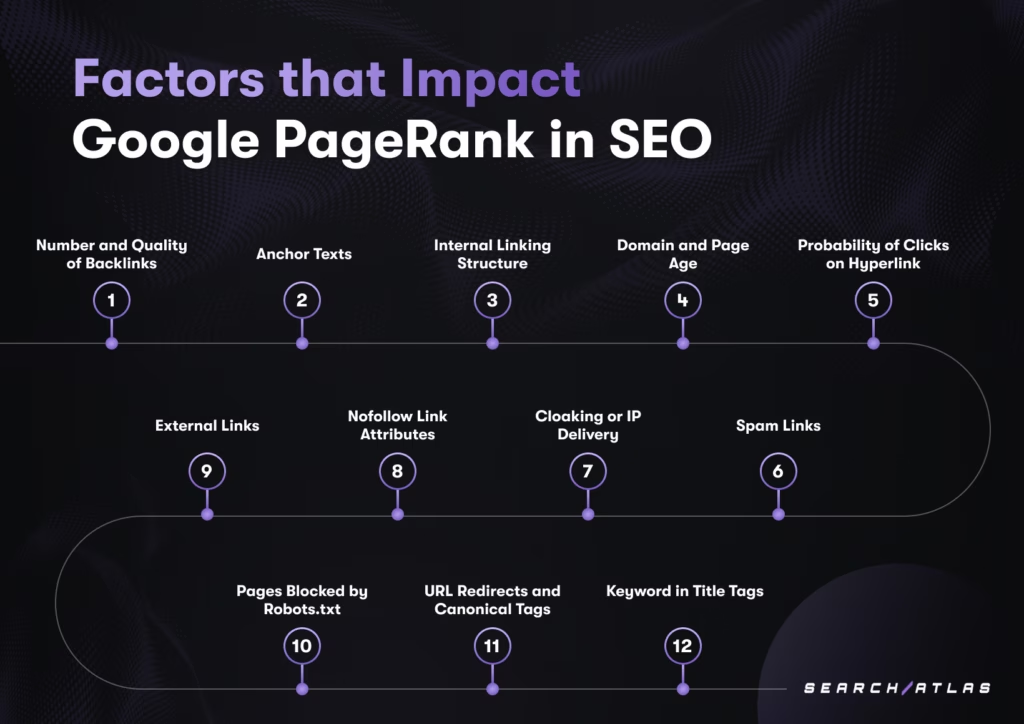
Twelve factors affect how much PageRank reaches a page, or how much it can use. Some are part of the PageRank calculation itself; others, marked below, act alongside it.
- Number and Quality of Backlinks. Links from pages with high PageRank pass more than links from weak pages. Quality backlinks are the main source of PageRank.
- Anchor Texts. Anchor text does not change how much PageRank a link passes in the basic formula, but it tells Google what the target page is about. Varied, descriptive anchors also avoid spam patterns.
- Internal Linking Structure. Internal links pass PageRank between your pages, so the structure decides which pages receive the most.
- Domain and Page Age. Age is not part of the PageRank formula. Older pages have had more time to earn links, which is why they often have more PageRank.
- Probability of a Click on the Hyperlink. Under the reasonable surfer model, links users are more likely to click, such as those in the main content, pass more than links in footers or sidebars.
- Spam Links. Google ignores or devalues links from link schemes, link farms, and spam networks, so they pass little or nothing.
- Cloaking or IP Delivery. Showing search engines different content from users violates Google’s spam policies and can lead to a manual action that removes rankings, whatever the page’s PageRank.
- Nofollow Link Attributes. Nofollow links were excluded from PageRank for years. Google now treats nofollow as a hint, so some may count.
- External Links. Each outbound link takes a share of the page’s PageRank, so a page with many outbound links passes less through each one.
- Pages Blocked by Robots.txt. Google cannot crawl a blocked page, so it cannot see the links on it, and PageRank does not flow through them.
- URL Redirects and Canonical Tags. Redirects and canonical tags point link signals from duplicate URLs to one preferred version instead of splitting them.
- Keywords in Title Tags. Title tags do not affect PageRank. They are a relevance signal that Google’s other systems combine with it.
How to Increase the PageRank of a Website for SEO?
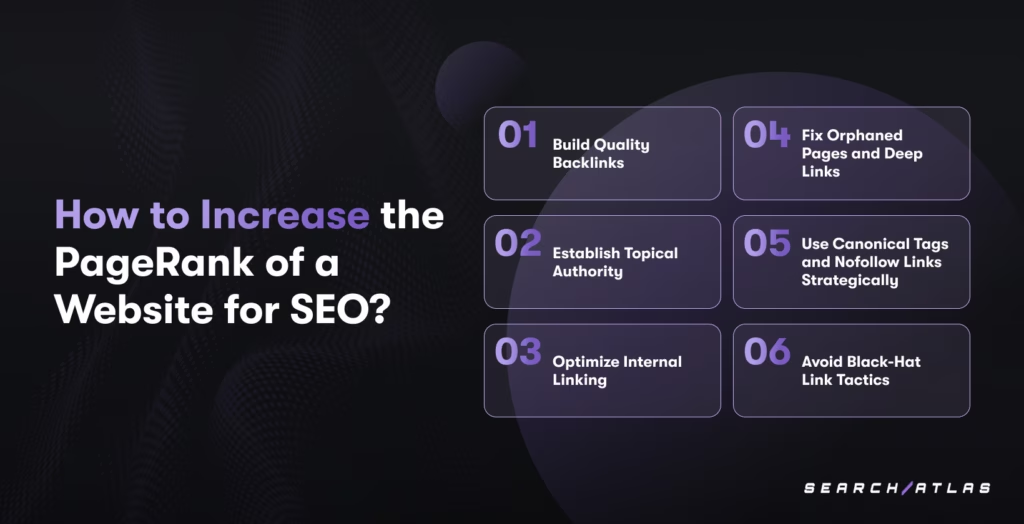
You increase the PageRank of a website by earning more links from strong pages and by routing that PageRank through your internal links to the pages that need it.
The six methods below cover both sides.
1. Build Quality Backlinks to Your Website
Backlinks are the most direct way to raise PageRank, because they are the only way new PageRank enters your site.
The value of a backlink depends on the linking page’s own PageRank, how many other links that page carries, and where the link sits. An editorial link in the body of a relevant article passes more than a link in a footer or on an unrelated directory.
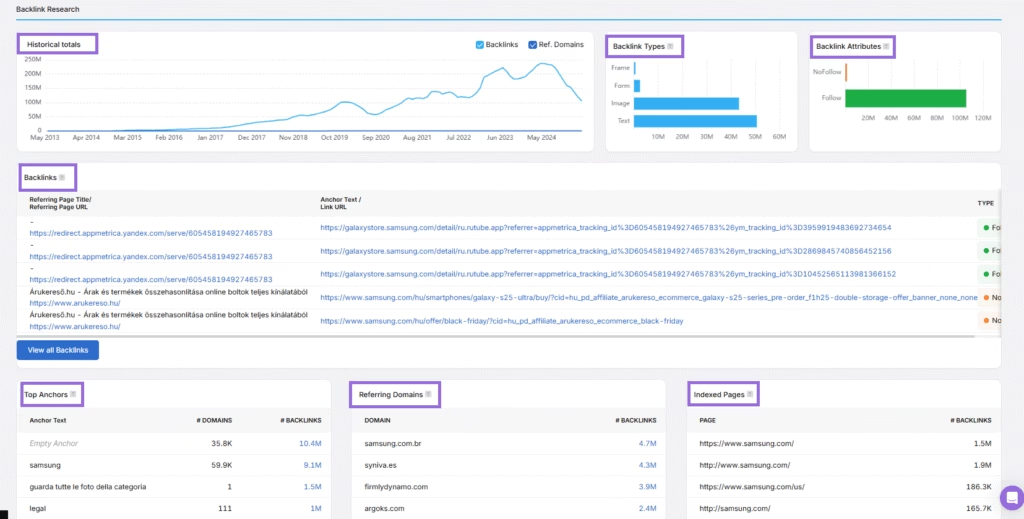
Search Atlas Site Explorer shows a site’s backlink profile: historical backlink totals, follow and nofollow links, top anchors, referring domains, and which pages earn the most links.
To earn more of these links, publish content other sites want to reference, such as original research, in-depth guides, and free calculators, then promote it through link building methods like digital PR outreach, guest contributions, and niche directories in your vertical.
2. Establish Topical Authority Through Content Clusters
Topical authority is the depth and breadth of coverage your site offers on one subject. Content clusters connect it to PageRank: well-linked cluster pages pass PageRank to each other and to the pillar, and a site that covers a topic in depth earns more links from other sites on that topic. Under the nearest-seed approach, links from sites close to trusted pages in your field count for more.
A content cluster is a set of related pages (blog posts, FAQs, use cases) that all link to a core pillar page. External links to any page in the cluster then pass part of their PageRank on to the pillar.
For instance, a website focused on cold email software could build a cluster around the keyword “cold email outreach.” Supporting content might include articles like “How to avoid the spam folder”, “Best cold email subject lines”, and “Cold email metrics that matter”. Each supporting page links back to the “Cold Email Outreach Guide” pillar, helping it become an authority hub in the eyes of search engines.
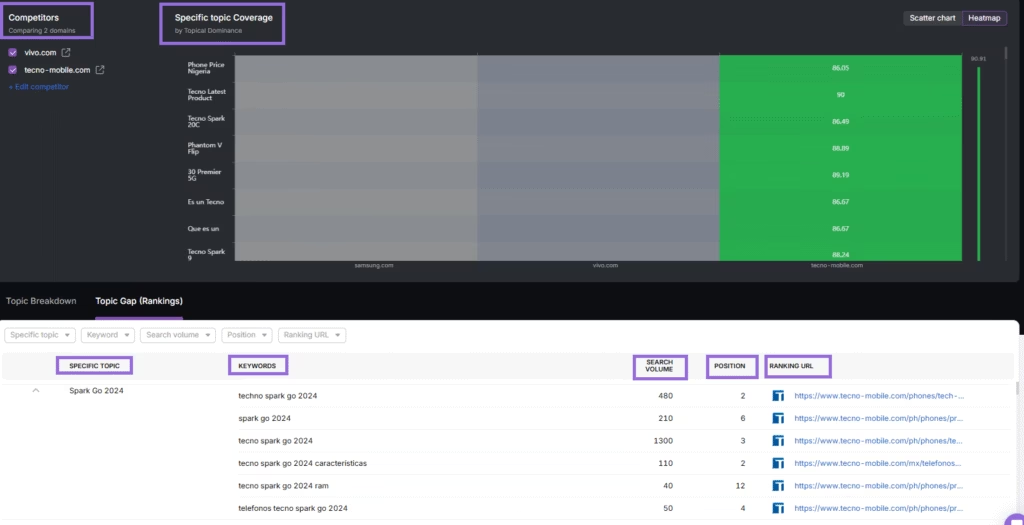
Topical Dominance in Search Atlas Site Explorer scores your coverage of each topic against competitors. Its Topic Breakdown and Topic Gap (Rankings) views show which topics you cover thinly and which keywords competitors rank for within them.
3. Optimize Internal Linking to Control PageRank Flow
Internal links decide where PageRank goes once it reaches your site. Backlinks bring PageRank in; internal links pass it from your strongest pages to the pages you want to rank.
A strong internal linking strategy starts with identifying your most authoritative pages, typically those that rank for competitive keywords or have strong backlink profiles.
From there, add contextual internal links from those pages with descriptive anchor text that names the target topic. Put them in the body content, where the reasonable surfer model gives links more weight than in footers or sitewide menus.
For example, if your blog post on “email list validation tools” ranks well and has earned strong backlinks, it can pass authority to a new page on “email list warm-up strategies” through a targeted internal link. Over time, this helps your newer content earn ranking power without relying on external links alone.
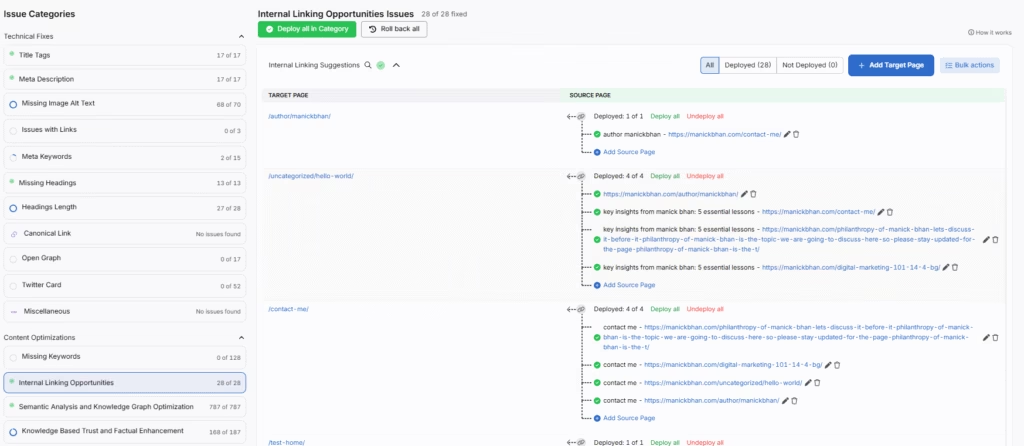
Search Atlas OTTO SEO finds internal linking opportunities between related pages and deploys the links through its pixel, without CMS edits. Each deployment is logged, and you can roll back any link or a whole category.
4. Fix Orphaned Pages and Deep Links
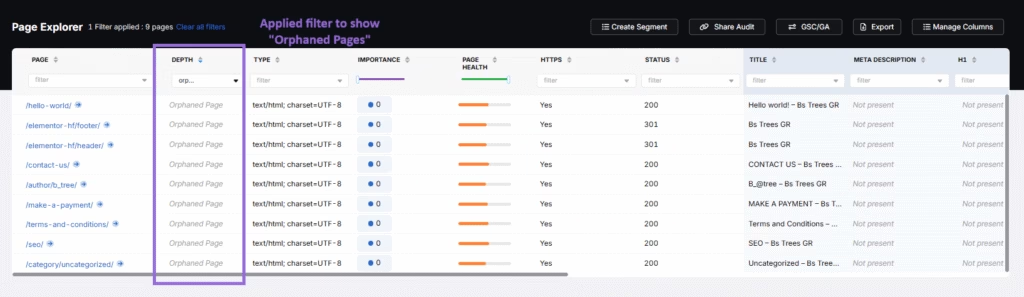
Orphaned pages are pages no other page on your site links to. They receive no internal PageRank, and they are harder for Google to find, crawl, and rank.
The Page Explorer in Search Atlas Site Auditor filters pages by depth, including an Orphaned Page filter. Link each orphan you keep from a relevant cluster page; if a page is not worth linking to, consider removing or redirecting it.
Deeply buried pages have a milder version of the same problem. Each extra click from the homepage is another hop, and PageRank shrinks at every hop by the damping factor and the number of links on each page along the way.
5. Use Canonical Tags and Nofollow Links Strategically
Canonical tags and link attributes decide which URLs collect PageRank and which links pass it.
When the same or similar content exists at several URLs (for example /blog/ and /blog/index.html), links can split across them. A canonical tag tells Google which version is preferred, so link signals consolidate on one URL.
Do not use nofollow on internal links to steer PageRank. Since 2009, nofollowed links still count when a page’s PageRank is divided among its links, so the share they would carry is lost rather than passed to your other links (Matt Cutts, Google, 2009). Keep internal links followed, and use rel="sponsored" for paid links and rel="ugc" for user-generated content.
6. Avoid Black-Hat Link Tactics and Low-Quality Backlink Sources
Black-hat links do not raise PageRank. Google ignores links from manipulative sources such as link farms, private blog networks (PBNs), and spam forums, and a pattern of them can lead to a manual action against the site.
Focus on earning links instead of buying them. Partner with other site owners, contribute guest articles, or publish original research that others cite.
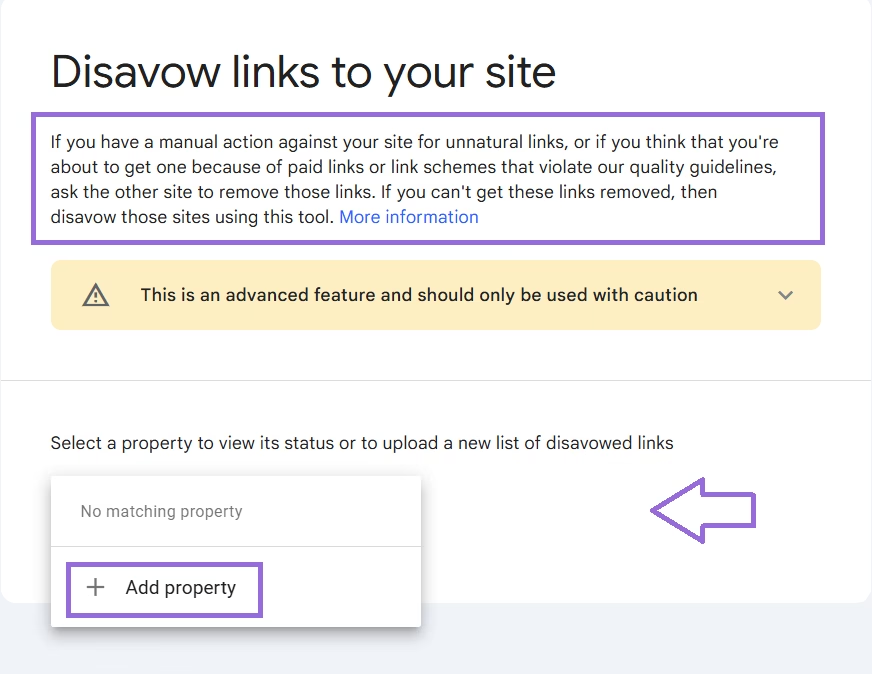
If you inherited spammy backlinks or bought links in the past, the Disavow links tool in Google Search Console (GSC) tells Google not to count them. Use it sparingly.
What is a PageRank for a Webpage?
The PageRank of a webpage is its share of importance in the link graph. Google calculates it for each page separately, so two pages on the same site can have very different PageRank.
Four inputs decide a page’s PageRank.
- Direct inbound links. Links pointing directly to the specific page from other websites.
- Internal links. Links from other pages within the same website.
- The authority of linking pages. Links from high-PageRank pages pass more value.
- The number of outbound links on referring pages. PageRank passed is divided among all links on the source page.
A homepage usually receives the most external links, so it usually has the highest PageRank on a site. From there, internal linking determines how that authority is distributed to other pages. Pages that are directly linked from the homepage generally receive more PageRank than those buried deeper in the site structure.
This is why a new page on an established site sometimes ranks quickly (it is linked from strong pages right away) and sometimes struggles (it gets few internal or external links).
Page-level thinking answers four planning questions.
- Which pages should link to your most important content?
- Where to place new content in your site architecture?
- Which pages deserve additional link-building efforts?
- How to structure internal linking to maximize the flow of PageRank to priority pages?
Treating PageRank as a page-level score rather than a domain-wide one points your link building and internal linking at the specific pages you want to rank.
What is the Best Alternative to Google’s PageRank Metric?
No public tool shows Google’s PageRank, so SEOs use third-party authority metrics instead. Moz Domain Authority and Ahrefs Domain Rating score domains mainly from their backlink profiles, and Ahrefs URL Rating does the same for individual pages.
Search Atlas Domain Power (DP) takes a different approach. It is a 100-point logarithmic authority score built from organic traffic, keyword performance, and ranking distribution across the top 100 search results, rather than from link graph size alone. In a Search Atlas study of 350,159 backlink placements across 13,002 pages, Domain Power predicted page-level ranking outcomes better than Domain Authority or Domain Rating.
Search Atlas groups Domain Power scores into three bands: 65 to 100 for established brands such as Google (100) and Forbes (83), 35 to 65 for niche leaders, and 0 to 35 for sites still building authority.
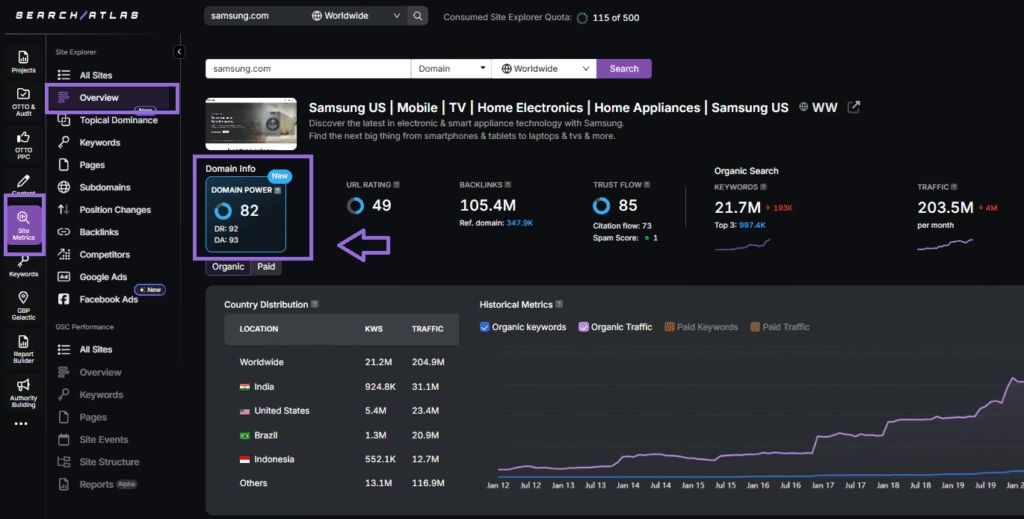
Domain Power is available in Search Atlas Site Explorer, which also has a bulk URL analyzer for checking many domains at once. See what Domain Power measures for the full methodology.
How to Check Google PageRank for Keywords?
You cannot check Google PageRank for keywords directly, because Google removed the public score in 2016. You can check the authority of the pages that rank for a keyword instead.
The SERP Overview in Search Atlas Keyword Research lists every page ranking for a keyword with its Domain Rating, Domain Authority, backlinks, page referring domains, ranking keywords, and organic traffic, next to the keyword’s search volume and keyword difficulty.
Search Atlas Keyword Gap then compares your site with up to five competitors on the keywords each ranks for, with position, intent, difficulty, and traffic potential.
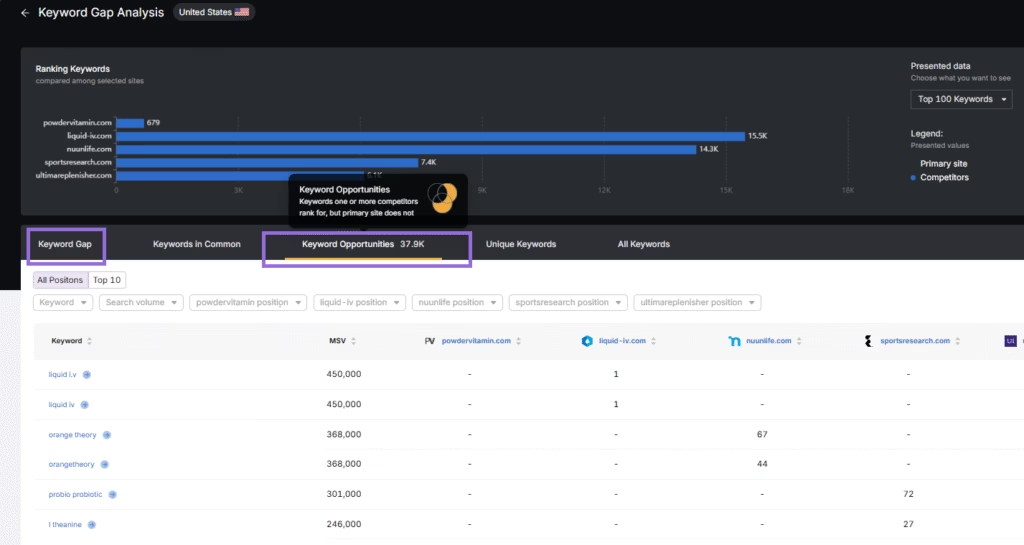
Also check which pages hold featured snippets, knowledge panels, or the top positions for the keyword, since those pages set the bar you have to clear.
Together, these checks show how much authority a keyword needs and how far your pages are from it.
Can PageRank be Tracked?
No. Google has not shown PageRank values publicly since 2016, and the scores it uses internally are not available to site owners. Third-party authority metrics, such as Domain Power, are the closest trackable substitute.
How Is PageRank Different From Click Depth?
Click depth counts how many clicks a page is from the homepage. PageRank measures how much link value reaches the page from every source, inside and outside the site.
The two usually move together, because each extra click is another hop that reduces PageRank. But a deep page can still have high PageRank if other sites link to it directly.
How Is PageRank Different From Domain Authority?
PageRank scores individual pages, while Domain Authority scores whole domains. Two pages on the same site can have very different PageRank.
PageRank is Google’s own signal, calculated from Google’s link graph. Domain Authority is a Moz metric that predicts ranking ability from Moz’s link index, and Google does not use it.
How Is PageRank Different From a Backlink Count?
A backlink count adds up links; PageRank weighs them. Each link passes a share of the linking page’s own PageRank, divided by that page’s number of outbound links, so one link from a strong, focused page can outweigh hundreds from weak pages.
Google’s later refinements, such as the reasonable surfer model, also weigh where the link sits on the page. That is why earning quality backlinks matters more than adding to the count.
How Is PageRank Different From Link Juice?
“Link juice” is SEO slang for the value a link passes; PageRank is the algorithm that calculates that value. The slang is useful shorthand, but it hides two details of the calculation: a page’s PageRank is divided among all its outbound links, so pages with fewer links pass more per link, and the values are computed across the whole link graph over repeated iterations until they settle.