A keyword research API returns search volume, keyword difficulty, CPC, and SERP data as structured output, usually JSON, so the data flows straight into dashboards, content systems, and programmatic SEO pipelines instead of manual exports.
The seven options below differ most on two points: which plan includes API access, and how usage is billed. DataForSEO charges per request, Ahrefs and Keywordtool.io include API access on every paid plan, Serpstat, SpyFu, and Semrush reserve it for higher tiers, and Search Atlas offers it on custom enterprise plans.
Pricing and API details below were checked against vendor documentation and pricing pages on October 9, 2026.
What Matters Most in Keyword Research API Tools
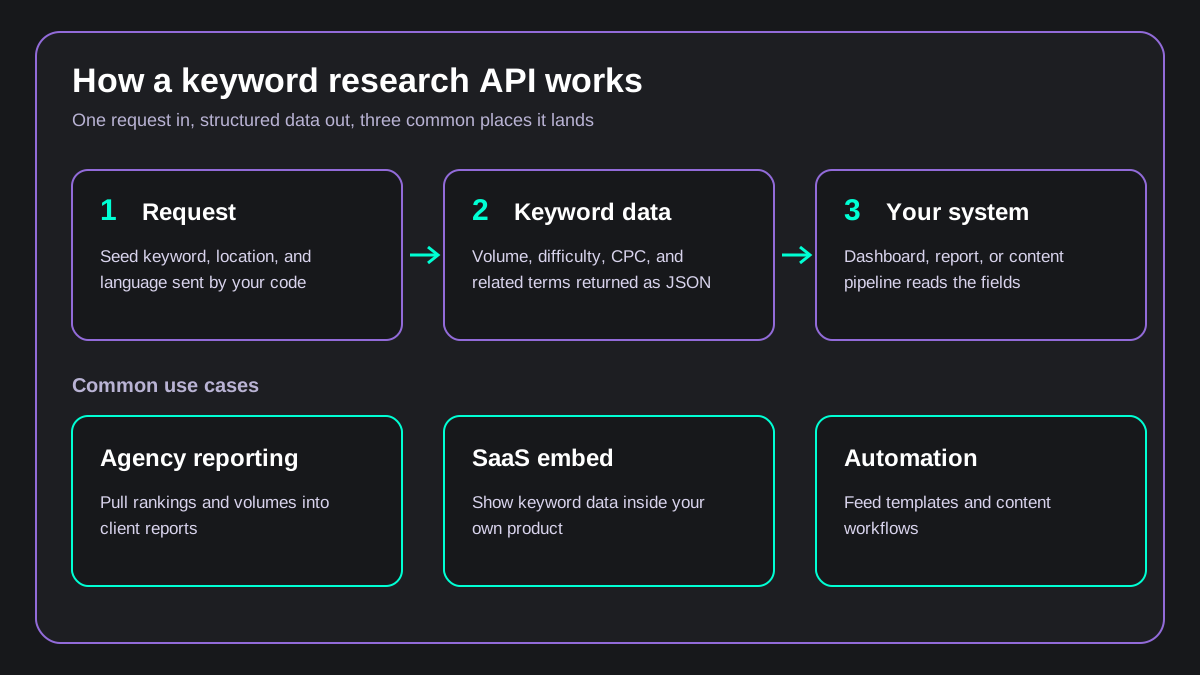 How a keyword research API works
The six factors that matter most in a keyword research API are integration fit, location and language coverage, core data points, competitive analysis, scale limits, and AI workflow compatibility. Check each one before you compare vendors.
- Integration fit. An API that returns structured JSON into your dashboards, content systems, and pipelines lets teams automate keyword research without manual exports or complex setups.
- Location and language coverage. Data segmented by country, region, or language enables precise targeting for local SEO and geographically tailored campaigns.
- Core data points. Look for search volume, cost per click, and keyword difficulty, plus SERP elements like People Also Ask and related terms that match business goals.
- Competitive analysis. Keyword gap analysis and competitor overlap reports reveal missed opportunities and track shifting demand across markets.
- Scale and rate limits. Programmatic SEO builders need bulk endpoints, structured JSON, and rate limits that hold under large-volume requests. Intent-classified results should feed templates without manual triage.
- AI workflow compatibility. Check for semantic clustering outputs, compatibility with LLM pipelines, and MCP access. AI agents depend on clean, structured keyword data.
For a full workflow on evaluating large keyword datasets, see our guide to bulk keyword research.
Trustworthy keyword data makes content planning smarter and connects your content to what people actually search for.
7 Best Keyword Research API Options for Growth
The table compares where API access starts and how each vendor bills for it.
| Platform | API access starts on | Lowest price with API access | Billing model |
|---|---|---|---|
| Search Atlas | Custom enterprise plan | Custom quote | Subscription |
| Serpstat | Team plan | $129/month billed monthly | Subscription + monthly API credits |
| Semrush | Advanced plan | $549/month billed monthly | Subscription |
| DataForSEO | Any account | $50 minimum payment | Pay per request |
| SpyFu | Pro + AI plan | $119/month billed monthly | Subscription + included API credits |
| Ahrefs | Lite plan | $129/month | Subscription + API credits |
| Keywordtool.io | Starter plan | $88/month billed monthly | Subscription + daily request pool |
1. Search Atlas
Search Atlas combines keyword research, content planning, and content production within a single platform, eliminating the need for separate keyword databases, content tools, and third-party integrations.
The platform draws on a database of 5+ billion keywords, with search volume, keyword difficulty, CPC, and search intent data across 200+ countries. Teams can research individual keywords, identify content opportunities, analyze competitors, and build large-scale content strategies from one workspace.
Search Atlas is particularly well-suited for programmatic SEO and AI-assisted content workflows. The Topical Map Generator plans clusters and feeds the plan to Content Genius, so teams move from keyword discovery to published content without exporting data between systems.
API access is available on custom enterprise plans, with quotas set per account.
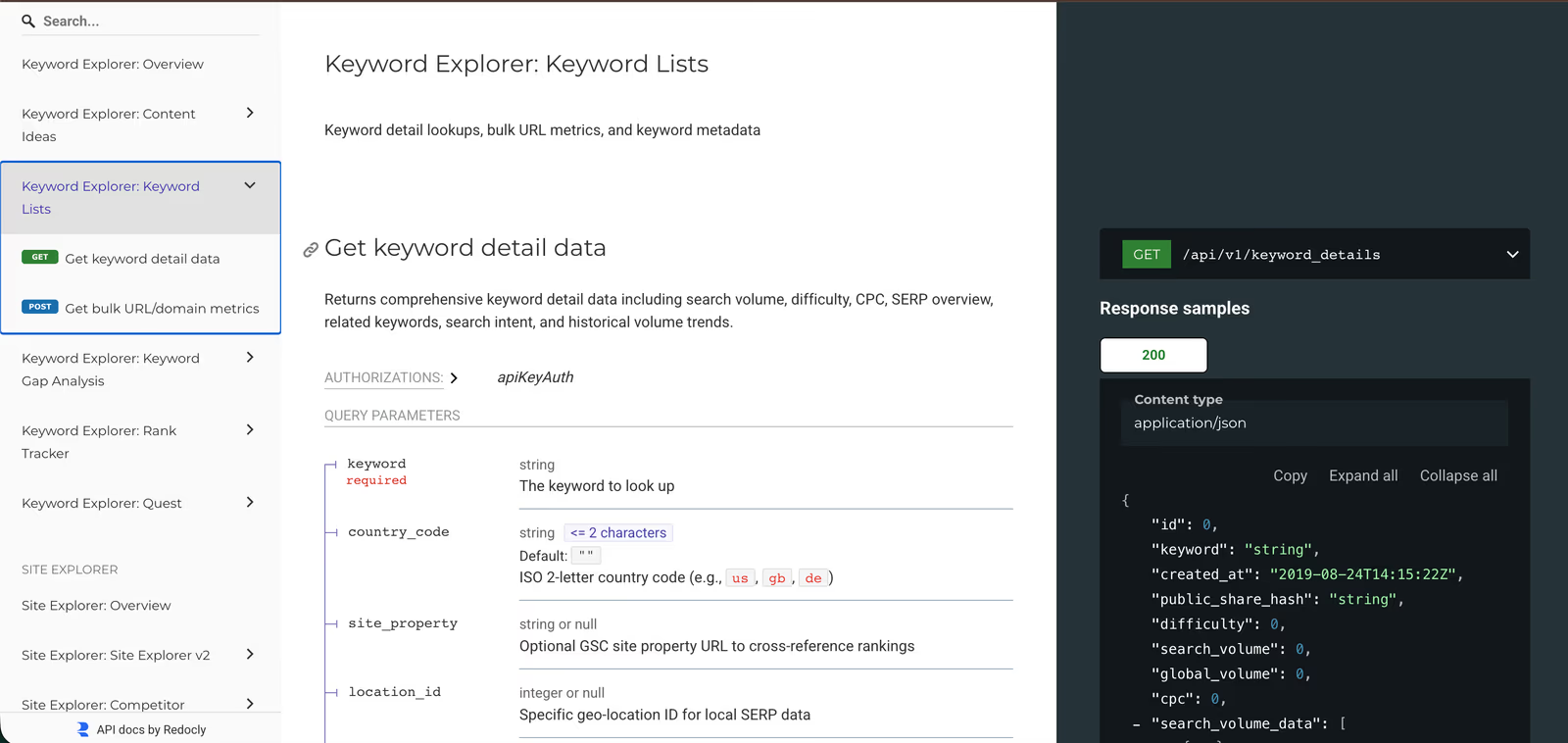
The public Search Atlas API documentation describes a REST API that authenticates with an X-API-Key header. The Keyword Explorer service has its own base URL, keyword.searchatlas.com.
Its keyword detail endpoint returns search volume, difficulty, CPC, a SERP overview, related keywords, search intent, and historical volume trends for a keyword, with optional country and location filters.
Search Atlas Popular Features
- Keyword Research: Volume, difficulty, CPC, and historical volume from the keyword database.
- Keyword Magic: Expands a seed keyword into related terms, tagged by intent.
- Keyword Gap: Finds the competitor keyword gaps for you and exports the data to CSV.
- Topical Map Generator: Turns one seed keyword into pillar and supporting clusters for a chosen country and language.
- Keyword Rank Tracker: Records starting and current positions, ranking movements, and historical trends by city, state, or country, on desktop and mobile.
- Content Genius: Researches the SERP, drafts the article, and adds visuals and schema from the keyword plan.
- Keyword Explorer API: Keyword details, bulk URL and domain metrics, keyword gap analyses against 1 to 4 competitor sites, rank tracker projects, and QUEST analyses.
- Enterprise API access: Custom enterprise plans add API access and tailored quotas across every skill.
Search Atlas Limitations
- API access is part of custom enterprise plans, not the Starter, Growth, Pro, or Agency tiers.
- OTTO SEO and the AI features draw from a monthly Universal Credits budget, so larger deployments need usage monitoring.
Search Atlas Pricing
| Starter | Growth | Pro | Agency | |
|---|---|---|---|---|
| Billed monthly | $99/month | $199/month | $399/month | $999/month |
| User seats | 1 | 3 | 5 | 10 |
| OTTO SEO projects | 1 | 2 | 4 | 10 |
| GSC projects | 5 | 15 | 100 | 999 |
| Keyword lookups | 500 | 2,000 | 5,000 | 100,000 |
| Keyword rank tracker projects | 20 | 50 | 1,000 | Unlimited |
| Keyword data refreshes | 2,000/month | 3,500/month | 5,000/month | 50,000/month |
| Backlink projects | 2 | 5 | 5 | 100 |
Each plan opens with a 7-day free trial that includes the full platform. API access is quoted separately on custom enterprise plans.
2. Serpstat
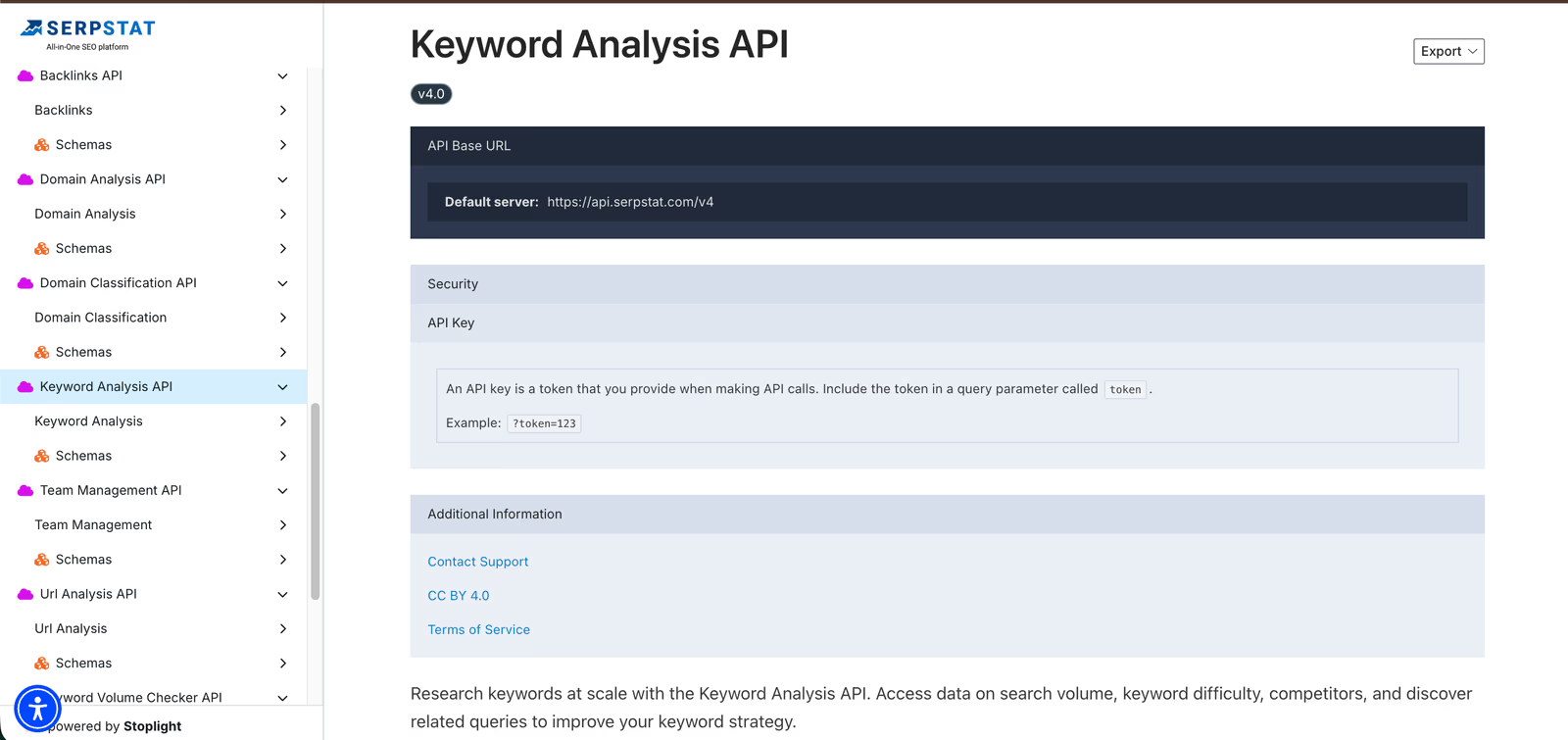
Via Serpstat
Serpstat offers a dedicated API for keyword research, designed to deliver structured SEO data directly into your applications, dashboards, or automated reports.
Its Keyword Analysis API (v4) retrieves search volume, keyword difficulty, competitors, and related queries. Requests go to api.serpstat.com/v4, and the API key travels in a token query parameter.
Request keyword information in real time, analyze search trends at scale, and extract insights without relying on the standard interface.
Serpstat Popular Features
- Keyword Overview. Access keyword-level data such as monthly volume, cost per click, and competition.
- Related Queries. Pull related queries and the domains that rank for a term.
- Multiple Search Databases. Choose the search engine database for each request, such as Google US.
- Separate APIs. Keyword Analysis sits alongside backlinks, domain analysis, and URL analysis APIs.
Serpstat Limitations
- The Individual plan excludes API access, so API work starts on the Team plan.
- API usage is metered in monthly API credits (200,000 on the Team plan), so high-volume pipelines need the larger plans.
- The Team and Team x2 plans allow 1 request per second. The Agency plan allows 10.
Serpstat Pricing
- Individual. $69/month billed monthly, or $50/month billed annually. Core features (keyword research, site analysis, rank tracker, site audit, backlink analysis). No API access.
- Team. $129/month billed monthly, or $100/month billed annually. Adds API access, ChatGPT and Claude integration through MCP, share access, batch analysis, and scheduled reports.
- Team x2. $209/month billed monthly, or $169/month billed annually. Team features with higher limits.
- Agency. $499/month billed monthly, or $410/month billed annually. The highest limits, 30 users, and 2,000,000 API credits per month.
3. Semrush
Via Semrush
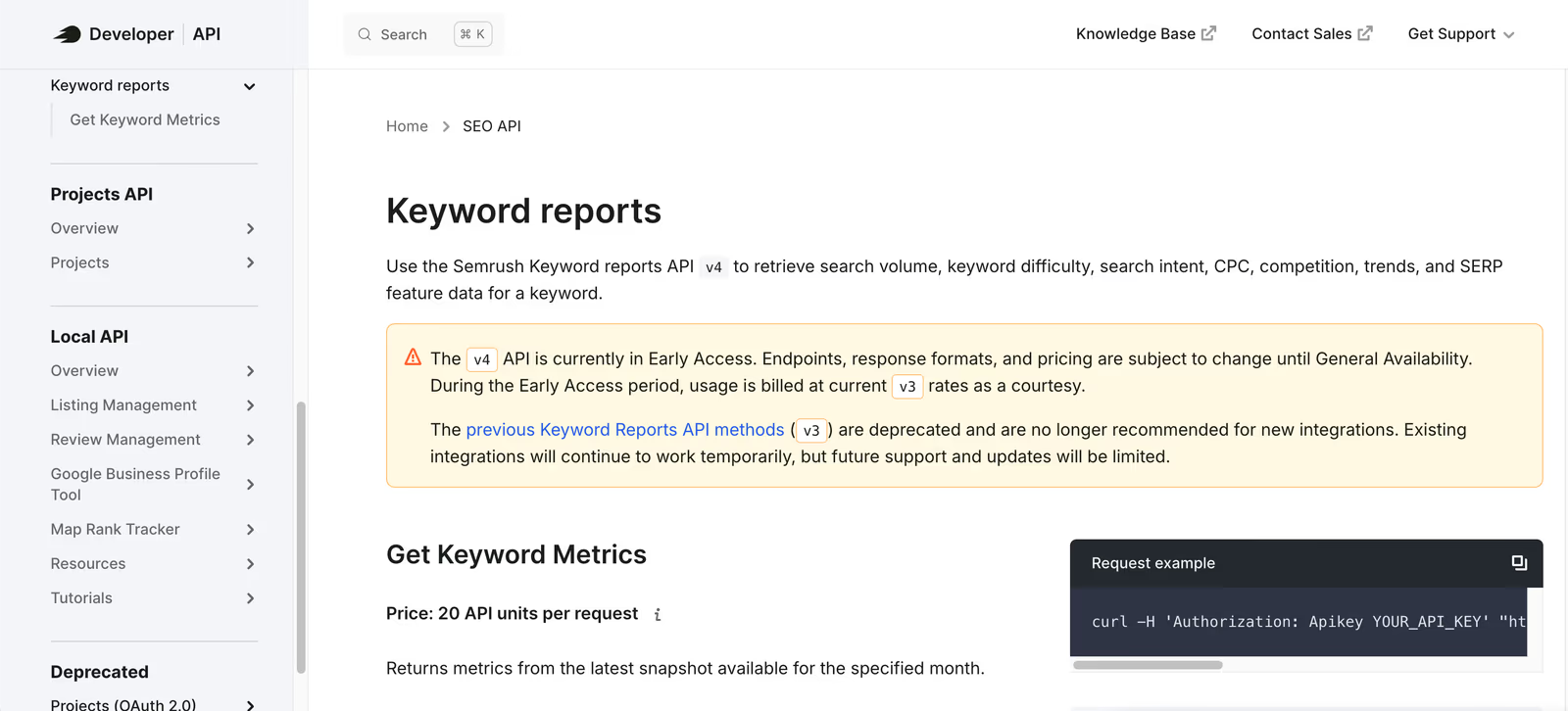
Semrush offers an API that allows direct access to its keyword database for integration into custom tools, internal systems, or SEO platforms. The current Keyword reports API (v4) uses a single keywords/v1/metrics endpoint, with the API key passed in the Authorization header.
Automate keyword discovery, gather historical advertising data, and retrieve related terms without navigating the main Semrush interface. For a head-to-head verdict, see Search Atlas vs Semrush.
The v4 API is in Early Access, so endpoints, response formats, and pricing can change before general availability. Semrush has deprecated the earlier v3 Keyword reports methods for new integrations.
Semrush Popular Features
- Keyword Metrics. Retrieve search volume, keyword difficulty, CPC, and competitive density for a keyword and country.
- Search Intent. Get the intent classification returned with each keyword.
- SERP Features. See which SERP features appear for the keyword.
- Trend Data. Pull 12 months of trend data and the number of results.
Semrush Limitations
- API data integration is included only on the Advanced plan, the most expensive self-serve tier.
- Each Get Keyword Metrics request costs 20 API units, so bulk pulls consume units quickly.
- The v4 API is in Early Access, so pricing and response formats can change.
Semrush Pricing
- Free. $0, for trying out the platform, with no credit card required.
- SEO. $139/month billed monthly, or $117.33/month billed annually. 5 websites to monitor.
- Starter (SEO + AI Search). $199/month billed monthly, or $165.17/month billed annually.
- Pro+ (SEO + AI Search). $299/month billed monthly, or $248.17/month billed annually.
- Advanced (SEO + AI Search). $549/month billed monthly, or $455.67/month billed annually. 40 websites, 5,000 tracked keywords, and API data integration.
4. DataForSEO

Via DataForSEO
DataForSEO provides a set of scalable APIs tailored for integrating keyword research and SEO insights directly into applications, dashboards, or internal systems. The Labs API adds keyword ideas, suggestions, related keywords, and search intent classification.
Structured endpoints return results optimized for bulk queries, ideal for platforms processing large datasets or automating keyword workflows. The service is designed for developers, tool creators, and analysts seeking high-speed access to accurate SEO and advertising data.
DataForSEO Popular Features
- Google Ads Data. Search Volume, Keywords For Site, Keywords For Keywords, and Ad Traffic By Keywords endpoints, based on the Google Ads API.
- Bing Ads Data. Search Volume, Keywords For Site, Keywords For Keywords, and Keyword Performance endpoints.
- Google Trends Explore. An endpoint for trend analysis across search terms.
- Clickstream Data. Search volume metrics from clickstream sources.
DataForSEO Limitations
- Costs scale with every request, so budgets need monitoring on large or frequent pulls.
- DataForSEO is built for developers, so teams without engineering support get less value from it than from a platform with a research interface.
- Ad policy rules apply to Google Ads data, so keywords in prohibited categories return no results.
- A free sandbox environment is available for testing before you spend.
DataForSEO Pricing
- Pay as you go. The cost depends on the method of data retrieval, with a $50 minimum payment.
5. SpyFu
Via SpyFu
SpyFu offers an API built for embedding keyword intelligence directly into your internal tools, research platforms, or large-scale SEO workflows.
Every paid plan includes more than 10 years of historical data, which enables bulk keyword analysis, ad insights, and historical performance tracking.
Submit flexible parameters to retrieve keyword groups, competitor strategies, and intent-driven suggestions at scale.
SpyFu Popular Features
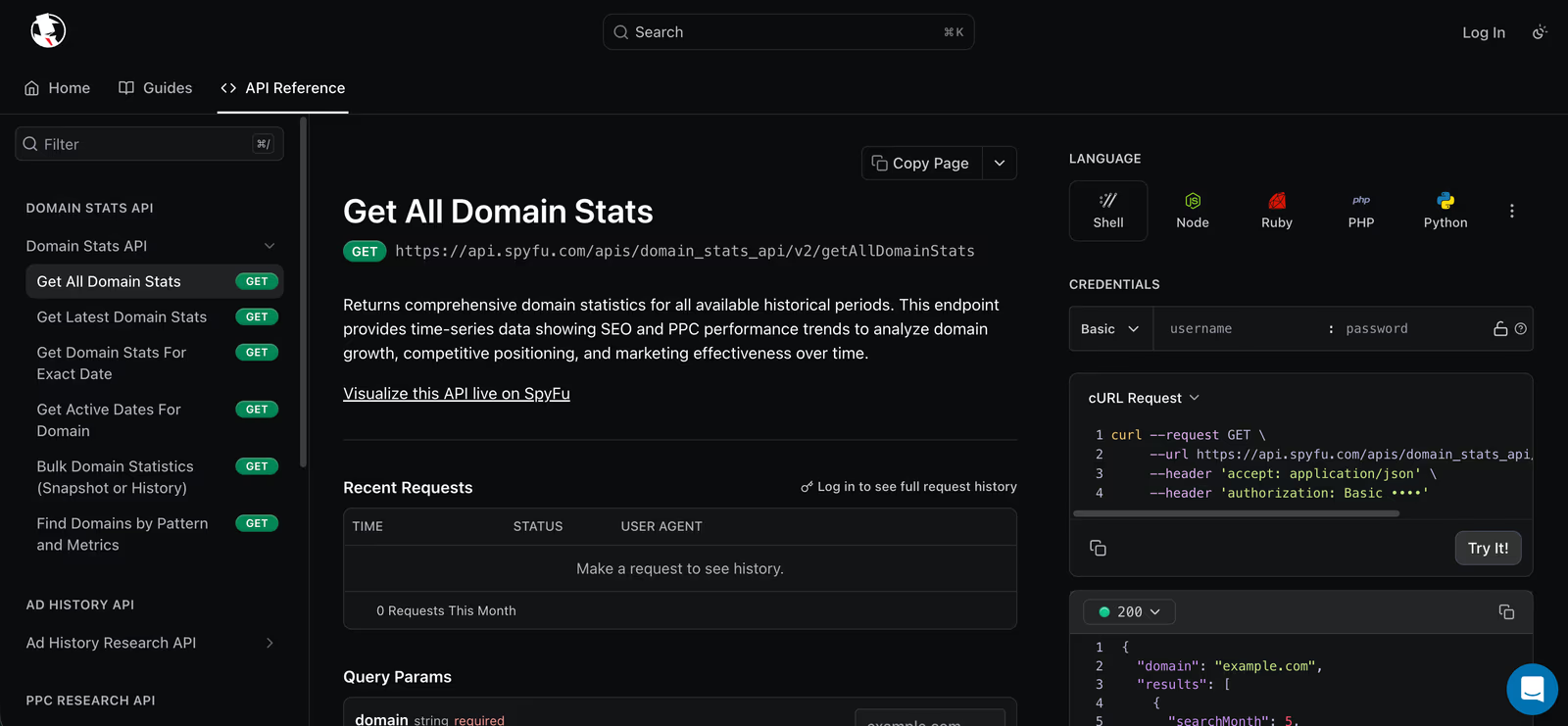
- Domain Stats. Time-series SEO and PPC performance data for a domain, with bulk snapshot and history endpoints.
- Ad History. Review the ad copy a domain has run over time.
- PPC Research. Pull paid search data for competitor analysis.
- SEO Research. Find the organic keywords and pages that drive a domain's traffic.
- Related Keywords. Expand a seed term into related keyword ideas.
SpyFu Limitations
- The Basic plan excludes API access.
- API usage beyond the included credits ($40 on Pro + AI, $100 on Team/Agency) is billed per row returned, at $0.20 to $5.00 per thousand rows depending on the endpoint.
SpyFu Pricing
- Basic. $39/month billed monthly, or $29/month billed annually. Search results and exports are capped at 10,000 rows, with 5,000 weekly tracked keyword rankings and 1 user. No API access.
- Pro + AI. $119/month billed monthly ($59 for the first month), or $89/month billed annually. Unlimited search results and exports, 15,000 weekly tracked keyword rankings, API access with $40 of included API credits.
- Team/Agency. $249/month billed monthly, or $187/month billed annually. 5 users, 50,000 weekly tracked keyword rankings, API access with $100 of included API credits.
6. Ahrefs
Via Ahrefs
Ahrefs provides an API for keyword research that enables automated access to core metrics and search insights across global datasets. For a head-to-head verdict, see Search Atlas vs Ahrefs.
It enables developers and SEO professionals to fetch keyword volume, difficulty scores, and ranking data for integration into dashboards or custom-built tools.
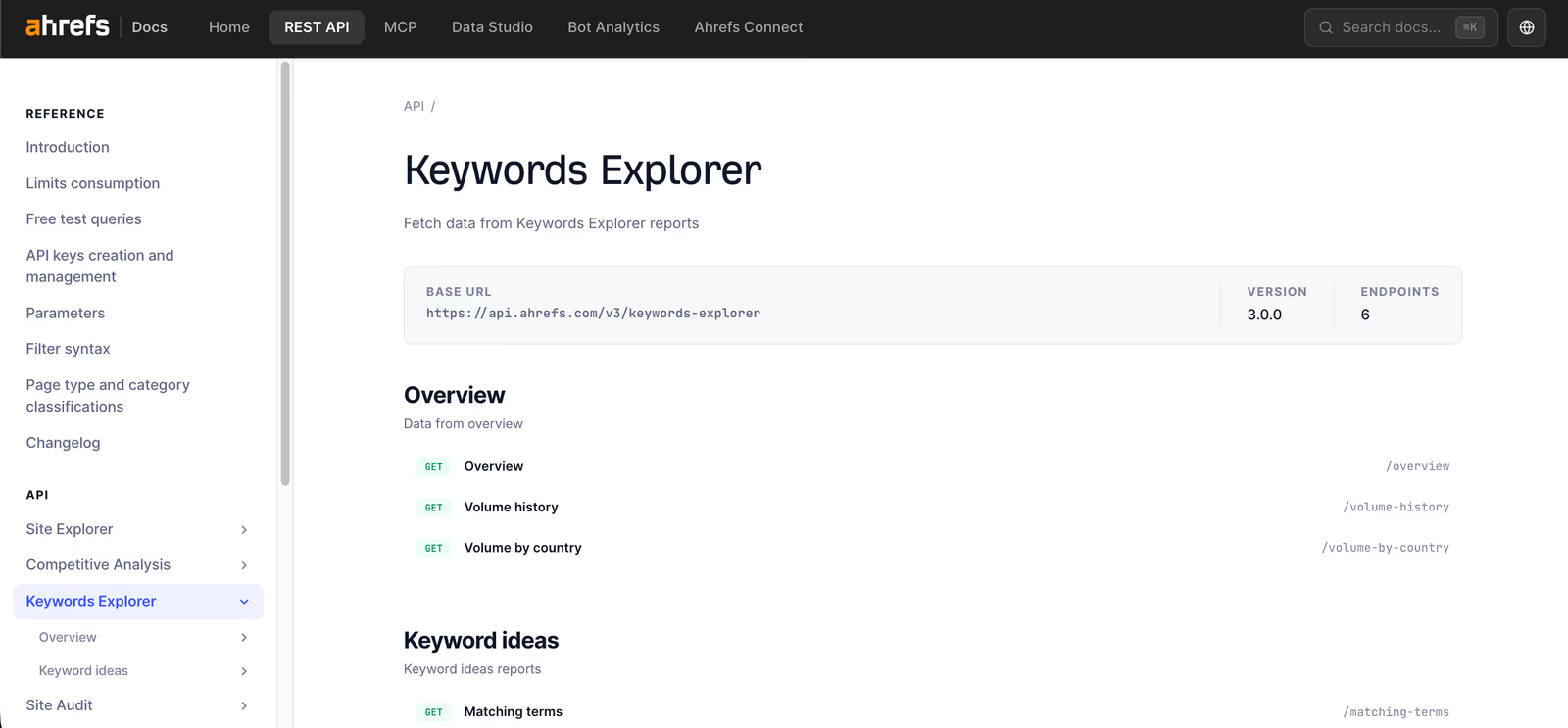
The v3 Keywords Explorer API has 6 endpoints, covering keyword overview, volume history, volume by country, and keyword ideas, without navigating the main platform.
Ahrefs Popular Features
- Overview. Pull core keyword metrics for a keyword and country.
- Volume History. Retrieve monthly search volume trends for a keyword across selected countries to monitor seasonal or long-term interest.
- Volume by Country. Compare how demand for a keyword splits across countries.
- Matching Terms. Collect keyword suggestions that directly include your seed term, which helps grow focused keyword sets.
- Related Terms. Uncover keywords with semantic relevance to expand coverage around a specific topic or niche.
- Search Suggestions. Generate autocomplete-style keyword prompts influenced by real user behavior, useful for content ideation.
Ahrefs Limitations
- Each plan includes 1 user; extra users cost $40 to $80/month each depending on the plan.
- The Lite plan includes 100,000 API units and returns at most 100 rows per request. Each request has a base cost of 50 units, plus a cost for every row field returned.
Ahrefs Pricing
- Lite. $129/month. 5 projects, 750 tracked keywords, 100,000 crawl credits, API and MCP access.
- Standard. $249/month. 20 projects, 2,000 tracked keywords, 500,000 crawl credits, API and MCP access.
- Advanced. $449/month. 50 projects, 5,000 tracked keywords, 1,500,000 crawl credits, API and MCP access.
- Enterprise. $1,499/month with an annual commitment. Uncapped API access and custom API endpoints.
Ahrefs lists annual billing at a discount of up to 17%.
7. Keywordtool.io
Via Keywordtool.io
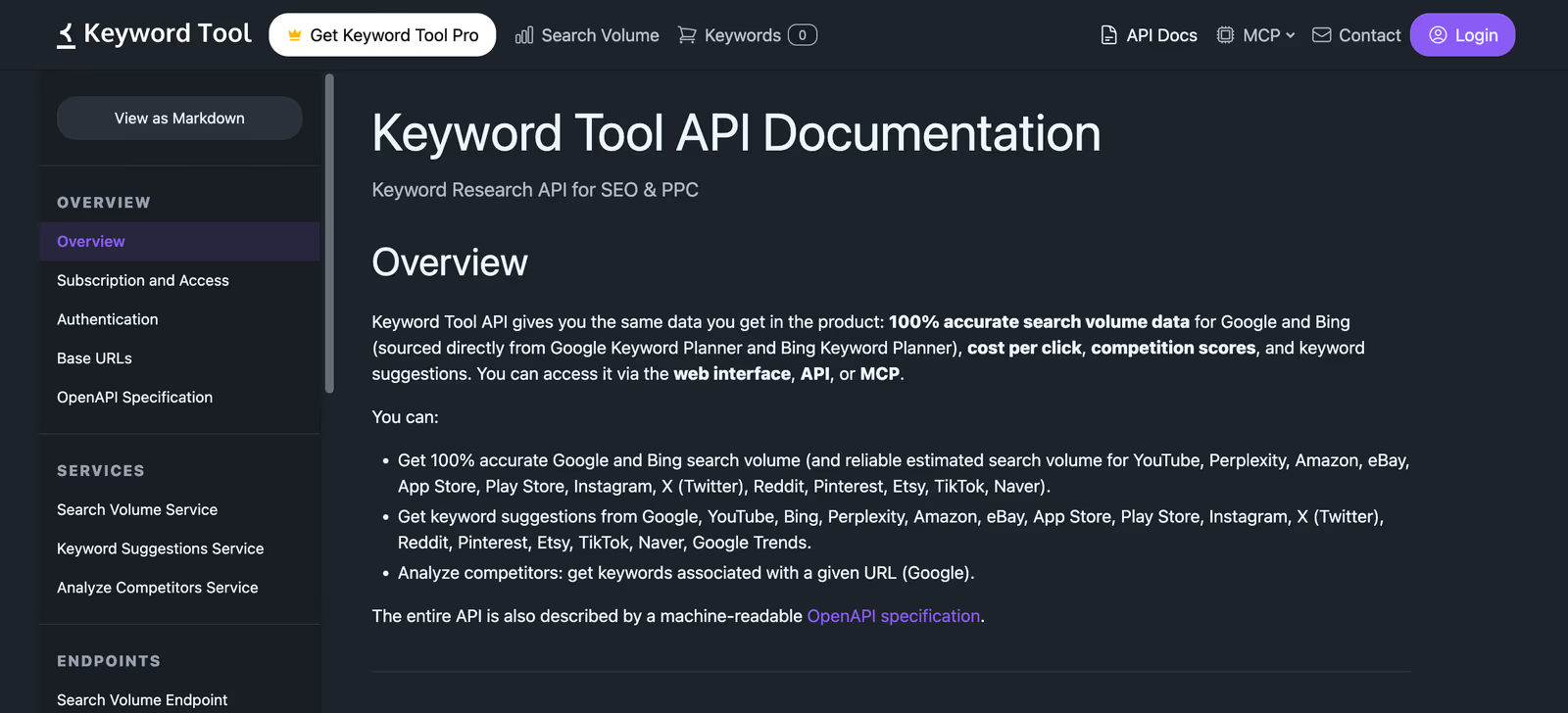
Keyword Tool API delivers search volume data and keyword suggestions across major platforms, which helps businesses scale keyword research without relying on manual tools.
It covers keyword suggestions from 16 platforms, including Google, YouTube, Amazon, and TikTok, across 195+ countries, which suits cross-channel keyword analysis. The same data is available through the web interface, the API, and MCP.
Integrate the API with scripts or spreadsheets to simplify repetitive research workflows and generate insights programmatically.
Keywordtool.io Popular Features
- Search Volume. Submit 1 to 1,000 keywords per request for Google and Bing volume sourced from their keyword planners, with CPC and competition, plus estimated volume for 13 more platforms.
- Analyze Competitors. Get the keywords Google associates with a URL, returning up to 2,000+ keywords.
- Related Keywords. Discover semantically similar search terms to expand your keyword coverage and diversify content themes.
- Question Keywords. Extract long-tail questions tied to your keyword, useful for answering user queries and guiding topic development.
- Preposition Keywords. Identify phrases containing prepositions and commercial intent, often tied to high-conversion search behavior.
Keywordtool.io Limitations
- The web interface, API, and MCP share one daily request pool, from 50 requests a day on the Starter plan.
- The API allows 15 requests per minute in a rolling one-minute window.
- The Starter plan includes 12 months of historical volume; 48 months requires the Scale or Agency plan.
Keywordtool.io Pricing
Every plan includes the web interface, API, and MCP access.
- Starter. $88/month billed monthly, or $68/month billed annually. 50 requests a day, 12 months of historical data.
- Growth. $188/month billed monthly, or $148/month billed annually. 100 requests a day, 24 months of historical data.
- Scale. $388/month billed monthly, or $308/month billed annually. 200 requests a day, 48 months of historical data.
- Agency. $788/month billed monthly, or $628/month billed annually. 400 requests a day, 48 months of historical data.
How to Choose a Keyword Research API
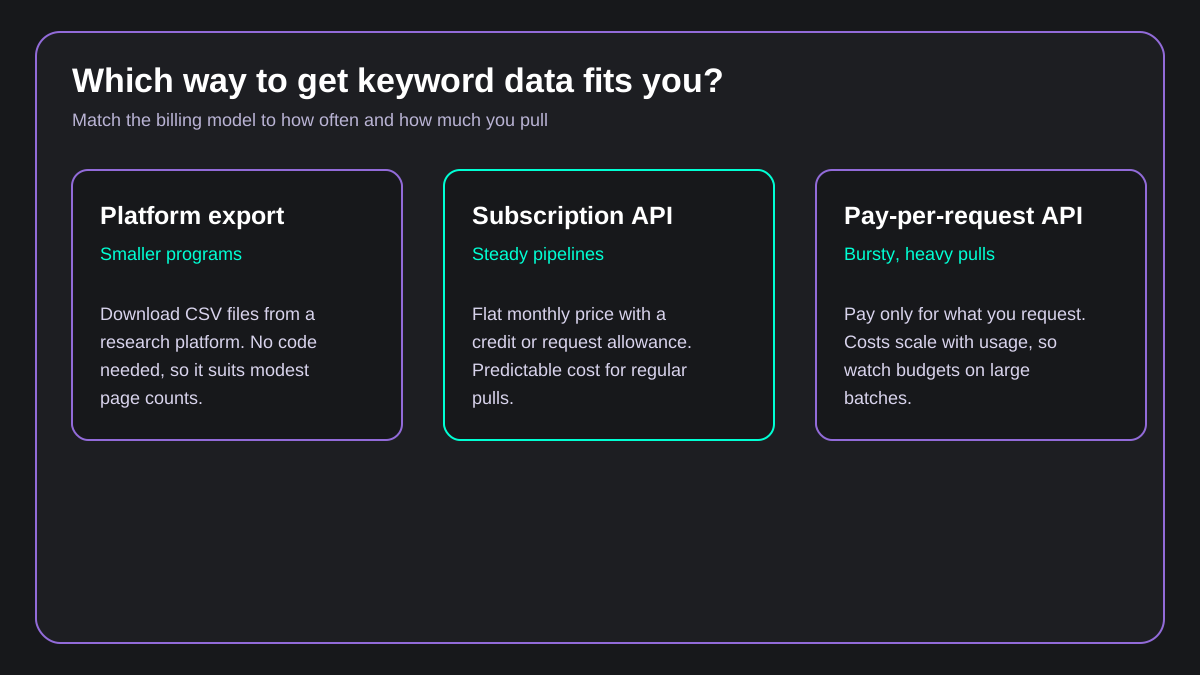
Choose a keyword research API by matching its billing model and limits to your volume. Run each option through the checklist below before you commit.
 Which way to get keyword data fits you
- Billing model. Decide between a flat subscription, monthly credits, and pay-per-request pricing. Heavy, bursty pulls favor pay-per-request, and steady pipelines favor a subscription.
- Rate limits and quotas. Check requests per second, monthly credits, and daily request pools against your largest planned batch.
- Data coverage. Confirm the locations, languages, and platforms you need, such as Google, YouTube, or Amazon.
- Output format. Look for structured JSON and bulk endpoints that feed templates and dashboards directly.
- AI assistant access. If agents will call the data, check for MCP access. Serpstat, Ahrefs, and Keywordtool.io list it.
- Plan tier. Confirm which plan unlocks the API before you budget, since Serpstat, SpyFu, Semrush, and Search Atlas gate it behind higher tiers.
For a related workflow, see our guide to automating keyword research.
Keyword Research API FAQ
What is a keyword research API?
A keyword research API is a programmatic connection to a keyword database. It returns volume, difficulty, CPC, and related terms as structured data that your own systems can read without manual exports.
How much does keyword research API access cost?
Entry costs range from a $50 minimum payment to $549 a month. DataForSEO bills per request. Keywordtool.io starts at $88 a month, SpyFu at $119, Serpstat and Ahrefs at $129, and Semrush Advanced at $549. Search Atlas quotes custom enterprise plans. The table above shows each billing term.
Does Search Atlas include API access?
Yes, on custom enterprise plans. Search Atlas quotes them per account, with tailored quotas across every skill on the platform. The Starter, Growth, Pro, and Agency plans do not include API access.
Do you need an API for programmatic SEO?
No, but an API removes manual exports once you generate pages in volume. Smaller programs can work from platform exports. Choose an API when keyword data has to feed templates, dashboards, or pipelines automatically.
Which keyword research APIs work with AI assistants?
Serpstat, Ahrefs, and Keywordtool.io list MCP access. Serpstat offers ChatGPT and Claude integration through MCP on its Team plan and above. Ahrefs includes API and MCP access on its paid plans, and Keywordtool.io includes MCP access on every plan.
Take Keyword Strategy Further with Search Atlas
Keyword research APIs provide the data, but teams still need systems to analyze opportunities, build content strategies, create pages, and improve performance. Search Atlas brings those workflows together in a single platform.
Keyword Research, Keyword Magic, and the Topical Map Generator turn keyword data into topic clusters and content plans. Content Genius takes the next step with AI-assisted content creation powered by real-time SERP analysis, semantic optimization, and search intent data.
For teams running programmatic SEO, Search Atlas connects keyword discovery, content planning, and content production in one workflow, without moving data between platforms.
OTTO SEO extends that workflow even further. After installation through a single JavaScript pixel, OTTO audits the site, identifies opportunities, and deploys optimizations across metadata, schema, internal links, content, and technical SEO automatically.
Build stronger keyword strategies, scale content production, and automate SEO execution with Search Atlas. Start a 7-day free trial with full platform access.