Entity authority defines how strongly search engines and AI systems recognize, validate, and trust a business as a real entity within a geographic area. Entity authority explains how local SEO shifts from keyword targeting to entity understanding, where systems evaluate identity, location, and services through structured data and external validation.
Entity authority matters because search engines and AI systems rely on consistent entity signals to rank and select businesses. Google validates entities by comparing repeated data across directories, websites, and profiles, which strengthens Knowledge Graph associations. AI systems evaluate entities through citation frequency, semantic clarity, and retrieval patterns, which determine inclusion in AI-generated answers.
Entity authority forms through core signals that reinforce trust and consistency across platforms. NAP consistency, structured data, Google Business Profile (GBP) optimization, reviews, citations, and local backlinks create a unified entity footprint. Strong alignment across these signals increases validation confidence, which improves rankings and AI visibility.
Entity authority requires structured execution across data, content, and external validation. Local businesses build authority by standardizing identity, implementing schema, strengthening citations, and generating reviews. Search Atlas tracks and measures this through the LM Visibility feature, which monitors citations, mentions, and share of voice across AI systems.
Entity authority measurement focuses on visibility and consistency across search and AI platforms. Metrics include citation frequency, engagement signals, and presence across queries. Google Search Console (GSC) and Google Analytics (GA4) reveal performance trends, while AI tracking tools measure inclusion in generated answers.
Entity authority impacts rankings and AI visibility directly. Strong authority increases inclusion in Local Pack, Google Maps, and AI-generated answers. Weak authority reduces trust, limits retrieval, and prevents selection, even with strong content present.
What is Entity Authority?
Entity Authority is a measure of machine understanding that defines how strongly search systems recognize a real-world entity. Entity Authority measures how clearly a business appears as a verified, consistent, and trusted entity across structured and corroborated data. Entity Authority reflects how AI systems interpret identity, location, and function through machine-readable signals instead of keyword matching.
What does Entity Authority explain in modern search systems? Entity Authority explains why search systems shifted from ranking pages to recognizing entities first. Entity Authority defines how systems evaluate who an entity is, where an entity exists, and what an entity represents across multiple sources. Entity Authority replaces keyword dependency with entity clarity, where recognition determines visibility inside AI-generated answers and local results.
How did Entity Authority emerge in AI search environments? Entity Authority emerged as search systems evolved toward entity-based understanding driven by platforms (ChatGPT, Claude, and Perplexity AI). Entity Authority reflects how these systems prioritize structured identity over backlinks because generative systems synthesize answers from trusted entities. Entity Authority defines a new evaluation model where consistency and validation replace link popularity as the primary trust signals.
What forms Entity Authority at a structural level? Entity Authority forms through clarity, consistency, connectivity, and trust reinforcement, which define how systems validate and trust an entity. Entity Authority depends on clear definitions that remove ambiguity, consistent signals that reinforce identity, connected data that maps relationships, and verified references that confirm credibility across sources.
How does Entity Authority differ from Domain Authority? Entity Authority differs from Domain Authority because Entity Authority measures machine understanding, while Domain Authority measures link-based popularity. Entity Authority focuses on entity definition through clear naming, stable context, and non-contradictory descriptions. Domain Authority focuses on backlink accumulation, which increases ranking strength but does not guarantee entity recognition in AI systems.
What attributes define how Entity Authority works in AI systems? Entity Authority includes machine understanding, structured data dependency, and trust prioritization as core attributes. Entity Authority measures how well systems interpret an entity, how structured data defines relationships, and how trust determines visibility outcomes. Entity Authority increases selection probability in AI-generated answers because systems choose entities they understand with high confidence.
What Are Entities in Local SEO?
Entities in local SEO represent businesses, locations, products, and services through defined attributes and relationships. Entities in local SEO reflect how systems interpret meaning, context, and connections instead of relying on keyword strings alone.
What do entities in local SEO represent in search systems? Entities in local SEO represent clearly defined concepts that systems treat as independent units of meaning. Entities in local SEO define who a business is, where a business operates, and what a business provides across structured and external data. Entities in local SEO replace keyword-only logic with semantic understanding, where recognition improves relevance in local queries.
What attributes define entities in local SEO for businesses? Entities in local SEO rely on structured attributes that define identity, classification, and geographic relevance. Entities in local SEO depend on consistent name, address, and phone data, precise business categories, defined service areas, structured products or services, and verified relationships with other entities. These attributes create a complete entity profile that systems recognize and validate across sources.
How did entities in local SEO emerge in search engines? Entities in local SEO emerged as search engines evolved beyond keyword matching toward contextual understanding and relationship mapping. Entities in local SEO became central with the launch of Google Knowledge Graph, which introduced the shift from strings to things. Entities in local SEO enabled systems connect information across sources, which improves relevance in local and AI-driven search environments.
How do entities in local SEO differ from traditional keywords? Entities in local SEO differ from keywords because entities carry meaning and relationships, while keywords remain isolated text strings. Entities in local SEO connect concepts, places, organizations, and products into structured networks. Keywords signal relevance, while entities define identity, which allows systems to interpret intent with higher accuracy.
How do entities in local SEO improve search understanding and relevance? Entities in local SEO improve contextual understanding by connecting queries to real-world concepts instead of isolated keywords. Entities in local SEO allow systems to interpret relationships between locations, landmarks, and services, which increases relevance in local queries. Entities in local SEO improve accuracy because systems match intent with defined entities instead of guessing from keyword patterns.
How do entities in local SEO impact visibility, stability, and local features? Entities in local SEO create stable visibility because entity recognition remains consistent across algorithm updates. Entities in local SEO strengthen presence in map results, knowledge panels, and voice search outputs, which depend on entity data instead of page signals. Entities in local SEO increase prominence in local results because systems prioritize verified entity profiles over unstructured content.
Why Does Entity Authority Matter for Local Search and AI Visibility?
Entity Authority matters for local search and AI visibility because AI systems select trusted entities instead of ranking all available options. Entity Authority determines which businesses appear in AI-generated answers, local packs, and recommendation-based results. Entity Authority defines visibility because recognition and trust control inclusion across AI-driven search environments.
The 5 main reasons that Entity Authority matters for local search and AI visibility are listed below.
1. Increases selection in AI-driven recommendations. Entity Authority places businesses inside AI-generated answers where systems recommend a limited set of trusted entities. This selection occurs because AI systems prioritize credibility signals over traditional ranking positions.
2. Improves lead quality and reduces sales friction. Entity Authority strengthens perceived credibility before interaction, which leads to more qualified prospects and faster decision cycles. A local business with strong entity signals recorded a 40%increase in organic traffic and a 25% increase in conversions within six months.
3. Strengthens visibility through structured data signals. Entity Authority connects structured data, reviews, and external references into a unified entity profile that AI systems interpret. Businesses with complete schema profiles recorded a 25% to 40% increase in organic traffic and appeared three to five times more frequently in AI-generated responses.
4. Builds credibility through AI-generated exposure. Entity Authority increases presence inside AI-generated summaries where systems synthesize answers from multiple sources. This exposure shapes perception because users associate featured entities with expertise and reliability even without visiting a website.
5. Reinforces dominance through Google Business Profile. Entity Authority strengthens visibility through GBP, which acts as a primary data source for local search and AI systems. Accurate profiles increase inclusion in maps, local packs, and AI answers because systems rely on verified operational data.
How Do Knowledge Graphs Support Local Entity Recognition?
Knowledge graphs support local entity recognition by structuring entities and relationships into connected, machine-readable networks. Knowledge graphs define entities as nodes and relationships as edges, which allows systems to interpret identity and context. Knowledge graphs reduce ambiguity because structured connections clarify how entities relate across locations, businesses, and services.
How do knowledge graphs define entities and relationships in local SEO? Knowledge graphs define entities as distinct concepts (businesses, locations, and services) connected through structured relationships. Knowledge graphs connect attributes (category, location, and service type), which allows systems to interpret meaning beyond isolated terms. This structure enables consistent recognition across local search and AI-driven environments.
How does Named Entity Recognition support knowledge graphs? Named Entity Recognition identifies and classifies entities from unstructured text into categories (person, organization, and location). Named Entity Recognition extracts structured signals from raw data, which allows systems to build and expand knowledge graphs efficiently. This extraction process connects text-based information into entity networks that systems interpret and query.
How do knowledge graphs improve local entity recognition accuracy? Knowledge graphs improve local entity recognition by resolving ambiguity and aligning entities with context. Knowledge graphs distinguish identical names by analyzing surrounding signals, which prevents misclassification. This disambiguation ensures systems recognize the correct entity instead of defaulting to the most common interpretation.
How do knowledge graphs resolve entity ambiguity in local search? Knowledge graphs resolve entity ambiguity by connecting entities to verified attributes and relationships. Knowledge graphs differentiate entities with similar names through location, category, and contextual signals. This resolution prevents confusion, which ensures accurate matching between queries and real-world entities.
How do knowledge graphs improve reliability in AI-generated responses? Knowledge graphs improve reliability by grounding responses in structured, verified entity relationships. Knowledge graphs reduce hallucination risk because systems rely on validated connections instead of probabilistic guesses. This grounding increases accuracy, which strengthens trust in AI-generated answers.
How do external sources validate entities in knowledge graphs? External sources validate entities by providing independent confirmation of identity and credibility. External sources (Wikidata, LinkedIn, and Crunchbase) reinforce entity signals across systems. This validation increases trust, which improves inclusion in AI-generated responses.
How do language models enhance knowledge graph entity recognition? Language models enhance entity recognition by automating entity extraction and contextual understanding at scale. Language models process large volumes of text, which expands knowledge graph coverage and improves relationship mapping. This automation increases efficiency, which strengthens entity recognition across dynamic datasets.
How Do AI Search Systems Evaluate Entity Authority?
AI search systems evaluate Entity Authority by analyzing structured signals, relationships, and external validation across multiple sources. AI search systems measure how clearly an entity is defined, how consistently that entity appears, and how strongly that entity is confirmed by independent data. AI search systems determine authority because recognition, trust, and corroboration define whether an entity appears in AI-generated answers.
How do AI search systems process entities and relationships for evaluation? AI search systems process entities by breaking content into tokens, identifying entities, and mapping relationships between those entities. AI search systems connect people, places, brands, and products into semantic networks, which define credibility and relevance. This mapping allows systems to evaluate how entities relate within a broader ecosystem instead of isolated content.
What core mechanisms define how AI search systems evaluate Entity Authority? AI search systems evaluate Entity Authority by measuring how confidently systems understand and trust an entity for reuse. AI search systems assess identity clarity, contextual role, and consistency across sources, which determines selection probability. This evaluation reflects the shift from keyword matching toward entity-based understanding built on structured ecosystems.
What dimensions do AI search systems use to measure Entity Authority? AI search systems measure Entity Authority through recognition, relationships, and corroboration across data sources. AI search systems identify which entities the content describes, how those entities connect, and whether external sources validate those connections. These dimensions create a complete evaluation framework that determines authority and inclusion.
What factors contribute to stronger Entity Authority signals in AI systems? AI search systems evaluate Entity Authority based on content depth, external validation, structured organization, and consistent messaging. AI search systems prioritize comprehensive coverage of a topic, verified mentions from relevant sources, and clear entity relationships.
How do AI search systems evaluate entity mass and semantic strength? AI search systems evaluate entity mass through repeated mentions, citations, and consistent reinforcement across trusted sources. AI search systems measure how often an entity appears within relevant contexts, which increases semantic weight. This accumulation strengthens authority because systems associate higher frequency and consistency with higher confidence.
How do AI search systems verify entities through external sources? AI search systems verify entities by cross-referencing external platforms that confirm identity and credibility. AI search systems rely on sources like Wikidata, LinkedIn, and Wikipedia to validate entity existence. This verification increases trust because independent confirmation reduces uncertainty.
How does machine trust differ in AI search system evaluation? AI search systems calculate trust through consistency, corroboration, and extractability instead of subjective perception. AI search systems evaluate how often facts repeat across independent sources and how easily systems extract those facts. This calculation produces confidence scores that determine whether an entity qualifies for inclusion in generated answers.
How does Generative Engine Optimization influence Entity Authority evaluation? Generative Engine Optimization (GEO) shapes Entity Authority by structuring content for machine readability and consistent entity representation. AI search systems evaluate how well content aligns with conversational queries and entity definitions. This alignment increases inclusion because systems select entities that match both structure and intent.
How Does Google Verify a Local Business as a Real Entity?
Google verifies a local business as a real entity by confirming physical presence, operational activity, and consistent identity signals. Google evaluates whether a business exists at a real location, operates legitimately, and matches the information provided across platforms. This verification process determines whether a business qualifies as a trusted entity inside local search and AI-driven results.
How does Google verify different business types as real entities? Google verifies a local business differently based on business type, which determines the required proof of operations and location. Google requires storefront businesses to show permanent signage and customer-facing areas, while hybrid businesses need to show both physical location and mobile operations. Service Area Businesses need to show vehicles, equipment, and job evidence, which confirms real-world activity without a public address display.
What documentation does Google require to verify a local business entity? Google verifies a local business using official documents that confirm legal registration and operational presence. Google requires business registration, utility bills, licenses, insurance, and financial documents that match the exact business name and address. This documentation reinforces identity consistency, which strengthens entity validation across systems.
What preparation steps improve the success of Google business verification? Google verifies a local business more efficiently when identity signals remain consistent across all platforms. Google expects matching name, address, and phone data across websites, directories, and profiles. This consistency reduces rejection risk because mismatched data lowers confidence in entity legitimacy.
What types of businesses face the highest verification difficulty? Google verifies a local business with stricter checks when signals appear weak or inconsistent across sources. Google applies higher scrutiny to new businesses, shared office locations, and mobile service providers without clear proof of operations. This scrutiny increases failure rates because unclear entity signals reduce trust.
What actions affect a business after Google verifies it as a real entity? Google verifies a local business but continues monitoring for consistency after approval. Google triggers re-verification when major profile changes occur shortly after validation. This monitoring ensures entity signals remain stable, which preserves trust and visibility in local and AI-driven search results.
Why does Google Business Profile verification matter for entity authority? Google verifies a local business through GBP to confirm legitimacy and control representation in search results. GBP verification establishes a trusted entity record that systems use for maps, local packs, and AI-generated answers. This verification increases visibility because confirmed entities receive higher trust and stronger inclusion across search environments.
What Are the Core Signals of Local Entity Authority?
The core signals of Local Entity Authority are NAP consistency across the web, Google Business Profile, local citations, reviews and ratings, website entity signals, local backlinks, and structured data. These signals define how search systems verify business identity, location, credibility, and relevance across local search environments. Local Entity Authority strengthens visibility because search engines and AI systems trust businesses with stable, corroborated, and machine-readable signals.
Local Entity Authority matters because search systems evaluate entity clarity, consistency, and external confirmation instead of isolated keyword usage. These authority signals improve recognition, reduce ambiguity, and increase confidence in a business entity. This confidence improves eligibility for local packs, map results, and AI-generated recommendations.
The 7 main signals of Local Entity Authority are listed below.
1. NAP consistency across the web. Name, Address, and Phone Number (NAP) consistency across the web strengthens Local Entity Authority because matching business name, address, and phone data confirms one unified entity. NAP consistency prevents entity fragmentation, which occurs when search systems split one business into conflicting versions. This consistency improves trust, strengthens local rankings, and increases visibility across directories, maps, and local results.
2. Google Business Profile as the primary entity source. GBP strengthens Local Entity Authority because Google uses the profile to define what a business is before evaluating performance signals. GBP establishes the entity boundary through business name, primary category, verification status, and supporting profile details. This entity boundary determines eligibility, which makes GBP one of the strongest local authority signals.
3. Local citations and directory references. Local citations and directory references strengthen Local Entity Authority because they confirm business existence across trusted third-party platforms. Local citations reinforce identity through repeated mentions of business details, categories, and locations. This repetition increases trust, improves map relevance, and validates the business as a legitimate local entity.
4. Reviews, ratings, and reputation signals. Reviews, ratings, and reputation signals strengthen Local Entity Authority because search systems interpret customer feedback as evidence of trust and real-world performance. Reviews reinforce local relevance through service terms, location references, and sentiment patterns. This reputation data improves ranking strength, increases click-through rates, and shapes AI-driven local recommendations.
5. Website entity signals and on-page identity matching. Website entity signals and on-page identity matching strengthen Local Entity Authority because the website acts as the primary source of truth for entity information. Website entity signals align business name, category, NAP data, and service descriptions with external platforms. This alignment reduces confusion, reinforces entity identity, and improves trust across local search systems.
6. Local backlinks and contextual authority. Local backlinks and contextual authority strengthen Local Entity Authority because relevant local links act as editorial endorsements from trusted geographic sources. Local backlinks confirm that a business belongs within a real market and local community. This contextual validation improves prominence and reinforces topical authority in both local search and AI-generated recommendations.
6. Structured data and schema markup for local entities. Structured data and schema markup strengthen Local Entity Authority because schema provides explicit machine-readable definitions of business identity, location, and relationships. Structured data connects the website to profiles, directories, and knowledge graph references through clear entity markup. This markup reduces ambiguity, improves indexing accuracy, and increases confidence in local entity recognition.
How Does Entity Authority Influence AI Search and Generative Engines?
Entity Authority influences AI search and generative engines by determining which entities AI systems recognize as credible enough to cite, summarize, and recommend. AI systems no longer evaluate only pages and keywords, which means visibility now depends on whether a brand exists as a clear, trusted, and corroborated entity. Entity Authority changes digital visibility because AI systems prioritize entity recognition, entity relationships, and entity trust before inclusion in generated answers.
Entity Authority changes search behavior because search evolved from strings to things and then from things to entities. This evolution moved search away from keyword matching and toward a structured understanding of brands, products, people, and services. Entity Authority now shapes AI visibility because generative engines operate on connected entity ecosystems instead of isolated web pages.
How do the phases of search evolution explain how Entity Authority influences AI search and generative engines? Entity Authority influences AI search and generative engines through the shift from Strings to Things to Entities. The Strings phase matched queries to text, which made keyword placement central to visibility. The Things phase introduced knowledge graph understanding, which allowed systems to recognize distinct concepts and relationships. The Entities phase extends that model into AI-driven reasoning, where systems evaluate whether an entity is defined, connected, and credible enough for reuse in generated answers.
How does structured understanding influence how Entity Authority affects AI search and generative engines? Entity Authority influences AI search and generative engines because AI systems operate under finite comprehension limits. Unstructured or inconsistent content forces systems to infer meaning through expensive processing, which increases ambiguity and exclusion risk. Structured entity definitions reduce that burden, which makes clearly modeled entities easier to interpret, easier to retrieve, and easier to cite across generative systems.
How do GEO and AEO show how Entity Authority influences AI search and generative engines? Entity Authority influences AI search and generative engines because both GEO and Answer Engine Optimization (AEO) depend on machine-readable entity clarity. GEO focuses on inclusion inside AI-generated answers across platforms, while AEO focuses on extractability and citation readiness inside those answers. Both frameworks rely on Entity Authority because AI systems select entities they understand and trust, not just pages that contain relevant keywords.
How does Entity Authority change source selection in AI search and generative engines? Entity Authority influences AI search and generative engines by shifting selection from traditional rankings to trusted recommendations. AI systems choose a small number of entities for generated answers, which means weakly defined or weakly trusted brands disappear from consideration entirely. This selection model makes credibility, corroboration, and clarity decisive because AI systems exclude entities that lack strong trust signals.
How do Recognition, Relationships, and Corroboration explain how Entity Authority influences AI search and generative engines? Entity Authority influences AI search and generative engines through three core evaluation dimensions: Recognition, Relationships, and Corroboration. Recognition determines whether systems identify which entity the content describes. Relationships determine whether systems understand how that entity connects to other entities. Corroboration determines whether outside sources validate those definitions and connections. These three dimensions shape whether an entity becomes reusable inside AI-generated answers.
How do governance systems show how Entity Authority influences AI search and generative engines? Entity Authority influences AI search and generative engines because entity SEO requires governance, not isolated optimization. Entity ownership establishes canonical definitions. Template-level integration keeps the schema aligned with content updates. Automated validation detects inconsistencies before they weaken trust. Real-time indexing pushes updated signals into search systems quickly. This governance layer protects entity consistency, which protects inclusion across AI-driven environments.
How Do LLMs Use Entity Signals in Local Search Results?
Large Language Models (LLMs) use entity signals in local search results by selecting information from structured data, consistent mentions, and trusted sources instead of relying on rankings alone. LLMs prioritize entities that show clear identity, stable attributes, and strong external validation. Weak or inconsistent signals reduce confidence, which lowers the chance of appearing in AI-generated answers.
How do LLMs interpret local relevance signals in search results? LLMs interpret local relevance signals through explicit mentions of neighborhoods, cities, and service areas inside content and data. LLMs connect these mentions with structured attributes, which define geographic context and business relevance. This interpretation relies on language patterns, not real-time proximity data, which makes clear location signals essential.
How do LLMs use structured data to evaluate local entities? LLMs use structured data as a reliable reference for entity identity, attributes, and relationships across sources. LLMs compare schema, listings, and external mentions to confirm consistency, which strengthens recognition. Missing or conflicting data reduces confidence, which increases the likelihood of exclusion or replacement.
How do LLMs use entity recognition and knowledge graphs in local search? LLMs use entity recognition and knowledge graphs to identify entities and map how those entities relate within a broader context. LLMs resolve ambiguity by connecting names, categories, and locations into structured relationships. This mapping increases accuracy because systems rely on defined entities instead of isolated terms.
Do LLMs rely on map data for local search results? LLMs process geographic relationships through learned data and entity connections, not direct GPS-based proximity at query time. LLMs infer distance, location context, and nearby relevance through structured knowledge and trained associations. This capability allows LLMs to answer location-based queries without relying on real-time map positioning.
How do consistency and reputation signals affect LLM visibility? LLMs evaluate consistency across websites, directories, reviews, and social platforms to determine entity reliability. Consistent identity signals strengthen trust, which increases inclusion probability in generated answers. Reputation signals from reviews and mentions reinforce credibility, which improves selection across AI-driven local results.
How do entity-based optimization practices improve LLM visibility? LLMs favor entities that maintain consistent naming, structured attributes, and verified presence across multiple platforms. Entity-based markup, standardized brand representation, and localized credibility signals strengthen recognition. This alignment increases trust, which improves visibility across AI-generated local search responses.
Does Entity Authority Impact Inclusion in AI-Generated Answers?
Entity Authority impacts inclusion in AI-generated answers by increasing the likelihood that AI systems recognize and trust an entity for reuse. This impact matters because generative systems select a limited set of entities, which determines visibility, citations, and brand presence across AI platforms.
Entity Authority impacts inclusion by reinforcing consistent identity signals across structured data, content, and external references. AI systems compare these signals across multiple sources, which confirms whether an entity exists as a stable and verifiable concept. This consistency increases confidence, which improves selection probability inside generated answers.
Entity Authority impacts inclusion by strengthening relationships between entities inside knowledge graphs and semantic networks. AI systems evaluate how entities connect to topics, locations, and other entities, which defines contextual relevance. This relevance increases inclusion because systems prioritize entities that fit clearly within a defined ecosystem.
Entity Authority impacts inclusion by increasing external corroboration through mentions, citations, and third-party validation. AI systems rely on repeated references across trusted sources, which confirms credibility and reduces uncertainty. This corroboration improves inclusion because validated entities appear safer to cite in generated outputs.
Entity Authority impacts inclusion by improving structured clarity through schema markup and machine-readable definitions. AI systems interpret structured data more efficiently, which reduces ambiguity and improves extraction accuracy. This clarity increases inclusion because systems favor entities that require less interpretation effort.
Entity Authority impacts inclusion by reducing inconsistency and entity drift across platforms and content. AI systems detect conflicting signals, which lowers trust and reduces selection likelihood. This stability improves inclusion because consistent entities maintain high confidence scores across AI-generated responses.
How Does Entity Authority Affect Google Maps and Local Pack Results?
Entity Authority affects Google Maps and Local Pack results by determining whether a business qualifies for ranking before traditional factors apply. Google evaluates entity classification first, which means a business needs to be clearly defined and trusted to enter the ranking pool. Weak or unclear entity signals prevent eligibility, which blocks visibility regardless of reviews, links, or proximity.
Entity Authority shapes local visibility because Google interprets what a business is before evaluating how well it performs. This interpretation creates an entity boundary that defines which queries a business appears for. Strong entity signals increase eligibility, which improves inclusion in Google Maps and Local Pack results.
How does entity classification affect Google Maps and Local Pack results? Entity classification affects Google Maps and Local Pack results by filtering businesses based on semantic fit before ranking begins. Google evaluates whether a business matches query intent, which determines eligibility for local results. This filtering limits visibility because only entities that pass classification enter the ranking stage.
How do business name and primary category affect Google Maps and Local Pack results? Business name and primary category affect Google Maps and Local Pack results by defining the entity boundary used for classification. Google evaluates these elements together, which determines how a business aligns with search intent. Misalignment reduces eligibility, which lowers rankings and limits visibility across relevant queries.
How does prominence affect Google Maps and Local Pack results? Prominence affects Google Maps and Local Pack results by measuring how well-known and trusted a business appears across the web. Google evaluates reviews, backlinks, citations, and brand signals, which define authority strength. Strong prominence increases rankings because trusted entities receive higher visibility in local results.
How do entity signals affect Google Maps and Local Pack results? Entity signals affect Google Maps and Local Pack results by reinforcing identity, consistency, and credibility across platforms. Google evaluates reviews, citations, website data, and structured signals, which confirm business legitimacy. Strong signals improve rankings because consistent entities create higher confidence for search systems.
How does behavioral validation affect Google Maps and Local Pack results? Behavioral validation affects Google Maps and Local Pack results by reinforcing entity trust through real user interactions. Google tracks clicks, visits, and engagement patterns, which signal satisfaction and relevance. Positive behavior increases rankings because strong engagement confirms entity value in local search.
How does Entity Authority affect AI visibility in local search results? Entity Authority affects AI visibility in local search results by determining which businesses appear in AI-generated recommendations. AI systems rely on entity clarity, external validation, and structured data instead of rankings alone. Strong Entity Authority increases inclusion because trusted entities appear more frequently in AI-generated outputs.
How does a local SEO strategy affect Entity Authority and Local Pack results? Local SEO strategy affects Entity Authority and Local Pack results by prioritizing foundational signals before advanced tactics. GBP optimization, reviews, citations, and structured data establish entity clarity and trust. Strong foundations improve rankings because advanced signals depend on clear entity classification.
How to Build Entity Authority for Local SEO and AI Search?
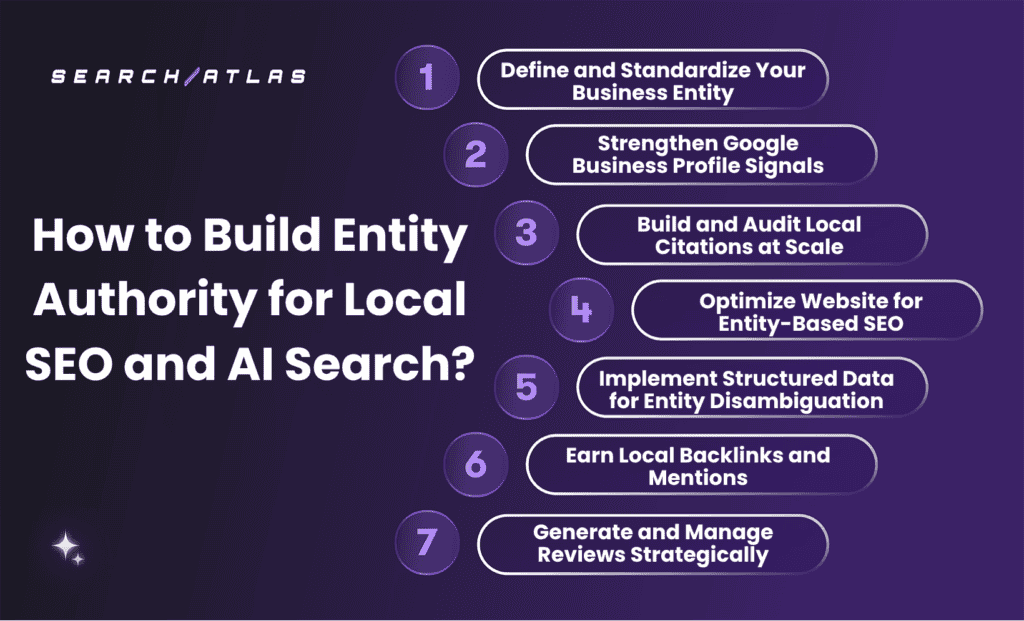
Businesses build entity authority for local SEO and AI search by aligning business identity, external signals, and structured data with how search engines and AI systems interpret, verify, and rank entities. Local and AI systems select businesses based on entity clarity, consistency, and trust across multiple sources. Strong entity authority improves eligibility, visibility, and inclusion in Local Pack results, Google Maps, and AI-generated answers rather than relying only on traditional ranking signals.
The 7 methods for building entity authority for local SEO and AI search are listed below.
- Define and standardize your business entity across all platforms.
- Strengthen Google Business Profile signals and engagement.
- Build and audit local citations at scale with consistent data.
- Optimize website structure for entity-based SEO and topical clarity.
- Implement structured data for entity disambiguation and validation.
- Earn local backlinks and mentions from relevant sources.
- Generate and manage reviews strategically for trust and prominence.
1. Define and Standardize Your Business Entity
Defining and standardizing your business entity ensures that search engines and AI systems clearly identify what the business represents across all platforms. This process matters because entity clarity determines whether a business becomes eligible for retrieval and inclusion in local and AI-generated results. Consistent entity definition increases visibility by reducing ambiguity, which strengthens trust signals and improves classification accuracy. Businesses apply this by aligning business name, category, description, and core attributes across websites, directories, and profiles. A practical takeaway involves maintaining identical entity details everywhere, which prevents fragmentation and increases inclusion across Local Pack rankings and AI-generated answers.
2. Strengthen Google Business Profile Signals
Strengthening Google Business Profile signals ensures that search engines and AI systems recognize a business as active, verified, and trustworthy within local search ecosystems. This process matters because GBP acts as a primary entity source that influences both local rankings and AI-driven recommendations. Strong GBP signals increase visibility by improving prominence, engagement, and eligibility for Local Pack inclusion. Businesses apply this by optimizing categories, maintaining accurate NAP data, publishing updates, and responding to reviews consistently. A practical takeaway involves treating GBP as the central entity hub, where ongoing activity and completeness directly improve authority and inclusion across local and AI search environments.
3. Build and Audit Local Citations at Scale
Building and auditing local citations at scale ensures that search engines and AI systems verify a business through repeated, consistent external references. This process matters because AI systems rely on distributed signals to confirm entity existence and credibility. Strong citation profiles increase visibility by reinforcing trust and improving inclusion in local results and AI-generated answers. Businesses apply this by submitting listings to authoritative directories, standardizing NAP data, and continuously auditing for inconsistencies or duplicates. A practical takeaway involves maintaining exact consistency across all citation sources, which strengthens validation signals and increases confidence for both search engines and AI systems.
4. Optimize Website for Entity-Based SEO
Optimizing a website for entity-based SEO ensures that search engines and AI systems interpret content through clearly defined entities and relationships. This process matters because AI retrieval depends on semantic understanding rather than keyword matching alone. Strong entity-based optimization increases visibility by improving contextual clarity, which allows systems to match content with user intent more accurately. Businesses apply this by structuring content around core entities, implementing internal linking, and reinforcing topical clusters. A practical takeaway involves building content around one primary entity per page, which strengthens authority and increases inclusion in search and AI-generated outputs.
5. Implement Structured Data for Entity Disambiguation
Implementing structured data for entity disambiguation ensures that search engines and AI systems interpret business information with precision and consistency. This process matters because structured data transforms content into machine-readable signals that improve retrieval and trust. An accurate schema increases visibility by reducing ambiguity, which allows AI systems to confidently include a business in generated answers. Businesses apply this by using schema types (LocalBusiness, Organization, and Service) with consistent identifiers and relationships. A practical takeaway involves creating a connected schema structure, which strengthens entity validation and increases inclusion across local results and AI-generated responses.
6. Earn Local Backlinks and Mentions
Earning local backlinks and mentions ensures that search engines and AI systems recognize a business as relevant and authoritative within a geographic area. This process matters because external validation signals influence how systems select and cite sources. Strong backlinks and mention profiles increase visibility by reinforcing authority and improving inclusion in both Local Pack rankings and AI-generated answers. Businesses apply this by building relationships with local organizations, securing media coverage, and earning mentions in trusted community platforms. A practical takeaway involves prioritizing locally relevant sources, which strengthens geographic authority and increases recognition across search and AI systems.
7. Generate and Manage Reviews Strategically
Generating and managing reviews strategically ensures that search engines and AI systems evaluate a business as credible, active, and trusted by real customers. This process matters because AI systems analyze sentiment, volume, and recency as key trust signals for inclusion. Strong review profiles increase visibility by improving prominence, which directly impacts Local Pack rankings and AI recommendations. Businesses apply this by consistently requesting reviews, responding to feedback, and maintaining engagement across platforms. A practical takeaway involves creating a steady flow of authentic reviews, which strengthens trust signals and increases authority across both local and AI-driven search environments.
How to Measure Local Entity Authority?
Measuring local entity authority involves assessing how search engines and AI systems interpret, validate, and rank a business within a specific geographic area. Local entity authority matters because inclusion in Local Pack results, Google Maps, and AI-generated answers depend on entity clarity, trust, and validation signals rather than keyword rankings alone. Strong authority improves visibility by increasing prominence, relevance, and proximity signals that drive retrieval and selection. Businesses measure this by analyzing click radius, NAP consistency, citation coverage, review signals, and engagement metrics.
Local entity authority measurement relies on behavioral and geographic signals that reflect how far users travel or interact with a business. Click radius and direction requests indicate demand strength, which increases prominence and expands ranking eligibility beyond immediate proximity. Businesses apply this by monitoring engagement data inside Google Business Profile insights and mapping tools that reveal user interaction patterns. A practical takeaway involves tracking the expansion of the click radius over time, which signals growing authority and stronger inclusion across local and AI-driven results.
Local entity authority measurement depends on NAP consistency across all platforms and directories. Consistent Name, Address, and Phone data matters because AI systems validate entities through repeated, matching references. High consistency improves visibility by reducing ambiguity and strengthening trust signals across search systems. Businesses apply this by auditing listings and correcting discrepancies across directories and social platforms. A practical takeaway involves using tools (Search Atlas) to maintain uniform data and prevent fragmentation that weakens authority.
Local entity authority measurement includes evaluating citation volume and quality across trusted local and industry sources. Citation signals matter because they confirm entity existence and reinforce credibility for AI retrieval systems. Strong citation profiles improve visibility by increasing prominence and strengthening inclusion in Local Pack and AI-generated answers. Businesses apply this by building listings on authoritative directories and auditing them regularly. A practical takeaway involves tracking citation growth and accuracy to ensure consistent validation signals.
Local entity authority measurement includes analyzing review signals that reflect trust, satisfaction, and engagement. Review signals matter because AI systems interpret sentiment, recency, and volume as indicators of credibility. Strong review profiles improve visibility by increasing prominence and influencing both rankings and AI recommendations. Businesses apply this by generating consistent reviews and responding to feedback across platforms. A practical takeaway involves using tools to monitor sentiment trends and maintain a steady flow of recent, high-quality reviews.
Local entity authority measurement includes evaluating structured data and entity clarity across websites and profiles. Structured data matters because it improves machine readability and enables accurate entity disambiguation. Clear schema implementation improves visibility by increasing confidence in entity identification and retrieval. Businesses apply this by implementing the LocalBusiness and Organization schema with consistent identifiers and relationships. A practical takeaway involves validating the schema with Google Rich Results Test to ensure correct implementation and stronger inclusion in search and AI outputs.
Local entity authority measurement includes tracking backlinks and mention signals that reflect external validation and community relevance. Backlink signals matter because AI systems prioritize entities supported by authoritative references. Strong backlink profiles improve visibility by reinforcing trust and increasing inclusion across search and AI-generated answers. Businesses apply this by earning links from local media, partnerships, and industry platforms. A practical takeaway involves monitoring backlink quality and growth using SEO tools to identify authority gaps and expansion opportunities.
Local entity authority measurement includes monitoring performance and visibility metrics across search and AI systems. Performance metrics matter for Generative Engine Optimization because inclusion frequency reflects entity trust and relevance. Strong metrics improve visibility by confirming consistent retrieval and user engagement across platforms. Businesses apply this by tracking impressions, clicks, calls, and AI visibility metrics over time. A practical takeaway involves using tools (Search Atlas) to measure traffic, conversions, and AI citation presence.
How to Track Entity Presence in AI Search?
Search engines and AI systems track entity presence by monitoring how often a business appears, gets cited, and gets selected across search results and AI-generated answers. Strong tracking improves visibility by revealing where a brand appears, how often it gets referenced, and how it compares against competitors across platforms.
Search systems detect entity presence through citation analysis, retrieval patterns, and entity matching across indexed and generated content. These systems evaluate how frequently a business appears in answers, how accurately it gets described, and how consistently it gets selected across queries. This evaluation groups entity mentions across platforms, which allows systems to measure authority, trust, and relevance in both traditional search and AI-generated outputs.
Entity presence tracking relies on analytics platforms that capture traffic signals and behavioral patterns tied to AI and search systems. GA4 tracks sessions, engagement, and referral patterns, which reveal indirect AI traffic through source segmentation and behavioral anomalies. GSC tracks impressions, clicks, and query-level visibility, which indicate shifts caused by AI Overviews and zero-click behavior. These platforms provide baseline visibility signals that reflect how entity presence changes over time.
Entity presence tracking depends on AI-specific visibility tools that measure citations, mentions, and share of voice across AI platforms. Search Atlas LLM Visibility track how often a brand appears across ChatGPT, Google AI Overviews, Perplexity, and other AI systems. This feature tracks citation frequency, brand mentions, sentiment, and competitive positioning, which creates a clear view of entity presence inside AI-generated answers. This tracking reveals whether a business gets selected, ignored, or replaced by competitors in AI outputs.
Entity presence tracking measures key performance signals that reflect authority and inclusion across search and AI systems. Citation frequency measures how often a brand appears across tracked queries. Share of voice measures how often a brand appears compared to competitors. Source attribution measures which pages or domains AI systems select as references. These metrics define how entity presence translates into visibility and authority across platforms.
Entity presence tracking evaluates platform-specific behavior because each AI system retrieves and ranks entities differently. ChatGPT prioritizes structured, entity-rich, and context-complete content. Perplexity prioritizes sources with clear data and references. Google AI Overviews prioritize content with strong SEO signals and proven ranking history. Tracking across platforms reveals where a business performs strongly and where entity signals require improvement.
Entity presence tracking faces limitations because AI systems operate as black boxes with limited transparency. Search systems expose impressions and clicks, but AI systems do not always expose citation logic or retrieval rules. This limitation requires combining multiple data sources, testing queries manually, and validating results across platforms. Consistent tracking over time reveals patterns that indicate whether entity authority increases or declines across both search and AI environments.
What Signals Indicate Strong Local Entity Authority?
Strong local entity authority signals indicate how search engines and AI systems validate, trust, and prioritize a business within a geographic area. Local entity authority matters for Generative Engine Optimization because inclusion in Local Pack results, Google Maps, and AI-generated answers depends on entity clarity, consistency, and external validation signals. Strong signals improve visibility by increasing prominence, relevance, and trust across multiple data sources rather than relying on keyword rankings alone.
The 10 main signals that indicate strong local entity authority are listed below.
1. Consistent brand identity. Consistent brand identity aligns business name, address, phone, and core attributes across all platforms. Consistent brand identity reduces ambiguity, which strengthens entity recognition and trust across search systems.
2. Visible and credible people entities. Visible and credible people and entities connect real individuals to content and business operations. Visible people entities increase trust, which improves credibility and strengthens authority signals.
3. Structured topical content. Structured topical content organizes information into clear entity-driven clusters. Structured topical content improves semantic clarity, which strengthens how systems interpret and rank the business.
4. Machine-readable data. Machine-readable data defines entity attributes through a schema and structured formats. Machine-readable data improves retrieval accuracy, which increases inclusion in search and AI-generated outputs.
5. Dedicated About and Team pages. Dedicated About and Team pages define identity, purpose, and expertise. These pages improve entity clarity, which strengthens Knowledge Graph recognition and trust signals.
6. High-quality reviews and ratings. High-quality reviews and ratings reflect customer satisfaction and trust. Strong review signals improve prominence, which increases ranking and recommendation likelihood.
7. Optimized Google Business Profile. Optimized Google Business Profile strengthens entity validation through accurate data and engagement. A complete profile improves visibility, which increases inclusion across local and AI-driven results.
8. Consistent local citations. Consistent local citations confirm business existence across directories and platforms. Strong citation consistency improves validation, which increases authority and trust signals.
9. Local backlinks and mentions. Local backlinks and mentions provide external validation from relevant sources. Strong backlinks increase authority, which improves ranking and inclusion across systems.
10. Real-world engagement signals. Real-world engagement signals measure interactions (clicks, calls, and direction requests). Strong engagement increases prominence, which expands visibility across geographic areas.
How Does Inconsistent NAP Data Confuse Entity Recognition?
Inconsistent NAP data confuses entity recognition by creating conflicting identity signals across websites, directories, and business profiles. Search engines and AI systems compare name, address, and phone details to determine whether multiple references point to one business. Inconsistent NAP data weakens that comparison, which reduces trust, lowers visibility, and increases the risk of duplicate or fragmented entity records.
Inconsistent NAP data weakens entity recognition because search systems rely on repeated agreement across sources to validate legitimacy. This validation improves local rankings, Knowledge Graph associations, and AI-generated business descriptions. Conflicting business details reduce confidence, which leads search systems to hesitate, merge records incorrectly, or suppress the entity in local and AI-driven results.
Inconsistent NAP data creates ambiguity because even small variations look as separate entities to machine systems. “ABC Plumbing Services” and “ABC Plumbing” do not always resolve to the same business. Different address formats, phone formats, or URL versions create the same problem. This ambiguity fragments authority signals, which weakens citation strength and local search performance.
Inconsistent NAP data disrupts AI systems because AI systems ingest business information as scattered text, schema, and listing records instead of one master file. Conflicting records force the system to choose between different versions or blend them into one uncertain description. This conflict produces vague brand summaries, wrong phone numbers, mixed addresses, or missing recommendations in tools (ChatGPT, Perplexity, and AI Overviews).
Inconsistent NAP data damages customer trust because customers expect the same business details everywhere they look. Wrong numbers, outdated addresses, or mismatched listings create confusion before contact even begins. This confusion reduces clicks, calls, visits, and conversions because customers often interpret conflicting details as a sign of low credibility or poor business maintenance.
Inconsistent NAP data reduces local ranking strength because Google uses citation agreement to confirm business legitimacy and geographic relevance. Consistent data across major directories strengthens prominence and trust. Inconsistent data breaks the trust chain, which lowers ranking confidence and weakens the business’s ability to compete in Google Maps and Local Pack results.
Inconsistent NAP data takes time to correct because search systems refresh and reconcile business records gradually across the web. One corrected listing rarely fixes the full problem. Businesses need to update core platforms, audit downstream citations, and maintain exact formatting everywhere. A practical takeaway involves treating NAP consistency as an ongoing entity management process, not a one-time cleanup task.
Why Do Duplicate or Conflicting Listings Reduce Trust?
Duplicate or conflicting listings reduce trust by creating inconsistent entity signals across platforms, which weakens validation and credibility. Search engines and AI systems rely on consistent data to confirm business identity and legitimacy. Conflicting listings break that consistency, which reduces confidence, lowers visibility, and limits inclusion in Local Pack results, Google Maps, and AI-generated answers.
Duplicate or conflicting listings reduce search engine confidence because validation depends on repeated agreement across trusted sources. Search systems compare business name, address, and phone details to confirm one unified entity. Multiple versions of the same business create competing signals, which makes it harder to determine the correct version. This conflict leads to suppressed visibility because search engines prioritize clear and consistent entity signals over fragmented data.
Duplicate or conflicting listings damage customer perception because customers expect accurate and consistent business information across all touchpoints. Mismatched addresses, phone numbers, or duplicate profiles create confusion during decision-making. This confusion reduces trust because inconsistent information signals poor business management or a lack of credibility. Customers often abandon interactions when basic details do not align, which directly impacts conversions and brand reputation.
Duplicate or conflicting listings weaken review signals because reviews spread across multiple profiles instead of concentrating on one authoritative listing. Fragmented reviews reduce total volume and dilute overall ratings, which lowers perceived credibility. A single profile with consolidated reviews builds stronger authority than multiple profiles with divided feedback. This fragmentation reduces engagement and weakens the business’s ability to reach trust thresholds that influence conversions.
Duplicate or conflicting listings confuse the Knowledge Graph because search systems struggle to connect all references to one verified entity. The Knowledge Graph relies on consistent attributes and relationships to build a unified entity profile. Conflicting listings introduce uncertainty, which leads to incorrect associations or incomplete entity understanding. This confusion reduces the likelihood of appearing in rich results, knowledge panels, and AI-generated summaries.
Duplicate or conflicting listings reduce local and AI search visibility because inconsistent data weakens prominence and trust signals. Search systems evaluate entity strength based on consistency across citations and platforms. Split listings divide engagement signals (clicks, calls, and direction requests), which lowers overall performance. Reduced performance signals decrease ranking potential and limit inclusion in both local results and AI-driven recommendations.
Duplicate or conflicting listings create financial and operational losses because reduced trust and visibility directly impact revenue and efficiency. Lower rankings reduce traffic, while confused customers reduce conversions and repeat business. Duplicate listings waste marketing resources because efforts are spread across multiple profiles instead of strengthening one entity. Businesses that resolve duplication restore signal clarity, which improves visibility, engagement, and overall performance across search and AI systems.