Server logs are the only data source that records direct access by AI crawlers to a website. Server logs capture retrieval bots, training crawlers, status code failures, crawl frequency, and request paths that standard analytics platforms never expose. This visibility matters because AI platforms retrieve and evaluate content through server-level requests rather than through JavaScript-based analytics systems.
Server logs matter because analytics platforms measure human sessions while AI crawlers operate outside traditional tracking frameworks. GA4 depends on browser-side execution and consented user activity. AI retrieval bots access content directly through HTTP requests, which means those visits appear inside server logs instead of inside standard analytics dashboards.
Server logs expose how AI systems actually interact with website content. Retrieval crawlers from OpenAI, Anthropic, Perplexity, and other platforms leave identifiable request patterns showing which pages AI systems retrieve, how often they revisit content, and where technical access problems exist.
Server logs improve AI visibility analysis because they reveal operational retrieval eligibility. A page optimized for AI answers creates no citation value when retrieval bots never reach the content due to crawl depth issues, blocked paths, or status code failures. Server logs expose those barriers directly.
Server logs create the missing measurement layer for AI search environments. Traditional SEO tools measure rankings, clicks, and impressions. Server logs measure retrieval access itself, which connects crawl activity, answer engine optimization, and AI citation visibility into one operational dataset.
What Are Server Logs?
Server logs are structured text files that web servers generate automatically for every HTTP request received. Server logs record requests from human visitors, search engine crawlers, AI bots, APIs, browsers, and edge platforms across the entire request lifecycle. Server logs function at the TCP and HTTP layer, which means every request creates a record regardless of JavaScript execution, cookie acceptance, or analytics tracking behavior.
What systems generate server logs? Server logs originate from web servers, CDN infrastructure, reverse proxies, and cloud edge platforms. Common server log systems include nginx, Apache, LiteSpeed, Cloudflare, Fastly, AWS CloudFront, and Microsoft IIS. These systems write request records continuously, creating chronological datasets that expose how traffic, crawlers, and applications interact with a website.
What information exists inside server log files? Server log files capture structured request-level data for every connection reaching the server infrastructure. Standard log entries record the IP address, timestamp, HTTP method, requested URL path, protocol version, response status code, transferred bytes, referrer URL, and user agent string. Expanded logging configurations record additional fields (response time, cache status, TLS version, geographic origin, and bot classification).
What formats do server log files use? Server log files use several structured formats depending on server software, hosting environments, and logging configurations. NCSA Combined Log Format appears commonly across nginx and Apache environments, storing request data through standardized text entries. W3C Extended Log Format appears frequently inside Microsoft IIS and enterprise CDN systems, storing configurable fields through timestamp-based records. JSON structured logs appear commonly across cloud platforms and edge infrastructure providers, storing nested request attributes through machine-readable JSON objects designed for large-scale processing pipelines.
What Do Server Logs Record That Analytics Platforms Like GA4 Don’t?
The difference between AI training crawlers and retrieval crawlers lies in purpose, timing, crawl behavior, and relationship to AI-generated answers. AI training crawlers collect large-scale web content for model training datasets, while retrieval crawlers fetch specific pages in real time to generate grounded answers and citations. This distinction determines how AI platforms interact with websites and how server log activity gets interpreted during AI traffic analysis.
AI training crawlers operate as large-scale indexing systems that collect publicly accessible web content across broad sections of the internet. These crawlers download pages, structured data, metadata, and textual content to expand or refresh large language model datasets. Training crawlers follow scheduled crawling patterns controlled by the AI platform itself rather than individual user behavior.
AI retrieval crawlers operate as real-time fetching systems connected directly to active user queries inside AI platforms. A user asking a question inside ChatGPT, Perplexity, or Claude triggers retrieval systems that request specific pages relevant to the query topic. Retrieval crawlers prioritize speed, topical relevance, and citation quality because fetched content contributes directly to generated answers.
The core differences between AI training crawlers and retrieval crawlers are below.
| Dimension | Training Crawlers | Retrieval Crawlers |
| Trigger | Operates through platform-scheduled crawling cycles. | Activates directly from user-generated queries. |
| Coverage | Crawls broad domain sections and large content sets. | Fetches narrow groups of query-relevant pages. |
| Speed | Processes requests through slower distributed crawling patterns. | Processes requests rapidly within seconds. |
| Return frequency | Revisits pages periodically across days or weeks. | Revisits pages whenever similar queries appear. |
| Content focus | Collects full-page content and structured datasets. | Fetches answer relevant passages and definitions. |
| Examples | GPTBot, ClaudeBot, Google Extended. | OAI SearchBot, PerplexityBot, anthropic ai. |
| Relationship to citations | Influences long term model training behavior indirectly. | Contributes directly to live citations and answers. |
What crawl behavior patterns distinguish training crawlers from retrieval crawlers? Training crawlers generate large request volumes distributed across broad sections of a domain over extended periods. Retrieval crawlers generate tightly grouped request clusters connected to specific topics, entities, or user questions. This clustering creates visible sequential request patterns inside server logs.
What does retrieval crawler activity look like inside server logs? Retrieval crawler activity appears as rapid sequences of requests across closely related URLs within short time windows. A retrieval session frequently requests three to ten pages connected through one topical cluster before generating a citation or a synthesized answer. This request pattern differs sharply from broad domain-wide crawling behavior.
Why does the distinction between training and retrieval crawlers matter for AI visibility analysis? The distinction matters because retrieval crawlers connect directly to live AI-generated answers and citation behavior. Training crawlers indicate dataset collection activity, while retrieval crawlers indicate active answer generation and visibility opportunities. SEO and AI visibility workflows depend heavily on distinguishing these two crawler behaviors correctly.
How do server logs expose retrieval events more clearly than analytics platforms? Server logs preserve request sequences, timestamps, user agent strings, and path relationships directly at the infrastructure layer. These request chains expose real retrieval activity tied to AI answer generation workflows. Traditional analytics platforms frequently miss these interactions because retrieval crawlers bypass browser-based JavaScript tracking systems entirely. Before diagnosing gaps this specific, it's worth confirming standard analytics tracking is even present sitewide — Search Atlas's analytics tracking detection flags pages missing it as a baseline check.
How Do AI Bot Access Patterns Differ from Traditional Search Engine Crawlers?
AI bots and traditional search engine crawlers differ in depth, timing, and the content types they prioritize. Googlebot and Bingbot crawl for index coverage. Their behavior is breadth-first (visit URLs from sitemaps, follow links, distribute crawl budget across the full domain). Crawl timing is driven by three priority signals. Page importance, change frequency, and crawl budget allocation all influence return cycles. These bots return to pages on cycles measured in days to weeks.
AI training bots crawl for content density. A GPTBot session often targets long-form text pages. Articles, documentation, and structured guides receive the most activity. The bot follows fewer links to low-content pages and spends more crawl budget on deep content directories. The user agent string identifies the platform, and the URL path sequence reveals the content type focus.
AI retrieval bots crawl for answer relevance. OAI-SearchBot (ChatGPT citations) and PerplexityBot arrive with a narrower path set, often hitting a small cluster of topically related pages within a single site in one session. The sequence maps to how a user query branches across a topic. A question about AI traffic attribution, for example, triggers retrieval requests across pages covering GA4, referrer headers, and direct traffic, not the full domain.
The table below maps behavioral differences across six dimensions.
| Dimension | Googlebot / Bingbot | AI Training (GPTBot) | AI Retrieval (OAI-SearchBot) |
|---|---|---|---|
| Crawl s\cope | Full domain, sitemap-driven | Deep text content focus | Query-relevant cluster |
| Session length | Long (many URLs per session) | Medium (content directories) | Short (3–15 URLs) |
| Request timing | Spaced (seconds to minutes) | Moderate (seconds between) | Rapid (under 10 seconds) |
| Content type focus | All pages with crawlable links | Long-form text, structured content | Answer-ready passages |
| Return interval | Days to weeks | Weeks to months | On query recurrence |
| Primary goal | Search index coverage | Training dataset expansion | Live citation grounding |
The clearest distinction in log data is session structure. Googlebot sessions are diffuse, covering wide paths across many URL types. AI retrieval sessions are dense, clustering around related content and often reaching leaf pages that generic crawlers deprioritize. Once logs identify which bots are actually visiting, the next step is deciding which ones to allow, restrict, or block by user agent, since monitoring and access control operate as separate, sequential steps.
Why Do Server Logs Matter for AI Search Visibility?
Server logs matter for AI search visibility because server logs provide direct evidence of AI crawler retrieval activity, citation access, and content fetching behavior. Server logs expose which AI systems accessed specific URLs, how frequently retrieval occurred, what status codes returned, and whether AI platforms successfully fetched content for live answer generation. This visibility makes server logs the most reliable infrastructure source for measuring AI search presence and retrieval behavior.
AI visibility analysis becomes unreliable without server log access because most traditional analytics systems exclude crawler activity completely. Referral data, LLM visibility dashboards, and Google Search Console patterns expose indirect visibility signals, but these systems infer AI interactions rather than recording direct crawler requests. Server logs eliminate inference because every request creates a timestamped infrastructure-level record.
Why does retrieval crawler activity matter more than training crawler activity for AI visibility? Retrieval crawler activity matters more because retrieval systems connect directly to live AI-generated answers and AI citations. A training crawler accessing a page contributes to long-term model training datasets, while a retrieval crawler fetching a page contributes to active answer generation workflows. This distinction separates historical dataset ingestion from real-time visibility inside AI search systems.
How do server logs expose live citation potential? Server logs expose live citation potential through repeated retrieval crawler access patterns across specific pages and topic clusters. A page receiving repeated OAI SearchBot requests across multiple days signals ongoing retrieval relevance and active answer generation demand. Frequent retrieval patterns indicate that AI systems continue evaluating the page as a trusted informational source.
What happens when retrieval crawlers cannot access a page? Retrieval visibility collapses when AI retrieval crawlers encounter blocked or inaccessible pages during answer generation workflows. A page returning 403 forbidden responses, 404 not found responses, or unstable server errors prevents successful content retrieval regardless of content quality. Failed retrieval requests remove the page from active citation opportunities inside AI-generated answers.
Why do server logs expose AI search behavior more accurately than GA4? Server logs record every infrastructure-level request directly at the HTTP layer without browser dependencies or bot filtering systems. GA4 excludes most crawler activity because GA4 depends on JavaScript execution inside browser sessions. This exclusion removes visibility into retrieval bots, training crawlers, sequential fetch behavior, and AI answer generation workflows.
What Crawl Data Do You Lose Without Direct Log Access?
Without direct server log access, critical AI crawler behavior becomes invisible.
The first missing layer is crawl frequency by platform. External analytics tools do not show how often GPTBot, OAI-SearchBot, PerplexityBot, ClaudeBot, or Gemini crawlers access the website. Server logs expose which AI systems crawl most aggressively and which sections they prioritize.
The second missing layer is error exposure by a bot. AI retrieval systems receiving 403, 404, 429, or 5xx responses lose access to content, but those failures rarely appear inside GA4 or Google Search Console. Log data reveals exactly which AI crawlers encounter blocking or failed responses.
The third missing layer is crawl depth and content reach. AI crawlers that stop after shallow navigation paths signal internal linking, pagination, or crawl efficiency problems. Log files show whether retrieval bots actually reach high-value content deeper inside the site structure.
The fourth missing layer is crawl path sequencing. Server logs reveal how AI crawlers move across categories, articles, hubs, and supporting pages during retrieval sessions. This path data exposes structural gaps where crawlers enter the site but fail to reach target content efficiently.
The fifth missing layer is crawler verification and spoofing detection. User agents alone are unreliable because bad actors frequently imitate GPTBot, ClaudeBot, or Perplexity crawlers. Server logs expose the originating IP addresses required to verify whether requests actually come from legitimate AI platforms.
How Does Server Log Data Connect to Answer Engine Optimization (AEO)?
AEO depends on retrieval visibility, and server logs confirm whether retrieval actually happens. A page optimized for AI answers creates no visibility impact if retrieval crawlers never access the content. Server logs expose whether systems (OAI-SearchBot, GPTBot, ClaudeBot, or Perplexity crawlers) actively retrieve AEO-targeted pages.
Log data validates whether answer-optimized content remains eligible for citation. Pages receiving recent retrieval bot activity alongside successful 200 response codes remain actively accessible for AI answer generation. Pages receiving no retrieval crawler activity over long periods contribute little to AI citation visibility regardless of how well optimized the content appears structurally.
Server logs reveal which content structures attract stronger retrieval activity. Pages using direct definitions, numbered workflows, comparison tables, concise answer blocks, and strong entity alignment consistently generate stronger retrieval crawler engagement than pages built around dense unstructured prose. That pattern aligns directly with how answer engines extract, rank, and surface citations across AI-generated responses.
How to Use Server Logs to Track AI Crawler Activity?
Tracking AI crawler activity through server logs requires five sequential steps, starting with log access and ending with retrieval validation against priority content. This process matters because server logs expose how AI crawlers actually access, retrieve, and evaluate website content across training and citation systems. Strong log analysis improves crawl visibility, retrieval access, and AI citation eligibility by revealing how retrieval bots interact with the site structure directly.
The 5 steps to track AI crawler activity through server logs are listed below.
1. Access and Parse Raw Server Log Files
Accessing and parsing raw server logs means locating the original HTTP request records generated by the web server or CDN environment. This process matters because AI crawler activity exists inside raw request logs before analytics platforms process or filter the data.
Self-hosted nginx and Apache environments typically store logs inside default server directories, while cloud infrastructure platforms route logs into storage buckets or centralized monitoring systems. Businesses access these files through local server access, cloud logging platforms, or log aggregation tools connected to the infrastructure stack.
Parsing converts raw requests into structured crawl datasets. The minimum useful fields for AI crawler analysis are timestamp, URL path, status code, and user agent. IP addresses and bytes transferred add verification and volume context during deeper analysis.
2. Segment Requests by AI Bot User Agents
Segmenting requests by user agent means separating AI crawler traffic from standard search engine and human traffic. This separation matters because AI training bots and AI retrieval bots perform different functions across AI search ecosystems.
Training bots collect content for model training and indexing workflows. Retrieval bots access content directly for live AI-generated answers and citations. Businesses identify these crawlers through user agent strings attached to each request.
Common AI crawler user agents include GPTBot, OAI-SearchBot, ClaudeBot, anthropic-ai, PerplexityBot, Perplexity-User, Google-Extended, and Meta-ExternalAgent. Separating these requests creates visibility into which AI systems actively retrieve website content and which systems primarily collect training data.
3. Analyze Crawl Depth, Frequency, and Path Patterns
Analyzing crawl behavior means evaluating how deeply AI crawlers navigate the website, how often they return, and which content paths they prioritize. This analysis matters because retrieval patterns reveal whether AI systems actually reach high-value content intended for citations.
Crawl depth exposes structural navigation problems. Retrieval bots that consistently stop at category pages without reaching articles or commercial pages signal weak internal linking or inaccessible site architecture.
Request frequency exposes retrieval freshness. Websites publishing new content regularly but receiving infrequent retrieval bot visits create citation lag across AI answer systems.
Path pattern analysis identifies which content clusters attract the highest retrieval activity. Pages receiving repeated retrieval access remain actively eligible for AI citations, while untouched clusters remain operationally invisible regardless of content quality.
4. Check HTTP Status Codes for AI Access Errors
Checking status codes means validating whether AI crawlers successfully retrieve pages or encounter technical access barriers. This validation matters because blocked or unstable retrieval paths directly reduce AI citation eligibility.
Status 200 confirms successful retrieval. Status codes 301 and 302 indicate redirects that reduce retrieval efficiency when chains become excessive. Status 404 exposes broken content paths. Status 403 reveals blocked crawler access caused by firewall or server rules. Status 429 signals rate limiting that reduces crawl frequency over time.
Building status code distributions for each AI crawler type exposes technical retrieval problems across specific sections of the website. High volumes of 403 or 429 responses from retrieval bots indicate infrastructure configurations actively limiting AI access to important content.
5. Cross-Reference AI Retrieval Against Priority Content
Cross-referencing retrieval activity against priority content means comparing AI crawler access logs against pages targeted for rankings, citations, or AI answer visibility. This comparison matters because optimized pages create no retrieval value when AI crawlers never access them.
Priority pages typically include high-value commercial pages, AEO-targeted articles, comparison pages, definitions, and conversion-focused content hubs. Pages receiving frequent retrieval crawler visits alongside successful 200 responses remain actively accessible for AI-generated citations. Pages receiving zero retrieval activity require investigation into robots’ rules, internal linking, crawl depth, or technical access barriers.
This final validation step confirms whether AI retrieval systems actually reach the content businesses expect to appear across AI-generated search experiences.
What Are the Best Practices for AI Bot Monitoring Through Server Logs?
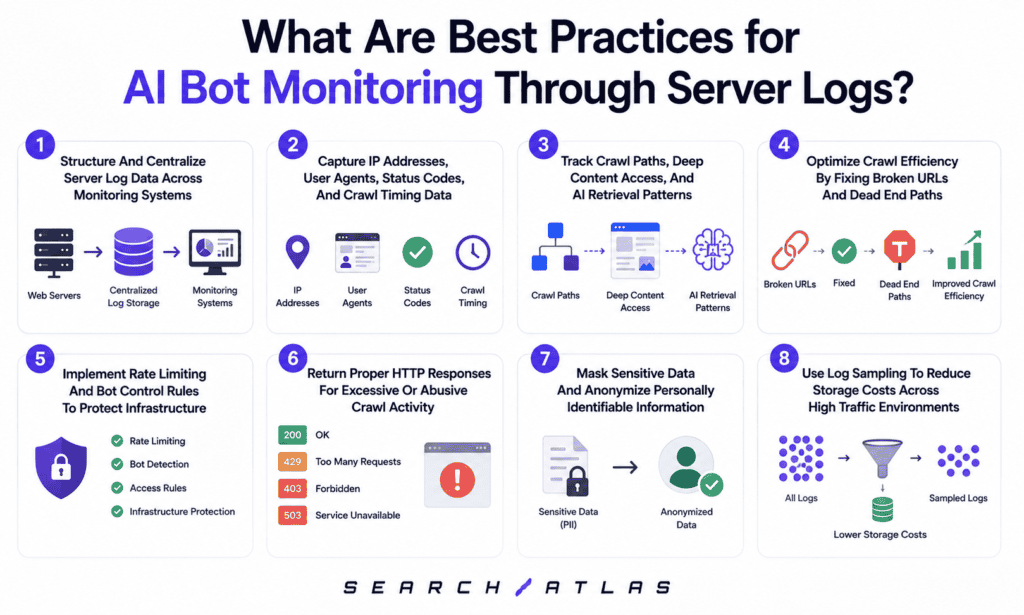
AI bot monitoring through server logs requires structured collection, retrieval, analysis, crawl management, and compliance controls across the entire logging pipeline. This process matters because AI crawlers generate retrieval, training, and citation signals that standard analytics platforms cannot expose directly. Strong monitoring practices improve retrieval visibility, protect infrastructure stability, and increase operational control across AI search environments.
The 8 best practices for AI bot monitoring through server logs are listed below.
1. Structure And Centralize Server Log Data Across Monitoring Systems
Structured and centralized logging means consolidating request data from servers, CDNs, edge networks, and load balancers into one searchable environment. This process matters because AI retrieval sessions frequently split across multiple infrastructure layers during a single crawl session.
Sites running distributed hosting environments generate fragmented log streams that become difficult to analyze independently. Centralized ingestion pipelines built with Fluentd, Logstash, or Vector unify those streams into one queryable dataset.
Structured JSON logging improves analysis speed and reliability because AI bot segmentation works more efficiently against normalized fields than against raw regex parsing on combined log formats.
2. Capture IP Addresses, User Agents, Status Codes, And Crawl Timing Data
Capturing complete crawl metadata means retaining the fields required for verification, retrieval analysis, and session reconstruction. This practice matters because incomplete log retention removes the visibility needed for AI crawler diagnostics.
The most important fields are IP address, user agent string, HTTP status code, and timestamp precision. IP addresses validate crawler ownership. User agents identify bot type. Status codes expose access success or failure. Precise timestamps reconstruct crawl sessions and frequency patterns. Retention policies that aggregate or strip these fields remove the ability to analyze retrieval behavior accurately across AI systems.
3. Track Crawl Paths, Deep Content Access, And AI Retrieval Patterns
Tracking crawl paths means reconstructing the navigation sequences AI retrieval bots follow during site access. This analysis matters because retrieval bots expose structural content accessibility problems directly through their crawl behavior.
Grouping requests by bot IP and timestamp window creates session-level crawl paths showing how AI systems move from entry pages toward deeper content. Repeated patterns reveal which sections retrieval bots prioritize and where navigation breaks occur.
Dead-end paths expose pages where retrieval bots stop without reaching high-value content. These dead ends signal weak internal linking, shallow architecture, or low retrieval relevance.
4. Optimize Crawl Efficiency By Fixing Broken URLs And Dead End Paths
Optimizing crawl efficiency means resolving technical retrieval barriers preventing AI crawlers from accessing important content. This process matters because failed retrieval paths directly reduce citation eligibility inside AI-generated answers.
Broken URLs returning 404 responses remove pages from retrieval workflows until redirects or link corrections restore access continuity. Multi-hop redirect chains reduce retrieval efficiency and weaken crawl reliability across AI systems.
Priority fixes follow retrieval frequency patterns. Pages repeatedly requested by retrieval bots represent actively targeted citation paths and require immediate resolution when failures appear.
5. Implement Rate Limiting And Bot Control Rules To Protect Infrastructure
Rate limiting means controlling crawler request frequency to maintain infrastructure stability during high-volume AI crawling activity. This process matters because simultaneous AI crawler access creates significant server and bandwidth load across large publishing environments.
Different AI bots require different thresholds based on retrieval importance. Retrieval bots tied to live AI answers benefit from more permissive limits than large-scale training crawlers collecting broad indexing data. Returning HTTP 429 responses alongside Retry-After headers preserves crawl relationships more effectively than hard blocking behavior.
6. Return Proper HTTP Responses For Excessive Or Abusive Crawl Activity
Proper HTTP response handling means sending technically correct server responses during blocked, limited, or removed content states. This practice matters because AI crawlers interpret response codes as long-term retrieval signals.
HTTP 429 communicates temporary rate limiting. HTTP 403 communicates restricted access. HTTP 410 confirms permanent content removal more clearly than standard 404 responses.
Soft 404 pages create retrieval confusion because crawlers process those pages as valid content despite missing information. Clear response handling improves crawl efficiency and reduces wasted retrieval activity across AI systems.
7. Mask Sensitive Data And Anonymize Personally Identifiable Information
Sensitive data masking means removing personally identifiable information before storing or exporting log datasets. This process matters because server logs frequently capture session identifiers, user parameters, and authentication data inside URLs.
Privacy-safe ingestion pipelines strip query parameters containing emails, tokens, or user identifiers before long-term retention. IP anonymization through hashing or truncation preserves crawler verification capability while reducing privacy exposure. Compliance controls become mandatory whenever logs move into third-party monitoring or analytics environments.
8. Use Log Sampling To Reduce Storage Costs Across High-Traffic Environments
Log sampling means retaining statistically representative request subsets while reducing storage overhead across large traffic environments. This process matters because high-volume websites generate enormous log datasets that become expensive to retain indefinitely.
Human traffic sampling reduces storage requirements significantly while preserving analytical distributions across status codes, URL paths, and crawl behavior. AI bot traffic typically remains unsampled because retrieval analysis depends on complete session reconstruction.
Sampling works most effectively at the ingestion layer after parsing occurs, which preserves analytical integrity while reducing long-term storage costs.
What Tools Analyze Server Logs for AI Crawler Behavior?
The best server log analysis tools identify AI crawler activity, monitor retrieval behavior, expose crawl errors, and connect retrieval visibility to AI citations. These tools analyze bot requests, crawl paths, status codes, and retrieval frequency to reveal how AI systems access website content across training and answer-generation workflows.
The 7 best tools for analyzing server logs and AI crawler behavior are Search Atlas OTTO SEO, GoAccess, Cloudflare Bot Analytics, Elastic Stack (ELK), Splunk, Screaming Frog Log File Analyser, and Datadog Log Management.
1. Search Atlas OTTO SEO. Search Atlas OTTO SEO connects crawl behavior, indexing signals, and retrieval visibility into a single operational workflow. OTTO SEO identifies technical barriers affecting AI crawler access and deploys fixes directly into websites. This connection matters because crawl accessibility problems reduce retrieval eligibility across AI-generated search environments.
2. GoAccess. GoAccess is an open-source real-time log analysis tool that parses raw access logs and visualizes bot activity, status codes, and URL-level crawl behavior. The platform supports lightweight AI bot analysis without requiring enterprise infrastructure. This accessibility matters because smaller websites still need visibility into retrieval crawler behavior.
3. Cloudflare Bot Analytics. Cloudflare Bot Analytics categorizes traffic across verified bots, unverified bots, and automated systems operating through Cloudflare infrastructure. The platform surfaces AI crawler activity directly at the CDN layer. This visibility matters because many retrieval systems interact with edge infrastructure before reaching origin servers.
4. Elastic Stack (ELK). Elastic Stack combines Elasticsearch, Logstash, and Kibana into a scalable log aggregation and visualization environment. The platform supports AI bot segmentation, session reconstruction, and large-scale retrieval analysis across high-volume infrastructures. This scalability matters because enterprise websites generate complex multi-source crawl datasets.
5. Splunk. Splunk provides enterprise-grade log management with advanced query capabilities for crawler analysis and retrieval monitoring. The platform supports session grouping, time-window analysis, and user agent categorization across large distributed environments. This flexibility matters because AI retrieval analysis frequently requires custom behavioral queries across massive datasets.
6. Screaming Frog Log File Analyser. Screaming Frog Log File Analyser parses raw access logs and visualizes crawler navigation paths across websites. The platform segments requests by bot type, status code, and crawl behavior without requiring complex infrastructure setup. This visibility matters because retrieval path analysis exposes structural crawl barriers affecting AI visibility.
7. Datadog Log Management. Datadog Log Management provides hosted log aggregation, anomaly detection, and real-time monitoring across server environments. The platform detects sudden changes in AI crawler frequency, retrieval failures, and infrastructure-level crawl disruptions. This monitoring matters because unexpected retrieval drops often signal access problems before citation visibility declines.
How Does a Log Analyzer Identify and Segment AI Bots Automatically?
Log analyzers identify and segment AI bots by detecting crawler identifiers inside the user agent string attached to every HTTP request. AI bots identify themselves through unique User-Agent headers, which allows log analysis systems to classify requests automatically during ingestion.
How do log analyzers identify AI bots? Log analyzers identify AI bots through string-matching rules applied against known crawler user agent patterns. Every HTTP request contains a User-Agent field that identifies the requesting client. AI crawlers (GPTBot, OAI-SearchBot, ClaudeBot, and PerplexityBot) include unique identifiers inside that field, which allows log analysis systems to categorize requests automatically.
How does automated AI bot segmentation work? Automated AI bot segmentation works by applying tagging rules during log ingestion. Requests containing known AI crawler identifiers receive bot category labels before storage and analysis. These labels organize subsequent reporting across request frequency, status code distributions, crawl paths, and retrieval behavior.
Why do AI bot user agent lists require continuous updates? AI bot user agent lists require continuous updates because AI platforms regularly release new crawler variants and identifiers. A static crawler list quickly becomes outdated as platforms introduce retrieval bots, training crawlers, browser agents, and experimental systems. Maintaining accurate segmentation requires ongoing updates against published crawler documentation from OpenAI, Anthropic, Perplexity, Google, and similar AI platforms.
How do log analyzers separate retrieval bots from training bots? Log analyzers separate retrieval bots from training bots through crawler classification rules tied to user agent identifiers. Retrieval bots access content directly for live AI answers and citations, while training bots collect data for model indexing and training workflows. This distinction matters because retrieval activity connects directly to AI visibility and citation generation.
What AI Crawler User Agents Should You Track in Server Logs?
AI crawler user agents identify which AI systems access, retrieve, and train on website content. These identifiers matter because server logs use user agent strings to classify crawler behavior, measure retrieval visibility, and separate training activity from citation activity across AI platforms.
The 9 most important AI crawler user agents to track in server logs are listed below.
1. GPTBot. GPTBot is OpenAI’s primary training crawler for GPT model training datasets. This crawler collects content for indexing and model training workflows rather than live answer retrieval.
2. OAI-SearchBot. OAI-SearchBot is OpenAI’s retrieval crawler used for ChatGPT citations and live answer generation. This crawler directly affects AI retrieval visibility across ChatGPT search experiences.
3. ChatGPT-User. ChatGPT-User handles browsing activity triggered during active ChatGPT user sessions. This crawler reflects live user-driven retrieval behavior inside ChatGPT browsing workflows.
4. ClaudeBot. ClaudeBot is Anthropic’s primary training crawler responsible for collecting content used in Claude model training workflows.
5. anthropic-ai. Anthropic-ai functions as Anthropic’s retrieval crawler for live Claude answer generation and citation workflows. This crawler signals active retrieval eligibility inside Claude interfaces.
6. PerplexityBot. PerplexityBot is Perplexity’s primary retrieval crawler responsible for fetching content used in AI-generated answers and citations across Perplexity search experiences.
7. Perplexity-User. Perplexity-User handles browsing and retrieval activity triggered directly by active Perplexity user sessions.
8. Google-Extended. Google-Extended is Google’s AI training control crawler that manages whether website content participates in Google AI training systems. This crawler functions primarily as a training opt-out mechanism rather than a retrieval crawler.
9. Meta-ExternalAgent. Meta-ExternalAgent is Meta’s AI training crawler used for collecting publicly accessible content for Meta AI systems and training datasets.
Googlebot itself does not function as a dedicated AI retrieval crawler.
Standard Googlebot primarily supports Google Search indexing workflows rather than direct AI Overviews retrieval activity. AI Overviews pull from Google’s main search infrastructure, which means Googlebot crawl frequency does not directly measure AI citation visibility.
The distinction between retrieval crawlers and training crawlers changes how websites respond operationally.
High retrieval crawler activity signals active AI citation potential and stronger Answer Engine Optimization opportunities. High training crawler activity without retrieval activity signals that content remains accessible for model training without generating meaningful live AI visibility.
How Do You Verify Whether a User Agent Is a Legitimate AI Crawler?
User agent strings alone do not verify legitimate AI crawlers because user agents are self-reported and easy to spoof. Verification requires validating the requesting IP address against the crawler platform’s published infrastructure.
User agent strings alone do not verify legitimate AI crawlers because allows any client to impersonate GPTBot, ClaudeBot, PerplexityBot, or other AI crawlers by copying the same user agent header. This spoofing creates false crawler signals inside server logs and makes user agent analysis unreliable without IP validation.
How do websites verify legitimate AI crawlers? Websites verify legitimate AI crawlers through reverse DNS lookups and IP ownership validation. Legitimate AI platforms publish their crawler IP ranges publicly, which allows verification against official infrastructure. OpenAI, Anthropic, Google, and Perplexity all maintain documentation listing approved crawler identifiers and IP ownership details.
How does reverse DNS verification work for AI crawlers? Reverse DNS verification works by resolving the requesting IP address into a hostname and confirming the hostname belongs to the crawler platform. Legitimate GPTBot requests resolve to OpenAI-owned domains, while legitimate Anthropic crawlers resolve to Anthropic infrastructure domains. Requests resolving to unrelated hosting providers, residential ISPs, or unknown infrastructure fail verification.
Why does forward DNS validation matter after reverse lookup? Forward DNS validation matters because spoofed reverse DNS records create false ownership signals. A forward DNS lookup confirms that the resolved hostname maps back to the same originating IP address. This bidirectional validation prevents spoofing attempts and confirms legitimate crawler ownership.
How do large-scale log analysis systems automate crawler verification? Large-scale log analysis systems automate crawler verification through ingestion-time enrichment workflows. The system resolves and stores verified hostnames alongside each requesting IP address during log ingestion. Subsequent analysis queries rely on verified infrastructure ownership rather than on user agent strings alone.
Can You Block Training Bots Without Affecting Retrieval Crawlers?
Yes. Websites block training bots without affecting retrieval crawlers because AI platforms separate training and retrieval systems through different user agent identifiers. This separation matters because businesses often want citation visibility without contributing content to AI training datasets.
Websites block training bots through robots.txt directives, WAF rules, CDN filters, or server-level access controls targeting specific user agent strings. GPTBot handles OpenAI training workflows, while OAI-SearchBot handles retrieval activity tied to ChatGPT citations and live answers. ClaudeBot handles Anthropic training, while anthropic-ai handles retrieval. Modern infrastructure systems evaluate these crawlers independently.
Blocking training crawlers does not directly remove citation eligibility because retrieval crawlers determine whether pages remain accessible for live AI-generated answers. Retrieval access remains the primary signal controlling short-term AI visibility across platforms.
Training access still carries long-term strategic implications. Model training influences how AI systems understand entities, industries, terminology, and topical relationships over time. Websites blocking all training access reduce exposure inside future model understanding layers, even while preserving retrieval visibility.
Businesses typically separate these decisions operationally. Retrieval access remains open for citation visibility, while training access depends on infrastructure policy, content ownership priorities, and long-term AI strategy.
Does robots.txt Reliably Stop AI Crawlers from Accessing Restricted Content?
Yes. robots.txt reliably stops major AI platform crawlers from accessing restricted content because the largest AI companies publicly honor robots.txt directives across their documented crawler systems. This behavior matters because robots.txt remains the primary crawl control layer for AI training and retrieval access management.
Major AI platforms respect robots.txt directives because OpenAI, Anthropic, Google, and Perplexity all publish crawler documentation confirming compliance with Disallow rules. Log analysis consistently confirms this behavior operationally. AI crawler requests typically disappear from blocked paths after robots.txt restrictions are implemented correctly.
robots.txt does not stop all automated access because robots.txt functions as a voluntary crawl instruction rather than as a technical enforcement mechanism. Independent scrapers, unauthorized data collectors, and user agent spoofers frequently ignore robots.txt rules entirely.
robots.txt works best for managing legitimate AI platform access rather than for protecting sensitive or restricted content. Truly restricted content requires authentication systems, WAF rules, server-side access controls, or HTTP response restrictions (401 and 403 status codes).
Businesses typically treat robots.txt as a crawler management layer rather than as a security layer. The file controls how compliant AI systems retrieve and process content, but it does not prevent malicious or unauthorized automated access outside trusted crawler ecosystems.
Can Server Log Insights Improve Which Pages You Prioritize for AEO?
Yes. Server log insights improve AEO prioritization because retrieval bot activity exposes which pages AI systems already access for citations and answer generation. This visibility matters because retrieval access determines whether optimized pages remain operationally eligible for AI visibility.
Server log insights improve AEO prioritization because pages receiving frequent OAI-SearchBot, PerplexityBot, or anthropic-ai requests already exist inside active retrieval workflows. Applying AEO improvements to these pages produces faster visibility gains because AI systems already retrieve and process the content regularly.
Server log insights improve AEO prioritization because logs expose high-quality pages that retrieval bots never reach. A page optimized for answer extraction creates no citation impact when retrieval systems cannot access the content due to crawl depth problems, robots.txt restrictions, broken internal links, or HTTP access errors.
Server log insights improve AEO prioritization because retrieval behavior adds an operational layer that content scoring alone cannot detect. Traditional content audits measure quality, structure, and semantic coverage. Server logs reveal whether AI retrieval systems actually interact with those pages in live retrieval environments. Server log insights improve AEO prioritization because retrieval frequency reveals where AI systems already identify topical relevance. Pages repeatedly accessed by retrieval bots signal stronger alignment with active AI retrieval demand, which creates clearer opportunities for citation expansion through answer-focused optimization.