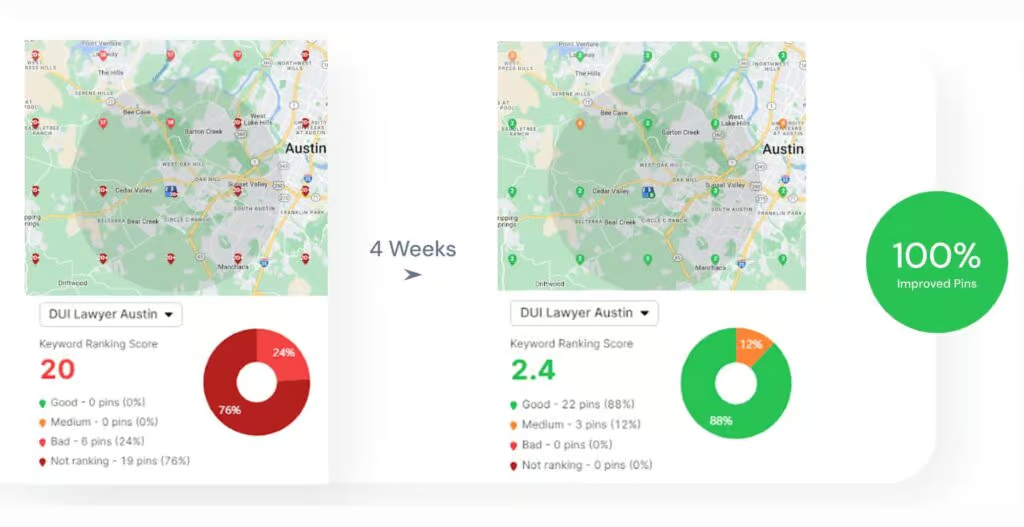
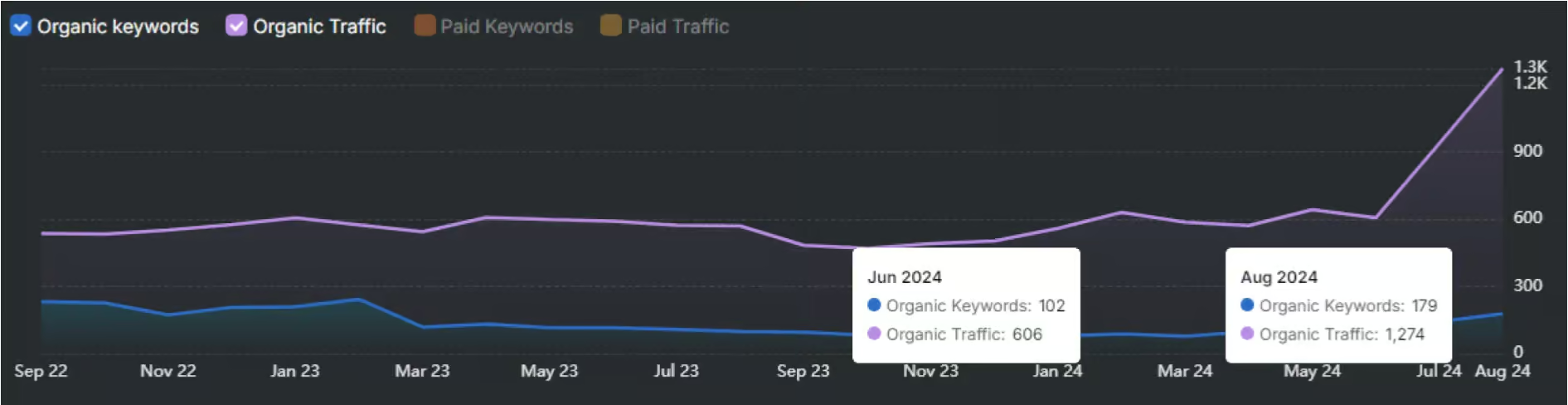
Topical authority is a website attribute that signals expertise and comprehensive coverage of a subject across interconnected content, entities, and user queries. The meaning of a topical authority framework explains how websites build semantic authority through complete topic coverage, structured relationships between pages, and alignment with search intent instead of isolated keyword targeting. This explanation clarifies what topical authority means in modern search systems, where depth and consistency define visibility and ranking potential.
Topical authority matters because search engines and AI systems evaluate content based on completeness, semantic relevance, and entity relationships rather than keyword frequency alone. Systems analyze how well a domain explains a subject across multiple pages, which determines ranking performance, indexing priority, and citation probability. This evaluation shows what topical authority means in SEO, where structured coverage increases visibility across both traditional search results and AI-generated answers.
Topical authority creates measurable advantages for domains operating in search and AI-driven ecosystems by improving ranking consistency, expanding keyword coverage, and increasing citation likelihood. Domains with strong topical authority achieve up to 3.5x more organic traffic, 67% higher rankings for comprehensive coverage, and 2.1x more backlinks from relevant sources. Pages ranking in positions 6 to 10 with strong topical authority receive 2.3x more AI citations than higher-ranked pages with weak topical depth, which shows how coverage outweighs position alone.
Topical authority reflects a structural shift in search systems driven by semantic matching and entity-based evaluation instead of keyword matching alone. AI answer engines prioritize entity trust, E-E-A-T signals, and semantic alignment, where cosine similarity thresholds above 0.88 determine whether content matches a query conceptually. Content containing 19 or more data points increases AI citation rates by 93%, while pages with 15 or more entities per 1,000 words show 4.8x higher citation probability. This shift explains why structured, data-rich, and semantically complete content dominates AI-driven visibility.
Topical authority requires a structured framework that combines niche clarity, topic mapping, pillar-cluster architecture, internal linking, and continuous optimization across content systems. A focused niche creates faster authority because every page reinforces the same subject and audience problem. A pillar-cluster model organizes content into a central hub with supporting articles that expand subtopics, while internal linking connects these pages into a semantic network that search engines interpret as expertise. Continuous updates maintain relevance as topics evolve, competitors expand coverage, and AI systems change retrieval patterns.
Topical authority requires long-term development through consistent publishing, structured expansion, and iterative improvement across topic clusters. Domains building authority from zero gain visibility up to 57% faster and increase traffic by 62% within the early stages, compared to low-authority domains with disconnected content. This growth compounds over time because each new page strengthens the overall topic network instead of acting as an isolated asset. The global growth of semantic search technologies, projected to expand from $1.5 billion in 2023 to $4.8 billion by 2028, reflects how entity-based optimization and topical authority define the future of search visibility.
What Is Topical Authority?
Topical authority is a search and content evaluation framework that defines how a website demonstrates expertise across a complete subject. Topical authority connects content depth to search visibility, which shifts optimization from isolated keywords toward full topic coverage.
Topical authority governs how search systems interpret content relationships, evaluate expertise signals, and assign trust within a defined subject area. Websites build topical authority to ensure their knowledge, structure, and coverage appear as the most reliable source across search results instead of competing on isolated pages.
Topical authority operates across what systems? Topical authority operates across semantic search systems, ranking algorithms, and AI-driven answer engines. These systems evaluate meaning, entity relationships, and content depth to determine which sources demonstrate real subject expertise. These systems prioritize context instead of exact-match keywords, which explains why topic coverage drives ranking outcomes.
What does Topical Authority optimize in search environments? Topical authority optimizes how content becomes discoverable, relevant, and dominant across a full topic. Topical authority focuses on coverage depth, internal linking structure, and keyword breadth so search systems assign higher trust to the website. This optimization increases visibility across related queries instead of limiting performance to single keywords.
What defines the core characteristics of Topical Authority? There are three main characteristics of topical authority. Firstly, comprehensive topic coverage defines subject depth because all subtopics receive structured content. Secondly, the internal linking structure defines relationships because connected pages reinforce contextual meaning across the site. Thirdly, keyword breadth defines visibility scale because ranking across many queries signals strong topical relevance to search systems.
Why does Topical Authority exist as a ranking factor? Topical authority depends on semantic search evolution that prioritizes meaning instead of keyword matching. Topical authority expanded after Google Hummingbird introduced intent-based interpretation, reinforced by Google Panda and Helpful Content System. These systems prioritize expertise signals, which explains topic-level evaluation across modern search environments.
Topical authority functions as the control system for subject-level visibility across search results. Search systems evaluate entire topic clusters instead of isolated pages, which means topical authority determines whether a website ranks consistently across related queries. This control defines what is topical authority because modern search prioritizes expertise across a subject instead of keyword-level ranking.
Why Does a Topical Authority Framework Matter?
A topical authority framework matters because it controls how a website builds expertise, scales visibility, and secures long-term search growth across a subject. A topical authority framework connects structured content ecosystems to ranking systems, which shifts strategy from isolated pages toward compounding topic dominance.
A topical authority framework governs how content depth, internal structure, and semantic alignment translate into authority signals across search and AI systems. Organizations use a topical authority framework to ensure consistent growth, predictable rankings, and stronger positioning across competitive search environments.
How does a Topical Authority Framework provide a strategic advantage in modern search? A topical authority framework aligns content with systems that evaluate expertise and intent. Helpful Content System prioritizes depth, clarity, and cohesion, which means structured topic coverage outperforms thin content. This alignment improves rankings because search systems evaluate internal links, semantic relationships, and author credibility as connected signals.
Why does a Topical Authority Framework lead to improved visibility and credibility? A topical authority framework expands topic coverage, which increases rankings across long-tail queries and related searches. This expansion strengthens trust because consistent visibility reinforces expertise signals across search results. Websites with strong topical authority appear more frequently in featured results and AI-generated summaries, which increases overall presence and perceived reliability.
What makes compounding growth a benefit of a Topical Authority Framework? A topical authority framework builds a connected content ecosystem that compounds over time. Each new page strengthens existing pages through internal links and shared relevance, which increases total ranking potential. This compounding structure drives sustained organic traffic growth, consistent keyword expansion, and continuous authority reinforcement across the topic.
How does a Topical Authority Framework adapt to AI and zero-click search environments? A topical authority framework structures content for systems that generate direct answers instead of link lists. AI systems (ChatGPT and Google AI Overviews) extract structured, trustworthy information from connected content clusters. This structure increases the probability of citation inside generated responses, which maintains visibility even without clicks.
Why does a Topical Authority Framework enable strategic decision-making? A topical authority framework replaces random SEO actions with a defined system for growth. This framework identifies high-impact topics, prioritizes content gaps, and aligns execution with measurable outcomes. This structure improves efficiency because decisions follow a clear model instead of isolated tactics.
What is the role of a Topical Authority Framework in supporting E-E-A-T? A topical authority framework acts as the structural expression of expertise, authority, and trust. E-E-A-T evaluates real knowledge through consistent, accurate, and interconnected content. This consistency strengthens credibility signals, which expands rankings across related queries without requiring constant new page creation.
How Search Engines and AI Answer Engines Evaluate Topical Authority?
Search engines and AI answer engines evaluate topical authority by analyzing how deeply, consistently, and credibly a website covers a subject. Topical authority connects content depth, entity clarity, internal structure, and external validation to source selection across search results and AI-generated answers.
Search engines and AI answer engines no longer evaluate expertise through keywords alone. They interpret semantic relationships, map entities, assess authorship, and compare sources against trusted references before selecting content for rankings, citations, and synthesized responses.
AI search engines interpret topical authority through what systems? AI search engines interpret topical authority through natural language processing (NLP), entity recognition, semantic relationship mapping, and vector-based retrieval. These systems build a topic map around the website. This topic map shows whether the site covers related subtopics with consistent expertise.
What signals define topical authority for AI systems? There are 5 main signals AI systems evaluate for topical authority. Content depth shows comprehensive coverage across core topics, adjacent questions, and nuanced perspectives. Consistency shows repeated expertise across related content instead of disconnected publishing. Original research shows unique data, case studies, and firsthand experience. Author credentials show real expertise through professional background, bios, and structured authorship. External validation shows trust through authoritative links, co-citations, mentions, and industry references.
How do traditional search and AI-powered discovery differ? Traditional search returns ranked pages, while AI-powered discovery synthesizes answers from selected sources. Traditional search emphasizes ranking position and keyword relevance. AI-powered discovery emphasizes semantic fit, extractable answers, and source credibility. This difference means a page does not need position 1 to earn an AI citation. The page needs clear authority on the specific answer the AI system generates.
What is the Topical Ownership framework? The Topical Ownership framework explains how AI systems select content, not just how content earns authority. Topical ownership has three rows (Coverage, Architecture, and Position). Coverage proves topic depth. Architecture makes that depth readable for machines. Position proves the entity deserves selection over competitors. A weak row limits selection because AI systems reward complete ownership, not partial strength.
How does Coverage affect topical authority? Coverage affects topical authority by proving that a source explains the full topic without major gaps. Coverage includes depth, breadth, and original thought. Depth covers the topic vertically. Breadth covers adjacent subtopics horizontally. Original thought makes the content non-interchangeable through reframing, unique data, or new frameworks.
How does Architecture affect topical authority? Architecture affects topical authority by making content understandable to search systems and AI systems. Architecture includes source context, topical maps, and semantic networks. Source context defines the identity of the publisher and the purpose. Topical maps organize pages, clusters, and internal links. Semantic networks reduce retrieval effort by connecting definitions, use cases, examples, FAQs, and advanced guides.
How does Position affect topical authority? Position affects topical authority by proving recognition beyond the website itself. Position includes temporal position, hierarchical position, and narrative position. Temporal position shows who established a claim first. Hierarchical position shows who others recognize as an expert. Narrative position shows who the market repeatedly references for the topic.
How does N-E-E-A-T-T map to topical authority? N-E-E-A-T-T maps to topical authority through credibility signals attached to the entity behind the content. Notability, experience, expertise, authoritativeness, and trustworthiness strengthen selection when AI systems understand the entity clearly. Coverage provides the knowledge base. Architecture classifies the knowledge base. Position turns credibility into a competitive advantage.
How does Recruitment determine AI content selection? Recruitment determines AI content selection by choosing between candidate answers based on relative standing. Coverage gets a source into the candidate pool. Architecture makes the source understandable. Position determines whether the source wins against competitors. AI systems select the entity that best fits the topic, answer, and trust context.
How do AI answer engines evaluate topical authority by 2026? AI answer engines evaluate topical authority through entity trust, extractable summaries, and third-party verification. AI systems prioritize concise answers in the first 1 to 2 sentences because extractable summaries reduce retrieval friction. AI systems cross-check brand facts across trusted platforms, directories, profiles, and citations. Inconsistent brand data increases hallucination risk and reduces citation confidence.
Why does topical authority matter more than keyword density? Topical authority matters more than keyword density because AI systems evaluate meaning, expertise, and topic ownership. Keyword density repeats terms. Topical authority proves understanding. Modern search systems analyze context, entities, intent, and semantic relationships instead of raw repetition. Excessive repetition weakens quality because it signals manipulation instead of expertise.
What are the three AI Search Evaluation Pillars? The 3 main AI Search Evaluation Pillars are lexical search, semantic search, and topical authority. Lexical search matches exact names, terms, and product language. Semantic search measures meaning through vectors and intent similarity. Topical authority decides which brand has earned the right to answer. These three pillars work together inside hybrid AI search systems.
How does AI search change content strategy? AI search changes content strategy by moving competition from isolated keywords to complete topics. Brands win AI visibility when content aligns with their core expertise, audience, and entity identity. Broad content outside the brand’s expertise loses value because AI systems prioritize sources with clear topic ownership.
What is the AI Citation Signal Hierarchy? The AI Citation Signal Hierarchy ranks the strongest signals for AI citation. Topical authority has the highest cited correlation at r=0.41. Cross-source consensus strengthens verifiable claims. Content structure and schema improve extraction. E-E-A-T signals filter weak sources. Freshness improves relevance. Data richness increases citation potential because AI systems prefer specific, verifiable information.
Search engines and AI answer engines evaluate topical authority as a complete selection system. Content depth proves knowledge, architecture proves machine readability, entity trust proves credibility, and position proves recognition. This evaluation defines modern topical authority because AI systems select the source that best explains, structures, and owns the topic.
What Signals Indicate Strong Topical Authority to Search Engines?
Strong topical authority signals are content depth, content structure, internal linking, external validation, author expertise, freshness, niche focus, engagement, semantic relevance, AI visibility, and performance growth. These signals show that a website covers a subject fully, connects related ideas clearly, and earns trust across search systems.
Topical authority affects rankings because search engines evaluate subject expertise instead of isolated keyword use. These authority patterns improve crawl understanding, strengthen relevance, and prove that a website owns a topic across multiple pages.
The 11 main signals of strong topical authority are listed below.
1. Content depth. Content depth proves expertise, which strengthens topical authority across a subject. Content depth occurs through pillar guides, supporting posts, case studies, examples, and original data. This coverage reduces content gaps and shows full subject understanding.
2. Content structure. Content structure clarifies relationships, which makes content easier for search engines and AI systems to interpret. Content structure occurs through topic clusters, clear headings, logical flow, and connected subtopics. This organization improves machine readability and answer extraction.
3. Internal linking. Internal linking connects related pages, which reinforces topic relationships across the site. Internal links occur through clear anchor text, pillar links, cluster links, and contextual links. This structure improves crawl paths and passes authority between relevant pages.
4. External validation. External validation proves trust, which strengthens authority beyond the website. External validation occurs through relevant backlinks, PR mentions, co-occurrences, and citations from trusted industry sources. This recognition confirms expertise within the niche.
5. Author expertise. Author expertise builds credibility, which aligns topical authority with E-E-A-T signals. Author expertise occurs through clear bylines, professional bios, author schema, expert commentary, and cited sources. This transparency proves that qualified people create the content.
6. Content freshness. Content freshness maintains relevance, which keeps authority signals current. Content freshness occurs through regular updates, refreshed statistics, new screenshots, current tools, and revised recommendations. This maintenance shows active expertise over time.
7. Niche specialization. Niche specialization sharpens relevance, which helps focused websites compete against broader domains. Niche specialization occurs through consistent publishing around one subject instead of disconnected topics. This focus proves subject ownership.
8. User engagement. User engagement reinforces usefulness, which signals that content satisfies search intent. User engagement occurs through longer sessions, lower bounce rates, stronger page views, comments, and shares. This behavior reflects content value and reader trust.
9. Semantic relevance. Semantic relevance improves understanding, which helps search engines map topic context. Semantic relevance occurs through related entities, questions, tools, concepts, and schema markup. This semantic coverage connects content to the full topic ecosystem.
10. AI visibility. AI visibility shows extractable expertise, which increases the chance of citations in AI-generated answers. AI visibility occurs through structured answers, complete coverage, clear definitions, and organized clusters. This structure makes content easier for ChatGPT, Perplexity, and AI Overviews to reference.
Performance growth. Performance growth confirms authority gains, which shows that topical authority has started compounding. Performance growth occurs through faster indexing, ranking growth, impression growth, topic traffic growth, and broader keyword visibility. This pattern proves stronger authority across the topic.
Why Do AI Answer Engines Reward Depth Over Domain Strength?
AI answer engines reward depth over domain strength because selection depends on expertise, structure, and semantic alignment instead of site size. Content depth matters because AI systems choose sources that explain a topic fully, not sources that only rank highly.
AI answer engines reward depth over domain strength because comprehensive content improves selection accuracy. Comprehensive content matters because AI systems extract clear answers, logical flow, and structured explanations more easily. Content with 40 to 50 articles across subtopics signals strong authority, while five shallow articles signal weak coverage.
AI answer engines reward depth over domain strength because topical authority predicts citations more accurately than domain authority. Topical authority matters because it correlates with AI citations at r equals 0.41, while domain authority correlates at r equals 0.18. This gap shows that focused clusters outperform broad, shallow domains in AI selection.
AI answer engines reward depth over domain strength because AI systems bypass top-ranked pages without strong topic ownership. Lower-ranked pages matter because they provide more complete coverage and clearer structure. Pages ranking positions 6 to 10 with strong topical authority receive 2.3 times more AI citations than pages in position 1 with weak coverage.
AI answer engines reward depth over domain strength because E-E-A-T acts as a strict selection filter. E-E-A-T matters because 96% of AI citations come from sources with clear expertise, author credentials, and trustworthy signals. Pages with author details, citations, and structured information receive significantly higher inclusion rates.
AI answer engines reward depth over domain strength because data-rich content increases citation confidence. Data-rich content matters because pages with 19 or more data points receive 93% more AI citations. These data points provide verifiable claims that AI systems use to confirm accuracy before selection.
AI answer engines reward depth over domain strength because semantic matching overrides keyword matching. Semantic matching matters because AI systems convert content into vector embeddings and compare meaning instead of exact words. Content that aligns with intent passes similarity thresholds above 0.88, while keyword-heavy content without coherence gets filtered out.
What is the Difference Between a Topical Authority Framework, a Topical Map, and Content Clusters?
The difference between a topical authority framework, a topical map, and content clusters lies in scope, function, and role within a content strategy. A topical authority framework defines the outcome of subject expertise, a topical map defines the planning structure, and content clusters define the execution structure. This distinction explains how strategy, planning, and implementation connect to build authority and search visibility.
A topical authority framework represents the end state of expertise, while a topical map organizes how that expertise is built, and content clusters execute the structure through connected pages. This relationship defines whether a website achieves consistent rankings or remains fragmented across topics.
The core differences between a topical authority framework, a topical map, and content clusters are below.
| Aspect | Topical Authority Framework | Topical Map | Content Clusters |
| Purpose | Defines subject expertise across a niche, which drives rankings and authority signals. | Organizes topics and subtopics, which guide content planning and structure. | Executes content groups, which build coverage through connected pages. |
| Primary goal | Establishes full topic ownership across a subject. | Creates a complete blueprint for content development. | Builds depth within specific topic segments. |
| Scope | Represents the broadest level as the outcome. | Represents a structured plan across a domain. | Represents the narrowest level as execution units. |
| Structure | Relies on depth, consistency, and authority signals. | Relies on topic hierarchy and keyword mapping. | Relies on pillar pages and supporting content. |
| Mechanism | Search systems evaluate full topic coverage and expertise. | Content planning defines relationships and coverage. | Pages connect through internal linking and semantic relationships. |
| SEO impact | Strengthens rankings across entire topic clusters. | Prevents gaps and duplication across content. | Improves rankings for related queries within clusters. |
| Content role | Defines how all content performs collectively. | Defines what content needs to be created. | Defines how content connects and reinforces each other. |
| Hierarchy | Represents the strategic outcome. | Represents the planning layer. | Represents the execution layer. |
What does a Topical Authority Framework do in SEO strategy? A topical authority framework defines how a website builds expertise across an entire subject. This definition creates a system where all content contributes to authority signals, which improves rankings, visibility, and trust across search systems.
What does a Topical Map do in an SEO strategy? A topical map organizes all topics, subtopics, and relationships before content creation begins in an SEO strategy. This organization ensures that every page has a clear role, which prevents overlap and strengthens overall content structure.
What do Content Clusters do in SEO strategy? Content clusters group related pages around a central topic to create depth and connection. This grouping improves internal linking, reinforces semantic relationships, and increases ranking potential across multiple related queries.
When should a Topical Authority Framework guide strategy? A topical authority framework guides strategy when the goal is long-term dominance within a niche. This approach builds sustained growth because complete topic coverage strengthens authority signals across search environments.
When should a Topical Map guide planning? A topical map guides planning when content needs structure before execution. This planning reduces inefficiencies, improves clarity, and ensures that content covers all relevant subtopics without duplication.
When should Content Clusters guide execution? Content clusters guide execution when the goal is to build depth within specific topics. This execution creates interconnected pages that reinforce authority and improve rankings across related searches.
What is Entity-Based SEO in Topical Authority?
Entity-Based SEO in topical authority is a search and content optimization framework that controls how search engines understand entities, relationships, and subject expertise across a topic. Entity-Based SEO connects content to entity recognition systems, which shifts optimization from keywords toward meaning, relationships, and contextual understanding.
Entity-Based SEO governs how search systems identify entities, map relationships, and assign credibility within a subject. Websites use Entity-Based SEO to ensure their content clearly defines people, concepts, organizations, and connections so search engines interpret expertise accurately instead of relying on keyword signals.
Entity-Based SEO operates across what systems? Entity-Based SEO operates across semantic search systems, knowledge graphs, and AI-driven answer engines. These systems process entities and relationships to build a structured understanding instead of relying on isolated keywords.
What does Entity-Based SEO optimize in topical authority? Entity-Based SEO optimizes how content becomes understandable, connected, and trustworthy across a topic. Entity-Based SEO focuses on entity clarity, relationship mapping, and semantic structure so search systems assign authority to the correct subject and source.
What defines the core components of Entity-Based SEO? There are 4 main components of Entity-Based SEO. Firstly, structured data defines entities explicitly through schema markup. Secondly, internal linking defines relationships between entities across pages. Thirdly, topic clusters define how entities group within a subject. Fourthly, entity relationship mapping defines how all entities connect within a knowledge structure.
Why did Entity-Based SEO emerge in modern search? Entity-Based SEO depends on semantic search evolution that prioritizes meaning instead of keyword matching. This shift expanded with Google Hummingbird and continued with RankBrain, which introduced relationship-based interpretation. Google Knowledge Graph organizes billions of entities and facts, which explains why search systems evaluate relationships instead of keywords.
Entity-Based SEO functions as the control system for how topical authority connects to entity understanding. Search systems evaluate entities and relationships instead of isolated terms, which means Entity-Based SEO determines whether a website becomes a recognized source within a topic. This control defines what is Entity-Based SEO because modern search depends on structured knowledge, not keyword matching.
What is Query Coverage in Topical Authority?
Query coverage is a search and content evaluation framework that measures how completely a webpage addresses a defined set of topics. Query coverage connects semantic depth to topical authority, which shifts optimization from keyword presence toward full topic alignment and contextual relevance. Query coverage governs how search systems compare content against expected topic coverage, evaluate semantic similarity, and identify gaps within a subject.
Query coverage operates across what systems? Query coverage operates across semantic search systems, embedding models, and AI-driven answer engines. These systems convert content into vector representations and compare meaning instead of matching keywords.
What does Query Coverage optimize in topical authority? Query coverage optimizes how content becomes complete, relevant, and aligned with user intent across a topic. Query coverage focuses on semantic similarity, section-level relevance, and topic completeness, so search systems assign higher authority to the page.
What defines the core components of Query Coverage? There are 4 main components of query coverage. Firstly, embedding similarity measures and semantic alignment through vector comparison. Secondly, section-level analysis evaluates relevance across structured content blocks. Thirdly, scoring frameworks classify coverage as strong, partial, or missing. Fourthly, Top-K matching selects the most relevant sections to calculate accurate coverage scores.
Why did Query Coverage emerge in modern search? Query coverage depends on semantic search evolution that prioritizes meaning instead of keyword matching. This shift expanded after Google Hummingbird introduced intent-based interpretation and continued with AI-driven retrieval systems. These systems evaluate contextual alignment, which explains why topic completeness determines ranking performance.
What are the main characteristics of Query Coverage? There are 3 main characteristics of query coverage. Firstly, semantic depth measures how closely content matches topic meaning through embeddings. Secondly, granular assessment evaluates relevance at the section level instead of the page level. Thirdly, coverage density measures how many relevant content blocks exist across the topic.
Query coverage functions as the control system for topic completeness within topical authority. Search systems evaluate whether a page answers the full set of related questions, which means query coverage determines whether content qualifies as authoritative. This control defines what query coverage is because modern search prioritizes complete answers instead of partial relevance.
What is the Difference Between Topical Authority and Domain Authority?
The difference between topical authority and domain authority lies in scope, focus, and how search systems evaluate expertise. Topical authority measures deep expertise within a specific subject, while domain authority measures overall trust and strength across an entire website. This distinction defines whether a website ranks through subject depth or through broad domain-level credibility.
Topical authority builds relevance within a niche, while domain authority builds trust across all topics. This relationship explains why focused websites outperform larger domains on specific queries, while large domains dominate broad, competitive searches.
The core differences between topical authority and domain authority are below.
| Aspect | Domain Authority (DA) | Topical Authority (TA) |
| Core distinction | Measures overall domain strength and trust across all topics. | Measures expertise within a specific subject or niche. |
| Definition | Represents domain-level credibility based on backlinks, trust, and site signals. | Represents subject-level expertise based on content depth and coverage. |
| Focus | Focuses on the entire website performance. | Focuses on specific topic performance. |
| Measurement | Uses third-party scores from Ahrefs, Semrush, and Moz. | Evaluated through rankings, topic coverage, and content relationships. |
| Influencing factors | Depends on backlinks, domain age, technical SEO, and brand signals. | Depends on content depth, internal linking, consistency, and topic clusters. |
| Speed of growth | Builds slowly over months or years. | Builds faster through focused content execution. |
| Ranking impact | Provides baseline trust for all pages across the domain. | Drives rankings for specific queries within a topic. |
| Competitive advantage | Helps compete in broad, high-volume keyword spaces. | Helps win long-tail and high-intent queries within a niche. |
| Content role | Supports all content across the domain equally. | Strengthens only content related to the specific topic. |
What does Domain Authority do in SEO performance? Domain authority defines how much trust a website holds across all its pages. This trust increases ranking potential because search systems rely on backlinks and reputation signals to evaluate credibility.
What does Topical Authority do in SEO performance? Topical authority defines how deeply a website understands and covers a subject. This depth increases ranking strength because search systems prioritize expertise across related queries instead of isolated keywords.
Why does Topical Authority outperform Domain Authority in specific cases? Topical authority outperforms domain authority when a focused website covers a topic more completely. This completeness increases relevance, which allows smaller sites to rank above larger domains for niche queries.
Why does Domain Authority still matter for broad rankings? Domain authority matters because strong domain trust improves baseline ranking potential across all pages. This baseline allows new content to rank faster, especially in competitive search environments.
When should Domain Authority drive strategy? Domain authority drives strategy when a website targets broad keywords across multiple topics. This strategy requires long-term investment in backlinks, technical optimization, and brand visibility.
When should Topical Authority drive strategy? Topical authority drives strategy when a website targets a specific niche or subject. This strategy focuses on content depth, structured clusters, and complete topic coverage to build expertise quickly.
Topical authority and domain authority work as complementary systems within an SEO strategy. Topical authority builds expertise within subjects, while domain authority builds trust across the entire site. This combination creates both depth and scale, which strengthens rankings across competitive and niche queries.
How to Build a Topical Authority Framework?
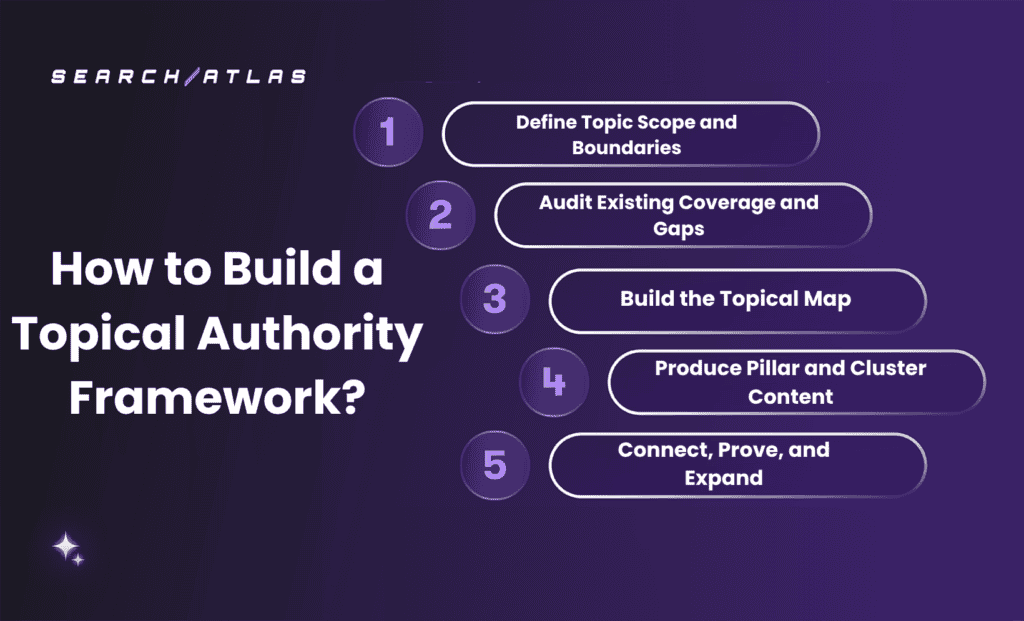
Topical authority is built by defining topic scope, auditing existing coverage, creating a topical map, producing pillar and cluster content, and expanding authority through proof signals. This process gives search engines and AI answer engines clear evidence that a website covers a subject deeply, accurately, and consistently.
The 5 steps to build a topical authority framework are listed below.
Stage 1: Define Topic Scope and Boundaries
Stage 2: Audit Existing Coverage and Gaps
Stage 3: Build the Topical Map
Stage 4: Produce Pillar and Cluster Content
Stage 5: Connect, Prove, and Expand
Stage 1: Define Topic Scope and Boundaries
Topic scope and boundaries define the exact subject area a website wants to own. This stage prevents broad, unfocused publishing and keeps content aligned with business goals, audience needs, and ranking opportunities. Topic scope defines the direction of the entire topical authority framework because every content decision connects back to this definition.
Topic scope matters because topical authority depends on depth within a defined subject. A website covering “marketing” competes across a broad field with unclear expertise signals. A website covering “B2B content marketing for SaaS companies” creates a focused semantic footprint that search engines interpret as stronger expertise.
Topic boundaries matter because search systems evaluate consistency across connected content. Topic drift weakens authority because unrelated pages scatter relevance signals across multiple entities and intents. Clear boundaries define what belongs inside the framework and what remains outside it, which protects semantic coherence.
How do topic scope and boundaries influence topical authority? Topic scope and boundaries influence topical authority by controlling semantic density, entity consistency, and internal relationships across content. A tightly scoped topic builds stronger connections between pages, which increases authority signals across search systems.
A strong topic scope starts with business relevance. The selected topic needs a direct connection to products, services, expertise, or customer problems. This connection ensures organic traffic aligns with revenue outcomes, which increases the long-term value of rankings.
A strong topic scope requires search demand. The core topic needs enough search volume to justify content investment. A topic with 1,000+ monthly searches creates sufficient demand for pillar pages and supporting clusters. This demand ensures the framework scales across multiple queries and intents.
A strong topic scope requires subtopic depth. The topic needs at least 8 to 15 meaningful subtopics that deserve individual pages. These subtopics create the foundation for a complete topical map and cluster structure. Without subtopic depth, the framework lacks the coverage required for authority.
A strong topic scope requires competitive viability. The topic needs realistic ranking entry points based on domain strength, content quality, and competitor coverage. Micro-niches often create faster wins because broad markets contain stronger incumbents with established authority.
Topic scope requires defining inclusions and exclusions. Inclusions define what topics belong inside the framework, while exclusions define what remains outside it. This distinction prevents dilution of authority signals and ensures every page contributes to the same semantic cluster.
Topic scope requires entity alignment. Each page needs to reinforce the same core entity through consistent terminology, concepts, and relationships. This alignment strengthens how search engines build knowledge graphs around the site.
A practical insight for defining topic scope is to start narrower than expected. Narrow topics build authority faster because every page reinforces the same entity, intent, and audience problem. Expansion happens after authority is established, not before.
Stage 2: Audit Existing Coverage and Gaps
A topical authority audit evaluates existing content against the target topic to identify strengths, gaps, overlaps, and underperforming pages. This audit shows what content contributes to authority and what content needs expansion, consolidation, or removal.
A topical audit matters because disconnected content fails to build authority. Many websites publish pages without a clear topic structure, which creates gaps, cannibalization, and orphan pages. The audit transforms scattered pages into a measurable content system aligned with the topical framework. A topical audit improves topical authority by identifying missing coverage, weak pages, and broken relationships between content pieces. This process strengthens semantic completeness and improves how search engines evaluate expertise.
The audit starts with a full URL inventory. Each indexed URL needs classification based on topic cluster, subtopic, content type, word count, last updated date, traffic data, and keyword performance. This inventory reveals which pages align with the framework and which pages exist without a strategic purpose.
The audit requires content gap analysis. Compare existing pages against top competitors, SERP patterns, and audience questions. This comparison identifies missing subtopics, weak coverage areas, and expansion opportunities. Competitor coverage reveals what search engines already expect within a topic.
The audit requires content quality evaluation. Each page needs enough depth to answer the primary query and related questions. Thin content, outdated examples, weak evidence, and generic explanations reduce authority signals. Strong pages provide detailed answers, examples, and actionable insights.
The audit requires internal link analysis. Pillar pages need links to cluster pages, cluster pages need links back to pillar pages, and related cluster pages need contextual links. Orphan pages weaken authority because crawlers cannot properly interpret or connect them to the topic.
The audit requires backlink relevance analysis. Relevant backlinks from niche sources strengthen topical authority more than unrelated links from broad domains. Context matters because authority signals depend on topic alignment, not just link quantity.
The audit identifies keyword cannibalization. Cannibalization occurs when multiple pages target the same query or intent. This overlap splits ranking signals and reduces performance. Each page needs a distinct purpose to avoid internal competition.
The audit produces a prioritized action plan. High-impact fixes include adding internal links, refreshing outdated pages, consolidating overlapping content, and expanding pages ranking in positions 11 to 20. These actions create immediate authority gains.
A practical insight for auditing coverage is to prioritize high-impact fixes first. Small structural improvements often produce faster ranking gains than creating new content without fixing existing issues.
Stage 3: Build the Topical Map
A topical map is the strategic blueprint that organizes topics, subtopics, keywords, entities, and internal links into a complete content plan. This map converts expertise goals into a structured roadmap for building topical authority.
A topical map matters because topical authority requires complete subject coverage. Search engines and AI answer engines evaluate relationships between pages, entities, and queries. The topical map defines these relationships before content production begins.
A topical map builds topical authority by organizing content into structured clusters that mirror real-world relationships between concepts. This structure improves semantic clarity and increases retrieval accuracy across search systems.
A topical map starts with a core topic. The core topic needs enough breadth to support 15 to 50 articles and enough focus to remain relevant to the business. This balance ensures scalability without losing semantic cohesion. A topical map requires audience research. Audience research identifies questions, pain points, objections, and knowledge levels. This research ensures content answers real user intent instead of targeting keywords in isolation.
A topical map requires keyword clustering. Keyword clustering groups related queries based on shared meaning and intent. This grouping prevents keyword cannibalization and ensures each page serves a unique purpose within the framework. A topical map requires content hierarchy. The hierarchy defines pillar pages, cluster hubs, and supporting articles. Pillar pages cover broad topics, cluster hubs organize major subtopics, and supporting articles answer specific questions. This hierarchy creates a clear semantic structure.
A topical map requires internal linking plans. Pillar pages link to clusters, clusters link back to pillars, and related pages link laterally where context overlaps. This structure distributes authority and reinforces relationships between content pieces. A topical map evolves. New queries, competitor content, and AI answer patterns create new subtopics. Regular updates ensure the map remains complete and aligned with search demand.
A topical map benefits from automation. Search Atlas generates structured topical maps using AI-driven clustering, entity relationships, and keyword mapping. These systems accelerate planning and improve accuracy across large content strategies.
A practical insight for topical mapping is to treat the map as a living system. Review the map quarterly, add missing questions, refresh outdated clusters, and expand areas where rankings or AI citations increase.
Stage 4: Produce Pillar and Cluster Content
Pillar and cluster content transforms the topical map into published pages that demonstrate expertise. This stage builds authority through structured, interconnected content that covers a topic completely. Pillar content matters because it acts as the central hub for the topic. A pillar page usually contains 2,000 to 4,000 words and explains the broad subject clearly. This page defines the topic and connects all related content.
Cluster content matters because it proves depth across subtopics. Each cluster page targets one query, one intent, or one subtopic. Strong cluster pages provide detailed answers with examples, evidence, and actionable steps. Pillar and cluster content build topical authority by creating a network of interconnected pages that cover a subject from multiple angles. This network demonstrates both breadth and depth of expertise.
The pillar-cluster model creates structured expertise. The pillar page provides the overview, while cluster pages provide detailed explanations. This structure helps search engines understand both the big picture and specific subtopics. Pillar pages require a strong structure. A pillar page needs a clear definition, logical sections, internal links, examples, and structured formatting. This structure improves readability and enables AI systems to extract information effectively.
Cluster pages require a unique intent. Each cluster page needs a distinct focus to avoid cannibalization. Pages targeting the same intent compete against each other and weaken ranking signals. Cluster pages require internal links. Every cluster page needs at least one contextual link back to the pillar page. Related cluster pages need lateral links where the topic relationship is relevant.
Content depth determines authority strength. Deep content includes examples, frameworks, comparisons, and data. Shallow content fails to demonstrate expertise and limits ranking potential. A practical insight for producing content is to prioritize depth over volume. Five high-quality cluster pages build stronger authority than dozens of shallow pages covering the same topic.
Stage 5: Connect, Prove, and Expand
Connecting, proving, and expanding transforms a content framework into a long-term authority system. This stage strengthens relationships, validates performance, and expands coverage based on real data. Connection matters because topical authority depends on relationships between pages. Internal links create a semantic graph that shows how content connects across a topic. This graph helps search engines interpret expertise.
Proof matters because authority requires validation. Metrics (keyword growth, organic traffic, backlinks, and AI citations) show whether the framework produces real results. Expansion matters because topics evolve. New queries, competitor content, and AI-generated answers create new opportunities. Expanding coverage keeps the framework relevant and competitive. This stage builds topical authority by reinforcing internal relationships, validating expertise through external signals, and continuously expanding content coverage.
E-E-A-T strengthens this stage. Author bios, citations, expert insights, and transparent sources increase credibility. These signals improve trust and increase the likelihood of selection in AI-generated answers. Schema markup strengthens this stage. Structured data defines entities, relationships, and page purpose. Schema improves how search engines interpret and display content. Refresh cycles maintain authority. Updating content ensures accuracy and relevance. Fresh content performs better in dynamic search environments and increases citation probability.
Expansion strategies focus on data. Pages ranking between positions 11 and 20 represent quick wins. Expanding these pages often leads to faster ranking improvements than creating new content. A practical insight for expansion is to validate before scaling. Build one complete cluster, measure performance, and expand based on results. This approach reduces risk and improves efficiency across the framework.
How Do You Build Topical Authority from Zero Using a Framework?
Topical authority from zero is built through structured topic selection, complete content coverage, internal linking, validation signals, and continuous expansion across a defined subject. This framework matters because new websites start without backlinks, historical trust, or ranking signals, which means authority needs to come from semantic structure, content depth, and consistency across interconnected pages.
Topical authority from zero works by creating a focused content system around one core topic and expanding that system into a complete semantic network of subtopics, entities, and relationships. This approach allows new websites to compete with established domains because search engines and AI systems prioritize coverage completeness, entity clarity, and contextual consistency over domain age or backlink volume.
How do new websites build topical authority without domain strength? New websites build topical authority without domain strength by covering a topic completely, structuring content into clusters, reinforcing relationships through internal linking, and maintaining consistency across all pages. This structured coverage signals expertise even when external trust signals remain limited.
Topical authority from zero is built by starting with a single, well-defined core topic that aligns with the product, service, or expertise area. This topic needs to be narrow enough to dominate but broad enough to support multiple subtopics and content pieces. A focused topic (B2B content marketing for SaaS companies) creates a clearer authority path than a broad topic (marketing) because every page reinforces the same entity, intent, and audience problem.
Topical authority from zero is built by mapping the entire topic before publishing content. This mapping process defines all subtopics, related questions, and semantic connections that belong to the topic. A complete map ensures no critical subtopic remains uncovered, which is essential because search engines evaluate whether a website answers the full range of questions associated with a subject.
Topical authority from zero is built by structuring content into a pillar-cluster architecture. A pillar page acts as the central hub that covers the main topic comprehensively, while cluster pages expand into specific subtopics with detailed explanations. This structure creates a semantic network that search engines interpret as expertise because the content mirrors real-world relationships between concepts.
Topical authority from zero is built by designing a strong internal linking system that connects all related pages. Pillar pages link to cluster pages, cluster pages link back to pillar pages, and related cluster pages link laterally where topics overlap. This linking structure distributes authority across the entire content system and reinforces relationships between pages, which improves crawlability and semantic clarity.
Topical authority from zero is built by prioritizing content based on search intent and ranking feasibility. Early content targets long-tail, low-competition queries that generate initial rankings and traffic. As authority grows, the framework expands into broader and more competitive queries. This progression allows new websites to build momentum instead of competing directly with established domains from the start.
Topical authority from zero is built by publishing consistently and refreshing content regularly. Consistent publishing reinforces topical signals, while content updates maintain accuracy and relevance. Search engines favor content that remains current, especially in fast-changing domains where outdated information reduces trust and visibility.
Topical authority from zero is built by integrating validation signals that prove expertise. Backlinks from relevant sources, mentions across the web, engagement metrics, and structured data all contribute to authority validation. These signals confirm that the content is comprehensive and recognized, and trusted within its topic.
Topical authority from zero is built by expanding coverage based on data and performance insights. Pages ranking between positions 11 and 20 represent immediate opportunities for improvement. Expanding these pages often produces faster ranking gains than creating entirely new content because the foundation already exists.
Topical authority from zero is built as a compounding system where each new page strengthens the entire framework. Every additional cluster page reinforces the pillar, every internal link strengthens relationships, and every update improves relevance. This compounding effect increases visibility, rankings, and AI citation probability across related queries.
Topical authority from zero succeeds when the system prioritizes depth, structure, and consistency instead of shortcuts or isolated optimizations. The practical deployment insight that remains consistent across successful implementations is to start with one narrow topic, build complete coverage, validate results, and expand systematically into adjacent areas.
How Do You Know When a Topic is Fully Covered?
A topic is never fully covered because coverage depends on depth, context, perspective, and evolving information rather than a fixed endpoint. Topic coverage matters because search engines and AI systems evaluate completeness across related questions, entities, and subtopics, not whether content reaches a final state.
A topic is not fully covered because new questions, use cases, and perspectives continue to emerge as users interact with content. A guide that answers 20 questions still leaves uncovered angles that future users search for. This expansion shows that coverage grows over time rather than reaching completion.
A topic is not fully covered because different audiences require different explanations, formats, and levels of depth. A beginner’s guide explains definitions and basics, while an advanced guide explains strategy, edge cases, and implementation details. This variation means multiple versions of the same topic remain necessary.
A topic is not fully covered because semantic relationships extend beyond initial subtopics into adjacent entities and related concepts. A page about “topical authority” connects to entities (internal linking, content clusters, semantic search, and entity recognition). This network expands continuously as new connections appear.
A topic is not fully covered because search intent evolves based on trends, tools, and user behavior. A topic that focused on keyword optimization in 2015 now requires coverage of AI search, entities, and semantic systems. This shift proves that coverage requires continuous updates rather than a static definition.
A topic is not fully covered because competing content introduces new data, examples, and interpretations that redefine completeness. A competitor publishes a new case study, dataset, or framework that adds missing context. This addition creates new gaps in existing content.
A topic is not fully covered because AI answer engines evaluate completeness differently from traditional search engines. AI systems compare multiple sources, extract overlapping facts, and prioritize sources that cover the widest range of related questions. This comparison rewards expanding coverage instead of static completeness.
A topic is not fully covered because content depth varies between surface-level summaries and deep, actionable explanations. A short article explains what a concept is, while a detailed guide explains how it works, why it matters, and how to implement it. This difference shows that depth defines coverage more than page count.
How do you know when coverage is strong instead of complete?
Coverage is strong when content answers the majority of relevant questions, connects related subtopics, and ranks across a wide set of semantically related queries. Strong coverage signals authority because search engines detect consistent relevance across multiple pages.
How do you identify gaps in topic coverage? Gaps appear when content fails to answer related questions, lacks depth in key sections, or does not connect to adjacent subtopics. Pages ranking outside the top 10 or missing long-tail queries often indicate incomplete coverage areas.
How do engagement signals reflect topic coverage quality? Engagement signals reflect coverage quality through time on page, scroll depth, and repeat visits. High engagement indicates that content satisfies user intent, while low engagement indicates missing explanations or weak structure.
How do semantic signals indicate coverage depth? Semantic signals indicate coverage depth through entity presence, contextual relationships, and topic consistency across pages. Content that mentions related entities and connects them logically shows stronger coverage than content focused on isolated keywords.
How do AI systems evaluate topic coverage? AI systems evaluate topic coverage by comparing content against multiple sources and selecting pages that provide consistent, structured, and comprehensive information. Pages that answer more related questions increase the probability of citation in AI-generated responses.
Can AI-Generated Content Build Topical Authority?
Yes. AI-generated content builds topical authority because authority depends on coverage, structure, and consistency across related topics, not content origin. AI-generated content matters because it accelerates topic expansion, identifies gaps, and organizes clusters that strengthen semantic coverage.
AI-generated content builds topical authority because AI systems generate topic clusters, subtopics, and keyword groupings at scale. A content plan created in minutes replaces manual research that takes days. This speed enables faster expansion across a topic, which strengthens coverage signals. AI-generated content builds topical authority because AI identifies missing questions, related entities, and semantic gaps within a topic. A cluster that covers 25 subtopics instead of 10 shows stronger topical depth. This expansion improves relevance across search systems and AI answer engines.
AI-generated content can build topical authority because AI supports consistent publishing across connected topics and structured frameworks. A site publishing 2 to 3 cluster articles weekly grows faster than inconsistent publishing. This consistency reinforces topical relationships across pages. AI-generated content cannot build strong topical authority alone because authority depends on originality, experience, and information gain. AI outputs repeat existing patterns and consensus knowledge without adding new insights. This limitation reduces differentiation across competitive topics.
AI-generated content builds topical authority when human validation transforms generated drafts into original, expert-level content. A rewritten article that adds case studies, data points, and real examples creates information gain. This transformation converts generic output into authoritative content. AI-generated content builds topical authority when combined with structured frameworks, internal linking, and continuous updates. A well-connected cluster with refreshed content and validated insights increases semantic completeness. This completeness improves visibility across search engines and AI systems.
How Do You Measure a Topical Authority Framework?
A topical authority framework is measured by evaluating coverage depth, semantic alignment, internal structure, and performance across a defined topic ecosystem rather than isolated keyword rankings. Measurement matters because topical authority emerges from consistent signals across multiple pages, entities, and queries, not from a single high-ranking URL or a limited keyword set. A framework that measures authority correctly reveals how completely a website covers a subject, how strongly pages connect semantically, and how effectively search engines and AI systems recognize that coverage as expertise.
A topical authority framework is measured because authority directly influences ranking speed, visibility, and traffic growth across clusters instead of individual pages. Pages within strong topical clusters gain traffic up to 57% faster than isolated pages because search systems interpret consistent coverage as expertise. A site that publishes 30 interconnected subtopics instead of 5 disconnected articles creates a measurable increase in ranking breadth, keyword coverage, and impressions. This difference shows why measurement focuses on cluster performance and topic-level visibility instead of single-page metrics.
A topical authority framework is measured because search engines evaluate topic completeness, entity relationships, and contextual consistency across all indexed pages within a domain. A website that connects pillar pages, topic clusters, and supporting articles through structured internal linking creates a clear semantic graph. This semantic graph signals how topics relate, which pages define concepts, and which pages expand subtopics. Measurement captures this structure through internal link distribution, crawl paths, and how often search engines revisit and index related pages together.
A topical authority framework is measured because AI systems evaluate multiple sources simultaneously and select content that provides the most complete and structured answers. AI answer engines compare content coverage across sources, extract overlapping facts, and prioritize pages that answer a wider range of related questions. A page that answers 12 related questions has a higher citation probability than a page that answers only 3. This evaluation makes measurement dependent on coverage breadth, semantic depth, and entity completeness rather than keyword density or backlink volume alone.
A topical authority framework is measured by defining a clear topic territory before tracking performance signals across content clusters. Topic territory includes core topics, subtopics, entities, and user questions mapped into a structured hierarchy. This hierarchy acts as the reference model for measurement because it defines what “complete coverage” is for a specific subject. Without this structure, measurement becomes fragmented and fails to capture whether content actually builds authority or simply generates isolated traffic.
A topical authority framework is measured by analyzing coverage gaps across the defined topic territory using competitor comparison, SERP analysis, and audience-driven queries. Gap analysis identifies missing subtopics, weak content areas, and underdeveloped clusters that reduce authority signals. A cluster missing 10 key subtopics compared to competitors indicates incomplete coverage and reduced ranking potential. This analysis transforms measurement into a system that identifies expansion opportunities rather than only reporting current performance.
A topical authority framework is measured by detecting content drift and semantic inconsistency across pages that belong to the same cluster or topic group. Content drift occurs when a page expands into unrelated subtopics or loses its original focus, which weakens entity clarity and reduces ranking consistency. A page initially focused on “technical SEO for SaaS” that expands into general marketing concepts loses topical precision. Measurement captures this drift through semantic comparison, query mismatch, and declining rankings for the original intent.
A topical authority framework is measured by evaluating AI citation readiness and visibility across AI-driven search environments and answer engines. AI citation readiness measures whether content appears in responses from systems (ChatGPT and Perplexity AI). This measurement reflects a new layer of authority because AI systems select sources based on completeness, clarity, and trust signals. A topic with high AI visibility indicates strong semantic alignment and structured knowledge representation.
A topical authority framework is measured by calculating topic share across keyword clusters and comparing traffic distribution against competing domains within the same topic. Topic share reflects how much of the total search demand a domain captures within a defined subject area. A domain capturing 25% of topic-level traffic demonstrates stronger authority than a domain capturing 8%. This metric connects content coverage directly to market share within search results, making it a key authority indicator.
A topical authority framework is measured by calculating the topical authority ratio, which compares the number of pages dedicated to a specific topic against the total indexed pages. A website with 90 pages focused on a single topic out of 100 total pages shows strong topical concentration. A website with only 20 relevant pages out of 200 total pages shows diluted focus. This ratio quantifies how strongly a site aligns with a specific subject, which directly impacts perceived expertise.
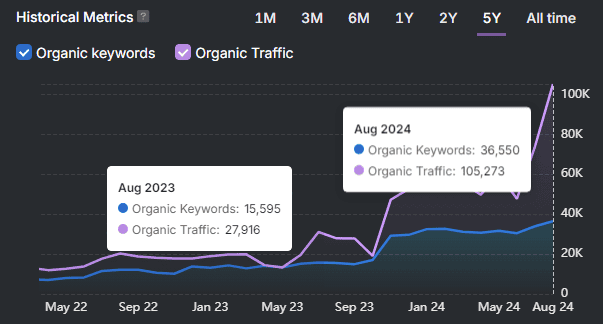
A topical authority framework is measured by tracking ranking breadth across a wide set of semantically related keywords rather than focusing on a small set of primary keywords. Ranking breadth reflects how many queries a cluster covers and how consistently pages rank across those queries. A cluster ranking for 300 related queries signals stronger authority than a cluster ranking for 40. This breadth indicates that search engines associate the domain with the entire topic rather than isolated keywords.
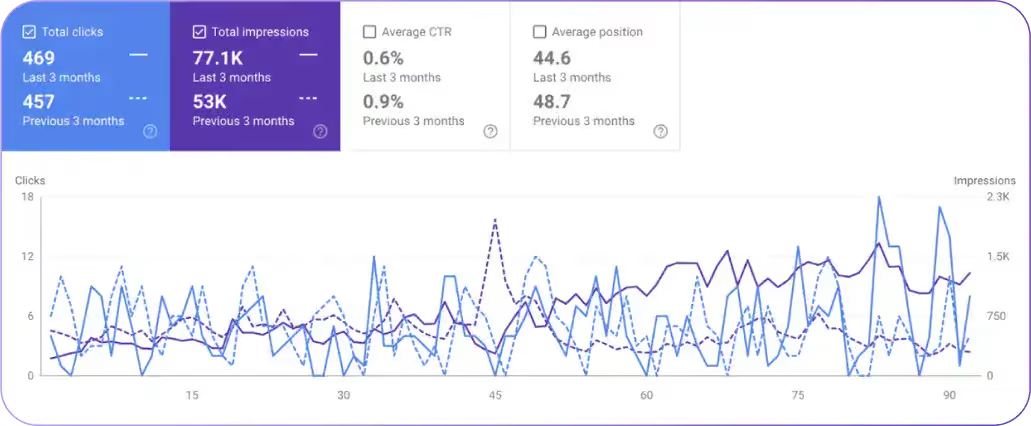
A topical authority framework is measured by tracking organic traffic growth across clusters instead of individual pages to capture the cumulative effect of topical coverage. Traffic growth across multiple interconnected pages signals that search engines recognize the domain as a trusted source for the topic. A cluster that grows from 1,000 to 5,000 monthly visits demonstrates increasing authority because multiple pages contribute to the same topic ecosystem.
A topical authority framework is measured by analyzing engagement signals (time on page, scroll depth, pages per session, and return visits) across topic clusters. High engagement indicates that content satisfies user intent and provides complete answers, which reinforces authority signals. Low engagement indicates missing explanations, weak structure, or incomplete coverage, which reduces authority despite traffic levels.
A topical authority framework is measured by validating backlink relevance within the same topic rather than focusing only on backlink volume or domain-level authority. Backlinks from contextually relevant domains strengthen topical authority because they reinforce the same subject area. A SaaS-focused backlink profile strengthens SaaS-related authority more effectively than unrelated backlinks from general domains. This alignment makes backlink measurement dependent on topic relevance rather than raw link count.
Search Atlas measures topical authority through a specialized framework that evaluates semantic coverage, entity relationships, and consistency across content clusters rather than relying only on backlinks or keyword rankings. The Search Atlas platform includes the Topical Dominance inside Site Explorer, which calculates a 0 to 100 score based on content volume, topical relevance, and cluster consistency. The SCHOLAR system evaluates semantic depth, entity flow, and alignment with quality standards, which provides a structured way to measure how well content matches search engine expectations.
A topical authority framework fails measurement when content remains disconnected, shallow, or inconsistent across clusters because search systems cannot identify clear relationships or expertise signals. Disconnected pages weaken semantic graphs, thin content reduces depth, and inconsistent linking breaks topic structure. These failures create misleading performance signals because traffic and rankings do not reflect true authority across the topic.
A topical authority framework improves measurement accuracy through continuous tracking, iterative updates, and structured expansion based on data-driven insights across clusters. Measurement reveals gaps, updates improve semantic coverage, and expansion increases authority over time. The practical insight is to measure topical coverage continuously, expand strategically based on gaps, and validate authority through rankings, traffic growth, and AI visibility signals across the entire topic ecosystem.
Does Topical Authority Guarantee Rankings?
No, topical authority does not guarantee rankings because rankings depend on multiple factors beyond coverage, relevance, and expertise across a topic. Topical authority matters because it strengthens semantic relevance, improves coverage, and increases visibility, but it does not override technical SEO, backlinks, or competition.
Topical authority does not guarantee rankings because search engines evaluate multiple ranking signals, not a single authority metric. A site with strong topic coverage still loses rankings if technical issues block crawling or indexing. This dependency shows that authority needs proper infrastructure to translate into rankings.
Topical authority does not guarantee rankings because backlinks and external validation remain critical ranking signals across competitive queries. A well-structured cluster without relevant backlinks struggles against competitors with strong link profiles. This imbalance shows that authority within a topic still requires external trust signals.
Topical authority does not guarantee rankings because competition level influences ranking outcomes even with strong coverage and depth. A niche site covering 20 subtopics outranks larger sites in low-competition queries, but struggles in high-competition markets. This difference explains why authority works best within realistic competitive boundaries.
Topical authority does not guarantee rankings because content quality, originality, and information gain determine whether pages outperform competitors. A cluster that repeats existing information fails to rank against content with original data or unique insights. This limitation shows that depth alone does not replace differentiation.
Topical authority does not guarantee rankings because internal linking and site structure control how search engines interpret relationships between pages. A cluster without clear pillar connections weakens semantic signals and reduces ranking strength. This structure shows that authority depends on how content connects, not only what content exists.
Topical authority does not guarantee rankings because search systems interpret authority as a combination of relevance, trust, and usability signals. Engagement metrics, page experience, and content clarity influence rankings alongside coverage. This combination explains why authority needs supporting signals to perform.
Topical authority does not guarantee rankings because it often reflects a reorganization of existing ranking principles (relevance and authority) rather than a new standalone factor. Search systems have evaluated topical relevance and expertise for over a decade. This continuity shows that topical authority strengthens existing signals instead of replacing them.
Topical authority improves ranking probability when combined with technical SEO, backlinks, structured content, and consistent updates across clusters. A site with strong coverage, strong links, and clear structure ranks more consistently than a site relying on one factor alone. This combination shows how authority contributes to rankings without guaranteeing them.
Topical authority ultimately increases the likelihood of rankings rather than guaranteeing them because search engines evaluate complete systems, not isolated strategies. The practical insight is clear is to build topical authority as a core layer, then reinforce it with links, structure, and performance signals to achieve consistent ranking outcomes.