The primary alternatives to SpyFu include 16 distinct platforms, with Search Atlas, SEMRush, and Ahrefs identified as leading competitors. Search Atlas offers superior value, including all features in its base price, advanced AI placement data without additional costs, and link-building capabilities described as being on a “completely different level.” SEMRush, an all-in-one digital marketing suite, scored 19/20 in SEO Tools & Features compared to SpyFu’s 15/20, has a 27.8 billion keyword database (vs. SpyFu’s 13 billion), and a backlink database of 808 million domains (vs. SpyFu’s 125 million). Ahrefs, a core SEO functionality tool, is recognized for its massive backlink index and fast web crawler.
Users seek alternatives due to SpyFu’s perceived cost, lack of advanced features, and accuracy concerns. SpyFu’s plans range from $39 to $299 per month, with its keyword database being significantly smaller than SEMRush’s and its backlink database considerably smaller than Ahrefs’ estimated 35 trillion links indexed. SE Ranking, an affordable alternative, has attracted over 1,500,000 users and offers a wider range of functions, with its Essential plan starting at $33/month. Moz Pro demonstrates higher accuracy for organic search results and keyword rank tracking, with annual plans starting at $39/month.
Specialized alternatives include iSpionage, focusing on PPC campaign tracking with a 92,000,000 keyword base, and BrightEdge, an enterprise SEO platform with a 0.51% market share (vs. SpyFu’s 0.16%) and serving over 1,880 customers (vs. SpyFu’s 608). Scalenut specializes in AI-powered content creation, with plans starting at $19/month. Google’s Keyword Planner offers free keyword research, while Majestic and KeywordSpy serve similar market segments, with Majestic holding a 0.16% market share and KeywordSpy covering 32 countries for international PPC research. SEO PowerSuite, a comprehensive desktop solution, offers unlimited keyword tracking and a Professional plan at $29.10/month.
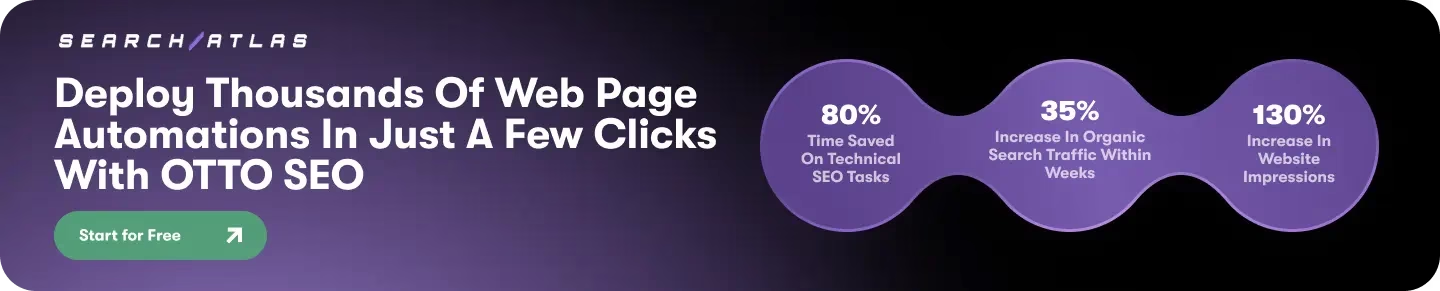
What are the SpyFu Alternatives?
The primary alternatives to SpyFu are listed below.
- Search Atlas (AI-powered SEO Automation)
- SEMRush (SEO Tool)
- Ahrefs (SEO Tool)
- SE Ranking (SEO Tool)
- Serpstat (SEO Tool)
- Moz Pro (SEO Tool)
- Similarweb (Traffic Intelligence Tool)
- iSpionage (PPC Campaign Tracking Tool)
- BrightEdge (Enterprise SEO Platform)
- Mangools (SEO Tool)
- Scalenut (AI Writing and Optimizing Tool)
- Click Insights (Advanced SEO Solution)
- Google’s keyword planner (Keyword Research Tool)
- Majestic (Backlink Analysis Tool)
- KeywordSpy (International Research Tool)
- SEO PowerSuite
1. Search Atlas
Search Atlas is the best SpyFu alternative because it offers superior value with all features included in the base price, provides advanced AI placement data without extra costs, features link-building capabilities on a completely different level, delivers impressive SEO admin automations and content writer capabilities, and offers a broader range of comprehensive features than competitors.
How does Search Atlas offer superior value? Search Atlas is described as the “most value-packed SEO tool” by users, leading one to cancel Ahrefs after 10 years. Unlike SEMRush, which charges for individual features, Search Atlas includes all functionalities in its base price. To match Search Atlas’s capabilities, Ahrefs would cost over $1,000 per month, and a bundled SEMRush solution would likely exceed Search Atlas’s highest tier of $399 per month.
Why is Search Atlas’s AI placement data superior? Search Atlas displays all AI placements at no additional cost and with no restrictions. Competitors like Ahrefs and SEMRush charge astronomically for this data, making Search Atlas a more accessible option for tracking AI visibility across platforms like ChatGPT, Claude, and Gemini.
What makes Search Atlas’s link-building capabilities advanced? Search Atlas’s link-building is described as being on a “completely different level” compared to alternatives. It allows for in-software contact and integrates with “Link Laboratory,” simplifying the outreach process for users.
How do Search Atlas’s SEO admin automations and content writer features enhance its value? The SEO admin automations work as advertised, offering full automation or manual control. Its AI generation feature for suggested fixes is highly valued, with suggestions generally following SEO best practices and capable of solving “years of issues in minutes.” The Content Writer (Content Genius/OTTO) is impressive, simplifying the content workflow from keyword research to brief generation, drafting, and optimization, saving significant time with AI-powered briefs and bulk writing.
What comprehensive features does Search Atlas offer? Search Atlas provides a broader range of features included in its base price, such as geo-grids for local rankings, backlink analysis, keyword research, on-page optimization, ranking tracking, competitor analysis, content generation, topical map generator, and PPC management. This comprehensive suite addresses diverse SEO needs, making it a reliable all-in-one platform.
2. SEMRush
SEMRush is a SpyFu alternative because SEMRush offers a broader all-in-one digital marketing suite compared to SpyFu’s specialized focus. SEMRush provides a more extensive feature set with higher scores in SEO tools. SEMRush targets larger organizations and SEO experts with enterprise-level features. SEMRush excels in keyword research with more accurate data and a larger database, and SEMRush dominates in backlink analysis with a significantly larger database and auditing tools.
How does SEMRush’s broader suite contribute to its alternative status? SEMRush is an “all-arounder” SEO tool, offering SEO, PPC, social media, and content marketing analysis, making it an “all-around better tool for digital” according to one commenter. This contrasts with SpyFu’s more specialized focus on competitive analysis and PPC research. SEMRush is highlighted as one of the only genuine all-in-one digital marketing platforms, supporting various functions from SEO software for agencies to full-stack marketing departments.
Why is SEMRush’s extensive feature set a significant differentiator? SEMRush scored 19/20 in SEO Tools & Features, while SpyFu scored 15/20. SEMRush gained an edge due to its technical auditing capabilities, detecting over 130 different technical and SEO mistakes, and a backlink auditing tool, features that SpyFu lacks. SEMRush offers an extensive toolset across SEO, PPC, social media, and content marketing, including expansive keyword databases, backlink tools, competitor tracking, and auditing capabilities.
What makes SEMRush’s target audience relevant to its alternative positioning? SEMRush is most suitable for teams needing a full marketing suite, including paid ads, content planning, and social reporting, fitting well into SEO software for business setups that require multiple tool types in one platform. It is best for SEO experts, SEO agencies, and large organizations, whereas SpyFu is often recommended for SEO beginners, SEO freelancers, and small businesses.
How does SEMRush’s keyword research capability establish it as an alternative? SEMRush offers more accurate keyword difficulty calculations (e.g., “SEO Tools” difficulty: 92 vs. SpyFu’s 55), includes a search intent metric (e.g., Commercial intent), and provides more keyword ideas and questions than SpyFu. SEMRush’s keyword database contains 27.8 billion keywords compared to SpyFu’s 13 billion, and it typically returns a larger number of keyword suggestions with six additional pieces of data, while SpyFu provides only three.
Why is SEMRush’s backlink analysis superior? The SEMRush Review highlights that it has a significantly larger backlink database with 808 million domains compared to SpyFu’s 125 million. Tests showed SEMRush comprehensively beat SpyFu in surfacing backlinks for various websites. SEMRush provides more detailed backlink reports, including breakdowns of dofollow vs. nofollow links, country of origin, anchor text, new vs. lost domains, and linking domain types, while SpyFu’s reporting is described as “extremely basic.” SEMRush also offers a ‘backlink auditing’ tool to identify ‘toxic’ links and a ‘link building’ tool for managing outreach, which SpyFu lacks.
3. Ahrefs
Ahrefs is a SpyFu alternative because both offer core SEO functionality for improving search rankings, both provide keyword research and difficulty analysis for strategic planning, both include competitor analysis and insights into market strategies, and both feature backlink tracking and link metrics for understanding domain authority.
How do both tools offer core SEO functionality? Both Ahrefs and SpyFu are popular SEO tools designed to help marketers, agencies, and businesses improve search rankings, analyze competitors, and drive organic traffic. This shared foundational purpose makes them direct alternatives for users seeking to enhance their overall SEO performance.
Why is shared keyword research significant? Both Ahrefs and SpyFu offer keyword research and difficulty analysis, which matters for identifying profitable keywords and understanding the competitive landscape. Ahrefs uses AI for keyword analysis and offers free AI tools, while SpyFu focuses on uncovering profitable keywords, making them interchangeable for this core task.
What makes their competitor analysis a key alternative feature? Both platforms provide competitor analysis and competitive insights, allowing users to understand competitor strategies. SpyFu specifically focuses on competitor research and keyword intelligence, providing detailed insights into competitors’ organic and paid search strategies and PPC campaigns. Ahrefs is also reliable for competitive research and large-scale audits.
How does backlink tracking contribute to their alternative status? Both Ahrefs and SpyFu include backlink tracking and link metrics, essential for understanding a website’s authority and link profile. The Ahrefs Review highlights that it is known for its massive backlink index and fast web crawler, consistently capturing the highest number of referring domains and updating its index multiple times per day. While SpyFu has a smaller index, it still offers this core functionality.
4. SE Ranking
SE Ranking is a SpyFu alternative because it offers a wider range of functions at a more affordable price, it is an all-in-one SEO platform compared to SpyFu’s specialization, it has seen significant user adoption with over 1,500,000 users, it provides superior keyword research capabilities, it includes comprehensive site audit and technical SEO tools, and it offers reliable content marketing features.
How does SE Ranking’s affordability and wider functions make it an alternative? SE Ranking is implied to be more affordable than SpyFu, with its Essential plan starting at $33/month compared to SpyFu’s Basic plan at $39/month. SE Ranking also offers a wider range of functions, making it a cost-effective solution for small to medium-sized businesses, freelancers, and digital marketing agencies.
Why is SE Ranking’s all-in-one nature a key differentiator? SE Ranking functions as an all-in-one SEO platform, providing a comprehensive suite of tools. In contrast, SpyFu specializes primarily in competitor analysis. This broader functionality makes SE Ranking a more versatile option for users seeking a single platform for various SEO needs.
What evidence supports SE Ranking’s user adoption and growth? To date, over 1,500,000 users have either joined SE Ranking or switched from another SEO platform, indicating strong market acceptance and growth since its launch in 2014. This demonstrates its appeal as a viable alternative in the SEO tool market.
How do SE Ranking’s keyword research capabilities compare? SE Ranking offers comprehensive keyword research data, including search volume, difficulty, and related keywords, and tracks rankings across multiple search engines and locations. It is described as a “far superior device for keyword research” compared to SpyFu, which excels more in competitive keyword research.
Why are SE Ranking’s site audit and technical SEO tools significant? SE Ranking provides a comprehensive tool for identifying technical SEO issues, on-page errors, and overall site health, offering actionable recommendations. SpyFu, while strong in competitive analysis, has only basic site audit capabilities, making SE Ranking a better choice for in-depth technical SEO.
What makes SE Ranking’s content marketing tools a valuable alternative? SE Ranking includes reliable content marketing tools such as topic research, optimization recommendations, brief generation, publishing, and CMS management. SpyFu has limited capabilities in this area, focusing instead on keyword and competitor analysis, positioning SE Ranking as a more complete solution for content strategy.
5. Serpstat
Serpstat is a SpyFu alternative because it offers comprehensive all-in-one capabilities with over 30 tools, provides budget-friendly pricing starting at $50/month, includes API access at lower tiers which typically costs extra, features a clean and intuitive user interface that is much cleaner than SpyFu’s, and has a broader keyword research scope with access to over 7 billion keywords across 230 countries.
How do Serpstat’s comprehensive capabilities make it an alternative? Serpstat provides over 30 tools for SEO and PPC, covering whole site analysis, competitor analysis, semantics collection, backlink checks, audits, clustering, and daily rank tracking. This makes it a one-stop SEO solution with over 15 main tools, each having multiple features, reducing the need for multiple subscriptions.
Why is Serpstat’s budget-friendly pricing a key differentiator? Serpstat is best known for its affordability, with an Individual plan priced at $50/month (according to one source) or $69/month (according to another source). This makes it a more economical option compared to SpyFu’s general pricing, which starts at $39/month for a basic plan but has fewer limits on its Pro plan at $79/month. Serpstat’s Pricing Value Rating is 5/5, indicating its strong value proposition.
What makes API access a unique advantage for Serpstat? Serpstat uniquely includes API access at its lower tiers, a feature that typically incurs additional costs with other providers. This allows users to integrate Serpstat’s data and functionalities into their own systems or workflows without extra expense.
How does Serpstat’s user interface compare to SpyFu’s? Serpstat’s dashboard is clean and organized, with a UI designed to be intuitive for both beginners and experienced SEO professionals. Users describe it as “much cleaner than SpyFu’s,” which prioritizes simplicity but can feel less organized. Serpstat has a User Experience Rating of 4/5.
Why is Serpstat’s keyword research scope broader than SpyFu’s? Serpstat offers access to over 7 billion keywords and 4.5 billion keyword suggestions across 230 countries. This provides a significantly broader reach compared to SpyFu’s coverage, which focuses on Google US and 19 other international markets. Serpstat’s Global Coverage Rating is 4/5.
6. Moz Pro
Moz Pro is a SpyFu alternative because it offers a comprehensive suite of SEO tools for organic search, provides actionable insights with a user-friendly interface, demonstrates higher accuracy for organic search results and keyword rank tracking, maintains a balanced toolset covering content, offsite, and technical SEO, focuses on a higher quality link database, and offers a free trial with competitive annual pricing starting at $39/month.
How does Moz Pro’s comprehensive suite of tools position it as an alternative? Moz Pro provides a full range of SEO functionalities, including a keyword explorer, rank tracking, site audits, and link-building tools. This comprehensive offering allows users to manage and improve organic search performance across various aspects, making it a direct competitor to SpyFu’s shared SEO features like keyword research and competition analysis.
Why are actionable insights and a user-friendly interface significant? Moz Pro is highlighted for its user-friendly interface and its ability to provide actionable insights for organic SEO. This focus on usability and practical guidance helps users effectively implement SEO strategies, contrasting with SpyFu’s strength in raw PPC data, which can be more complex to interpret for organic purposes.
What evidence supports Moz Pro’s higher accuracy for organic search and keyword rank tracking? User research indicates Moz Pro is “more accurate for organic search results” compared to SpyFu. Initial cross-checking by users found Moz Pro “better” for keyword rank tracking accuracy, with keywords ranking 1-5 in Moz showing as 20-50+ in SpyFu. A test with RankTracker (SEO Powersuite) aligned more closely with Moz Pro’s results, further validating its accuracy. Moz Pro’s rank tracking uses SERP grabs for its calculations and allows for a global, national, and local breakdown of results.
How does Moz Pro’s balanced toolset contribute to its alternative status? Moz Pro is described as a “good, balanced toolset covering content, offsite, and technical SEO considerations.” This complete approach to SEO, including a focus on content, makes it a strong alternative to SpyFu, which is considered more of a “niche” SEO tool focused on competitor analysis and less on in-depth site audits.
Why is Moz Pro’s link database a key differentiator? While its link database is “smaller than Ahrefs/mMajestic,” it is “getting larger all the time” and focuses on “higher quality links and less ‘noise’.” This emphasis on quality over sheer volume provides a different approach to backlink analysis compared to SpyFu’s smaller backlink database.
What are the practical benefits of Moz Pro’s pricing and trial? Moz Pro offers a free trial, allowing users to evaluate its capabilities before committing. Its annual plans start at $39/month, with the Medium plan costing $143/month, providing competitive pricing options for a comprehensive SEO suite.
7. Similarweb
Similarweb is a SpyFu alternative because it offers broader market and competitive intelligence across 100 million websites and apps, provides more comprehensive traffic source analysis, including social media and email, delivers deeper audience demographic insights, and uses AI capabilities for real-time trend analysis.
How does Similarweb provide broader market and competitive intelligence? Similarweb offers a comprehensive view of the entire digital world, covering over 100 million websites and apps. It provides broad website traffic analytics and allows for competitive benchmarking against up to 100 competitors to understand market share. This contrasts with SpyFu’s primary focus on competitor SEO/PPC strategies and Google search data.
Why is comprehensive traffic source analysis a key differentiator? Similarweb pinpoints traffic from diverse sources, including direct visits, search, social media, referrals, email, and display ads. It also analyzes competitors’ marketing mix, audience engagement, PPC, and display creatives. This extensive data collection, covering 5 billion search terms and 250 million display ads, provides a more complete understanding of digital performance than SpyFu’s Google-centric approach.
What makes Similarweb’s audience demographic insights more reliable? Similarweb provides detailed insights into visitor age, gender, location, and interests, offering a deeper understanding of consumer behavior. This allows businesses to segment audiences and tailor strategies more effectively. SpyFu, while strong in keyword strategies, does not offer this level of audience demographic detail.
How do Similarweb’s AI capabilities enhance its alternative status? Similarweb uses AI agents and AI traffic monitoring for real-time insights, including an AI SEO Strategy Agent, AI Brand Visibility, AI Trend Analyzer, and AI Chatbot Traffic tool. This AI integration provides actionable market insights and identifies emerging trends in the competitive landscape, offering advanced analytical power beyond SpyFu’s core SEO/PPC focus.
8. iSpionage
iSpionage is a SpyFu alternative because it offers specialized PPC campaign tracking for Google Ads and Bing Ads, provides outstanding landing page analysis with galleries, includes unique metrics like Keyword Effectiveness Index (KEI) and Ad Effectiveness Index (AEI), features an SEM Watch Campaign for competitor monitoring, and maintains a larger keyword base of 92,000,000 keywords.
How does iSpionage’s specialized PPC focus make it an alternative? iSpionage is primarily known for its “super niche” focus on PPC Campaign Tracking, making it ideal for users who “live and breathe PPC.” While SpyFu offers comprehensive SEO and PPC data, iSpionage’s dedicated tools for PPC competitor tracking on Google Ads and Bing Ads, alongside content performance intelligence, provide a targeted alternative for advertisers.
Why is iSpionage’s landing page analysis a significant differentiator? iSpionage offers “outstanding landing page information with galleries,” providing access to millions of landing pages. This feature allows users to “catch a competitor testing new landing pages before they even started scaling the campaigns,” a capability SpyFu does not offer, as SpyFu does not provide landing page screenshots.
What makes iSpionage’s unique metrics valuable? iSpionage provides proprietary metrics such as the Keyword Effectiveness Index (KEI) and Ad Effectiveness Index (AEI). These specialized indices offer deeper insights into campaign performance and competitor strategy, which are not available in SpyFu’s feature set, enhancing iSpionage’s analytical depth for PPC specialists.
How does the SEM Watch Campaign enhance competitor monitoring? iSpionage features an SEM Watch Campaign that monitors competitor strategy changes and delivers weekly reports. These reports include updates on landing pages, SEM performance, A/B test results, funnel campaigns, and SERP snapshots. SpyFu does not offer a comparable dedicated campaign monitoring feature, providing iSpionage users with proactive competitive intelligence.
Why is iSpionage’s keyword base a competitive advantage? iSpionage has a keyword base of 92,000,000 keywords, significantly larger than SpyFu, which has “Nothing Specified” for its keyword count. This extensive keyword database allows iSpionage to provide broader and potentially deeper insights into keyword strategies for PPC campaigns, despite SpyFu having a larger domain base of 77,000,000 domains compared to iSpionage’s 17,000,000.
9. BrightEdge
BrightEdge is a SpyFu alternative because it holds a significantly larger market share in SEO and SEM (0.51% vs. 0.16%), serves a customer base over 3 times larger (1,880 vs. 608 customers), offers advanced AI-powered automation with a 5/5 rating, provides comprehensive enterprise reporting with executive dashboards, and delivers high-quality data with 5/5 accuracy and strong international capabilities (5/5 global coverage).
How does BrightEdge’s market share and customer base position it as an alternative? BrightEdge commands a 0.51% market share in the SEO and SEM category, significantly outpacing SpyFu’s 0.16%. This larger market presence is reflected in its customer count, with BrightEdge serving 1,880 customers compared to SpyFu’s 608. BrightEdge also ranks 8th in customer count within the SEO and SEM category, while SpyFu is 12th, indicating a more established and widely adopted solution for search marketing needs.
Why is BrightEdge’s AI-powered automation a key differentiator? BrightEdge is recognized for its industry-leading AI-powered automation, receiving a 5/5 rating for AI Automation. This includes AI-powered recommendations that automatically prioritize fixes based on business impact, AI-powered keyword research for massive datasets, and advanced workflow automation to reduce manual tasks for large teams. This level of automation helps enterprise teams manage hundreds of websites and thousands of keywords across multiple markets.
What makes BrightEdge’s reporting and data quality superior? BrightEdge offers reliable enterprise reporting with executive dashboards and departmental performance metrics, providing stakeholders with clear insights. Its Data Cube provides metrics on keywords driving traffic and identifies significant topics for SEO planning, offering insights into both users’ and competitors’ website performance. BrightEdge is also rated 5/5 for Data Accuracy and 5/5 for Global Coverage, ensuring high-quality, comprehensive data for international markets.
How does BrightEdge’s feature set compare? BrightEdge provides unique features like Instant Keyword Searching Speed, which uses AI to provide useful keywords and create important topics in real-time, helping users analyze “winning percentages.” Its Storybuilder feature creates customized dashboards and charts to indicate traffic attracted by search engines and conversion rates based on capital injected. BrightEdge also offers no page count limit for SEO auditing and custom integrations with enterprise marketing stacks and CRM systems.
Why is BrightEdge’s target audience and scalability relevant? While BrightEdge aims at both small and large businesses, it is best known for Enterprise AI Automation, targeting enterprise teams managing hundreds of websites. Its scalable architecture is designed for large organizations, handling thousands of keywords across multiple markets. This focus on large-scale SEO management and its ability to handle complex SEO tasks make it a comprehensive alternative for businesses with extensive needs.
10. Mangools
Mangools is a SpyFu alternative because it offers a more affordable pricing structure with plans starting at $29.90/month compared to SpyFu’s $39/month, users rate Mangools higher at 4.5 stars versus SpyFu’s 4.0 stars (SoftwareSuggest, February 2026), its user-friendly design is described as “incredibly user-friendly, powerful, and easy-to-navigate” (Beyond SpyFu), it provides a distinct focus on long-tail keyword research and SERP analysis, and it avoids the negative corporate culture perceptions associated with SpyFu’s CEO (peterwhitefanclub, 1/27/2026).
How does Mangools’ pricing structure make it a viable alternative? Mangools’ Basic plan is $29.90/month, significantly lower than SpyFu’s Basic plan at $39/month. For more advanced needs, Mangools’ Premium plan is $44.90/month, while SpyFu’s Professional plan is $79/month (SEOmator). This affordability makes Mangools a strong option for users seeking a “small budget tool” without compromising on a “comprehensive suite of tools.”
Why do user ratings indicate Mangools as a superior alternative? Mangools holds a user rating of 4.5 stars, based on “verified & unbiased user reviews,” while SpyFu is rated 4.0 stars (SoftwareSuggest, February 2026). One user explicitly stated, “I haven’t tried Mangools, but it can’t possibly be worse,” implying a strong negative sentiment towards SpyFu and a perception of Mangools as a better option.
What makes Mangools’ user-friendly design a key differentiator? Mangools is known for its intuitive, user-friendly design, making it accessible for both beginners and experienced professionals. It is described as “incredibly user-friendly, powerful, and easy-to-navigate” (Beyond SpyFu), appealing to users who want to uncover keyword opportunities “without complex interfaces.” This contrasts with the implied complexity or difficulty of other tools.
How does Mangools’ feature focus differentiate it from SpyFu? While both offer keyword research and competitor analysis, Mangools specifically focuses on long-tail keywords for research and provides SERP Analysis to understand competitiveness. It also offers Site Audits for SEO health, on-page SEO, backlink profile, social media, and competitive performance, appealing to users whose main goal is uncovering keyword opportunities.
Why does corporate culture contribute to Mangools being an alternative? A user described SpyFu as “awful” and “a complete joke,” citing negative corporate culture, including the CEO reportedly making employees “work with their cameras on all day” (peterwhitefanclub, 1/27/2026). This negative perception of SpyFu’s company culture can drive users to seek alternatives like Mangools, which is perceived as a “breath of fresh air for those who appreciate simplicity and effectiveness.”
11. Scalenut
Scalenut is a SpyFu alternative because it specializes in AI-powered content creation rather than broad SEO/PPC research, offers advanced content optimization features like a “fix-it” button and NLP terms, provides a user-friendly interface contrasting with SpyFu’s “clunky” description, addresses accuracy concerns for specific regions like the UK, and presents a competitive pricing structure with plans starting at $19/month.
How does Scalenut’s specialization differentiate it? Scalenut focuses on AI writing assistance and content optimization, linking with Google Search Console for traffic and ranking visibility. It functions as an AI-powered content management platform for SEO and content marketing strategy, emphasizing content creation, planning, and optimization. In contrast, SpyFu is a comprehensive SEO and PPC research tool, providing data on competitors’ search engine strategies, with a focus on competitor keywords, PPC research, and backlink outreach.
Why are Scalenut’s advanced content optimization features significant? Scalenut offers a Content Optimizer that grades content and provides suggestions with a “fix-it” button, a Keyword Planner for topical authority and keyword grouping, and an SEO Content Editor utilizing NLP for real-time scores and keyword density. It also includes Cruise mode for AI-generated first drafts and a Traffic Analyser for website performance insights, including top gainers/losers and device distribution. These features are not explicitly listed for SpyFu.
What makes Scalenut’s user interface a compelling alternative? Scalenut is described as having a user-friendly interface and intuitive features, which is a direct contrast to SpyFu’s interface, which has been described as “a bit clunky.” Users like solopixels signed up for Scalenut specifically for its AI writing assistance and optimization capabilities, indicating a preference for its usability.
How does Scalenut address accuracy concerns? Users have expressed that they are “not totally convinced about the accuracy of SpyFu,” particularly for UK search regarding keyword volume and difficulty. While the text does not explicitly state Scalenut’s accuracy for UK search, its focus on content optimization and direct integration with Google Search Console suggests a more direct approach to content performance metrics, potentially mitigating such concerns.
Why is Scalenut’s pricing structure competitive? Scalenut offers plans starting at $19/month (Essential Plan), with other plans at $39/month (Small Business Growth Plan) and $74/month (Pro Plan). While one source states both Scalenut and SpyFu start at $39/month, SpyFu’s pricing includes a Basic plan at $39/month, a Professional at $9/month or $49/month, and Team at $79/month. Scalenut’s lower entry-level price point of $19/month makes it a more accessible alternative for users seeking cost-effective solutions.
12. Click Insights
Click Insights is a SpyFu alternative because it offers modern search analysis capabilities addressing AI-driven search evolution, provides a simplified user experience for diverse skill levels, includes key features not found in SpyFu, delivers advanced reporting and integration options, and focuses on digestible, real-time data over bloated toolkits.
How does Click Insights address modern search analysis limitations? Click Insights features LLM rank visibility tracking, competitor insights, and SERP change alerts, which SpyFu lacks. It incorporates a modern keyword rank tracker for daily performance monitoring and dedicated modules to understand how new search formats reshape visibility. Its AI Overviews tracker provides excellent insight into AI-affected SERPs, offering predictive SEO through LLM rank visibility tracking and exposure in AI-led search, whereas SpyFu has no AI Overviews or LLM visibility monitoring.
Why is Click Insights’ user experience a strong alternative? Click Insights is suitable for users at any skill level due to its simplified interface, contrasting with SpyFu’s “dated” appearance. It is ideal for anyone seeking simple, clear, and modern reporting, particularly teams managing multiple clients or complex campaigns. Click Insights offers clean, intuitive dashboards designed for clarity over clutter, making it a strong fit for users navigating AI-generated SERP changes and those looking for more intuitive dashboards.
What key features does Click Insights offer that SpyFu does not? Click Insights provides a centralized intelligence dashboard, scalable client management using SEO software for agencies, and campaign-focused analytics for SMEs. It includes AI-driven rank tracking, real-time keyword visibility, and SERP evolution monitoring with its AI overviews tracker. Additionally, it offers automated dashboards and reports, visual data insights via a Google Analytics reporting dashboard, future ranking insights using LLM rank visibility tracking, and resell-ready branding through white-label SEO software.
How does Click Insights provide advanced reporting and integration? Click Insights offers valuable features such as SEO reporting, Google Analytics reporting dashboard integration, and support for white-label SEO software, making it suitable for agencies seeking client-ready data. It provides automated, client-ready SEO reporting and a full analytics view via the Google Analytics reporting dashboard. This platform offers flexible, scalable growth with SEO software for agencies, businesses, and enterprises, including fully brandable, resellable white-label SEO software.
Why does Click Insights’ focus on digestible, real-time data make it a strong alternative? Click Insights prioritizes digestible data, real-time monitoring, and modern ranking analysis, contrasting with the “simplicity versus volume” dilemma often associated with SpyFu. It is built for accuracy across evolving search landscapes, specifically when analyzing rankings affected by AI responses. Click Insights is built for the future of SEO, focusing on AI-powered search tracking, enterprise-level reporting, multi-domain visibility, and scalable insights across changing SERP environments, revealing visibility across AI, LLM, and evolving search ecosystems, beyond rankings alone.
13. Google’s keyword planner
Google’s Keyword Planner is a SpyFu alternative because it provides search volume data for keyword research, it can mimic some SpyFu features like competitor keyword identification, and it offers accessibility without payment for a Google AdWords account.
How does Google Keyword Planner provide search volume data for keyword research? Google Keyword Planner’s most beneficial part is providing search volume data, which matters for deciding on keywords and topics for posts. This data indicates if a topic is worth writing about and helps in finding new keywords based on a provided keyword, even if with “limited benefits.”
Why can Google Keyword Planner mimic some SpyFu features? Google Keyword Planner can mimic some SpyFu features by allowing users to find competitor keywords by entering a URL, excluding brand names, and identifying questions using specific operators. This functionality provides a basic level of competitive intelligence, similar to SpyFu’s core purpose of analyzing competitors.
What makes Google Keyword Planner accessible as an alternative? Google Keyword Planner is accessible with a Google AdWords account, requiring no payment for its basic functionalities. This contrasts with SpyFu’s pricing, which ranges from $39/month to $299/month, making GKP a free entry point for keyword research, despite its recent throttling of results for low-paying/free users to general logarithmic estimates instead of exact figures.
14. Majestic
Majestic is a SpyFu alternative because both are direct competitors in multiple categories, they serve similar market segments with comparable customer bases, their pricing structures are competitive, and they are perceived as alternatives by industry sources.
How are Majestic and SpyFu, direct competitors? SpyFu and Majestic directly compete in SEO and SEM, Web Analytics, Pay Per Click, and Search Marketing categories. Both tools are evaluated across the same eight comparison criteria on TrustRadius, including Likelihood to Recommend and Return on Investment, indicating their direct competitive relationship.
Why do they serve similar market segments? In the SEO and SEM category, SpyFu holds a 0.16% market share with 608 customers, while Majestic also has a 0.16% market share with 580 customers. Both operate in 10 countries, with SpyFu having more customers in the United States, India, and the United Kingdom, and Majestic having more customers in the United States.
What makes their pricing competitive? Majestic offers a Lite plan at $49.99 and a Pro plan at $99.99. SpyFu’s plans are similarly priced, with a Basic plan at $39.00 and a Professional plan at $79.00, making them direct pricing alternatives for users.
How are they perceived as alternatives by industry sources? The 6Sense source explicitly lists SpyFu and Majestic as direct competitors. TrustRadius compares Majestic SEO vs SpyFu, implying they address similar user needs. The Marketing Agency mentions Majestic as a “notable mention” among SpyFu alternatives, highlighting its specialized capabilities for technical SEOs and digital PR professionals requiring deep link quality assessment.
15. KeywordSpy
KeywordSpy is a SpyFu alternative because both tools are explicitly positioned as direct competitors in market comparison. They share significant functional overlap in Adwords competitor analysis. KeywordSpy offers distinct advantages like international focus and affiliate tracking, SpyFu provides unique features such as API access and specific reporting tools, and their pricing structures offer different tiers ranging from $49 to $299 monthly.
How are KeywordSpy and SpyFu positioned as direct competitors? TrustRadius explicitly structures its entire comparison around KeywordSpy and SpyFu across multiple critical evaluation metrics, including Likelihood to Recommend, Pros, Cons, and Return on Investment. The title “Compare KeywordSpy vs SpyFu 2026” from TrustRadius directly indicates they operate in the same market space. Additionally, a Warrior Forum user asked for feedback on which tool is “best,” implying they are considered alternatives for similar functions.
What functional overlaps and similarities exist between the two tools? Both KeywordSpy and SpyFu are identified as tools for Adwords competitor analysis. They both offer export options and English language support. Both provide free trials to users. Furthermore, both tools are evaluated for Usability, Support Rating, and Return on Investment in market comparisons, highlighting their similar core offerings.
What key differentiating features make KeywordSpy a strong choice? KeywordSpy specializes in international PPC and organic research, covering 32 countries, particularly outside the US and UK markets where SpyFu primarily focuses. It includes an affiliate tracking feature to identify promotional opportunities. KeywordSpy also allows checking the history of keywords per domain, helping identify consistently profitable keywords used by competitors over 3-6 months. Its keyword database contains 127,000,000 keywords.
What specific advantages does SpyFu offer that make KeywordSpy an alternative to it? SpyFu provides API access, a feature that KeywordSpy does not offer. SpyFu’s customer support includes Live Chat, Email, and Phone support across multiple regions (US, Canada, UK, Spain, France, Italy, Poland). SpyFu has a domain base of 77,000,000 domains. It also offers specific features like “Keyword Groupie” and “Custom Reports” tailored for agencies.
How do their pricing structures compare? KeywordSpy’s monthly packages range from $89 to $139+. SpyFu’s monthly packages start at $49 for a very limited version and go up to $299. This range in pricing allows users to choose an alternative based on their budget and required feature set.
16. SEO PowerSuite
SEO PowerSuite is a SpyFu alternative because it offers a more comprehensive SEO toolkit, provides deeper backlink analysis, includes dedicated site audit and technical SEO features, supports unlimited keyword tracking, and offers a more competitive pricing model.
How does SEO PowerSuite offer a more comprehensive SEO toolkit? SEO PowerSuite is a holistic SEO solution launched in 2009, comprising four desktop applications: Rank Tracker, Website Auditor, SEO SpyGlass, and LinkAssistant. This integrated suite manages every aspect from keyword research to backlink analysis and content marketing, whereas SpyFu, established in 2005, specializes primarily in competitor analysis and keyword research, lacking dedicated content marketing tools.
Why does SEO PowerSuite provide deeper backlink analysis? SEO PowerSuite’s SEO SpyGlass offers in-depth backlink analysis, including detailed reports on backlink profiles, anchor text clouds, historical backlink profile data for up to a year, and bulk backlink auditing. It integrates backlinks from Google Analytics, Google Search Console, and other sources via CSV, and supports an API for specific backlink gathering. While SpyFu identifies competitors’ backlinks, it may not match this depth of analysis.
What makes SEO PowerSuite’s site audit and technical SEO features significant? SEO PowerSuite’s Website Auditor provides comprehensive site audits, identifying technical issues like crawl errors, broken links, and performance problems, and offering resolution recommendations. It also reviews website security and assesses keywords against competitors to suggest traffic boosts. SpyFu, in contrast, does not offer dedicated site audits or technical SEO features.
How does SEO PowerSuite support unlimited keyword tracking? SEO PowerSuite’s Rank Tracker offers unlimited keyword tracking, allowing users to monitor keyword rankings over time across multiple search engines and locations as frequently as needed. This contrasts with SpyFu, which tracks keyword rankings but does not specify unlimited tracking, making SEO PowerSuite a more scalable option for extensive keyword monitoring.
Why does SEO PowerSuite offer a more competitive pricing model? SEO PowerSuite’s annual plans are generally cheaper than SpyFu’s equivalents. The Professional plan costs $29.10/month, and the Enterprise plan is $49.95/month, offering unlimited projects, keyword tracking, and backlink analysis. SpyFu’s Essential plan is $39/month, and its Professional plan is $79/month, positioning SEO PowerSuite as a more cost-effective solution for comprehensive SEO needs.
Why do Users Search Alternatives to SpyFu?
Users search for alternatives to SpyFu because its cost is often prohibitive for smaller operations, it lacks advanced features and a broader scope compared to competitors, there are accuracy concerns regarding its data, its user interface and usability present challenges, its data volume and database size are sometimes perceived as limited, it lacks specific features like authority scores and detailed search intent data, and its customer support and trial limitations are less favorable than some alternatives.
How does cost influence the search for alternatives? SpyFu’s plans range from $39 to $299 per month, which is considered “a bit pricey” for indie hackers and “too cost-intensive for a small and quick start into SEO.” Users seek “reasonable cost” alternatives, with SE Ranking offering potential annual savings of $186 for a $33/month plan and $384 for a $167/month “BUSINESS” plan compared to unspecified alternatives. Previous tools like Sistrix, Ahrefs, and Searchmetrics were also deemed too expensive for small enterprises.
Why do users seek more advanced features and a broader scope? SpyFu “lacks some advanced features like site auditing and backlink analysis that SEMRush offers,” and “didn’t have any kind of website audit tool.” Ahrefs is described as “more comprehensive and feature-rich,” with a “massive database and advanced reporting capabilities.” SpyFu’s backlink reporting is “extremely basic in nature,” and its content marketing features are “more limited” than Semrush. It also does not offer social media marketing tools or a “broader, more complete view of their competitors’ marketing strategies.” SE Ranking, conversely, offers a “wider range of functions” and combines “everything we need for our clients.”
What are the accuracy concerns with SpyFu’s data? A user was “not totally convinced about the accuracy of SpyFu,” especially for “UK search,” speculating that “US is much more reliable.” Concerns were raised about the accuracy of “keyword volume and difficulty.” Semrush’s traffic estimates were found to be “more accurate” than SpyFu’s, particularly for sites with 50k+ visits per month. SpyFu tends to “downplay keyword difficulty at times,” with scores often considerably lower than Semrush’s and Ahrefs’. SpyFu’s backlink numbers “remained static” across multiple tests, suggesting infrequent database updates.
How do user interface and usability issues drive users away? SpyFu’s UI is described as “a bit clunky.” Its data loads “considerably slower” than Semrush’s, especially for organic search data. Creating keyword lists in SpyFu is “quite confusing” and “clunky,” and its link-building process often requires exporting data to Excel and using “more third-party tools.” In contrast, SE Ranking is praised for “high usability,” a “great & user-friendly” interface, and being “clear and intuitive.”
Why is data volume and database size a factor? SpyFu’s keyword database (13 billion keywords) is “significantly smaller” than Semrush’s (27.8 billion keywords). Semrush’s backlink database (808 million domains) is “considerably larger” than SpyFu’s (125 million). SpyFu limits domain analysis to 30 territories, while Semrush covers around 120 countries. Ahrefs has the “largest and most accurate backlink database in the industry, with an estimated 35 trillion links indexed,” compared to SpyFu’s “over 1 trillion links.”
What specific features are missing from SpyFu? SpyFu does not provide an authority score for the domain being investigated, lacks search intent data in its domain overview and keyword suggestions, and its keyword lists do not display keyword difficulty scores. Its backlink outreach tool is “a lot more basic” and often fails to provide email addresses. SpyFu “does not currently provide comparable AI visibility data” inside its domain analysis reports, and its SpyGPT feature is “more basic in nature.”
How do customer support and trial limitations influence user decisions? SpyFu “doesn’t offer a free trial,” only a free version with limited reports. Semrush, however, offers an “entirely free trial,” typically 7 days, with an extended 14-day trial available. Semrush also offers “leading support and educational resources,” and SE Ranking is praised for “quick, helpful, and efficient” client support.
What to Look for in a SpyFu Alternative?
SpyFu serves as a budget-friendly digital marketing tool primarily for keyword research and competitor analysis, particularly strong in PPC intelligence. SpyFu offers a cost-effective solution for users focused on basic content progress tracking, keyword targeting, and understanding competitor rankings. The tool provides a solid foundation for these core needs at a fraction of the cost of more comprehensive platforms.
What are SpyFu’s perceived advantages for digital marketing professionals?
SpyFu offers several perceived advantages for digital marketing professionals, including budget-friendly pricing, especially with lifetime deals. SpyFu provides solid capabilities for keyword research and competitor analysis, making it a cost-effective choice for these primary needs. The platform’s rankings side appears fairly accurate, giving users a decent ballpark figure on various metrics. SpyFu works best as a low-cost option for PPC research, offering a comprehensive set of Google Ads-related tools at a much lower price point.
SpyFu includes a ‘Google Ads Advisor’ for keyword suggestions and ‘Google Ads Templates’ for ready-to-import campaigns. SpyFu provides 20 years of ad history data, exceeding Semrush’s 14 years of data. SpyFu offers better value if users work exclusively on PPC projects. SpyFu gives access to historical data on all its plans, with 6+ months on the Basic plan and 10+ years on other plans.
SpyFu provides more generous rank tracking limits across all plans, including 5,000 keywords on Basic, 15,000 on Pro+ AI, and 50,000 on Team/Agency plans. SpyFu offers more generous reporting limits, with unlimited reports on ‘Pro + AI’ and ‘Teams / Agency’ plans, and 10,000 reports on the ‘Basic’ plan. The ‘Team / Agency’ plan includes five user accounts by default. SpyFu also provides some organic ranking history data from Bing.
What are SpyFu’s perceived disadvantages and limitations?
SpyFu has several perceived disadvantages and limitations, including a “clunky” user interface. SpyFu lacks advanced features such as site auditing and backlink analysis, which are present in tools like Semrush. Users express skepticism about SpyFu’s data accuracy, particularly for UK search results, suggesting US data might be more reliable. Users also question the accuracy of keyword volume and difficulty metrics.
SpyFu is less feature-rich and capable than Semrush, possessing a smaller keyword database of 13 billion keywords compared to Semrush’s 27.8 billion. SpyFu also has a smaller backlink domain database, with 125 million domains versus Semrush’s 808 million. SpyFu’s data is generally considered lower quality and less accurate than Semrush’s, especially for traffic estimates on sites with over 50,000 monthly visits.
SpyFu’s basic ‘AI Brand Monitoring’ feature (SpyGPT) lacks charts, historical trends, or competitor benchmarking. SpyFu does not include an ‘authority score’ for domains in its main overview, nor does it offer search intent data in its domain overview. SpyFu allows domain analysis for approximately 30 territories, significantly fewer than Semrush’s 120 countries. SpyFu does not provide a global overview of domain data.
SpyFu’s keyword difficulty scores tend to be lower and less accurate, aligning closer to Ahrefs’ scores in 6 out of 8 tests. SpyFu provides fewer keyword suggestions with less contextual data, offering only search volume, keyword difficulty, and cost-per-click. SpyFu’s keyword filters focus more on ad campaigns and lack a ‘search intent’ feature for keywords. Keyword list creation is clunky, associated with projects, and lists do not display keyword difficulty scores.
SpyFu’s backlink reporting is basic, and its ‘Link intersect’ tool is technically inferior due to a smaller database. SpyFu lacks built-in site auditing tools and does not allow identification of broken inbound and outbound links. SpyFu offers limited built-in content features. The interface is less suitable for detailed analysis, project-based work, and link building.
SpyFu data loads slower than Semrush. SpyFu lacks CRM-style outreach tools and offers only a limited free version. SpyFu requires a ‘Professional’ plan for API integration. Project limits are 1 for Basic, 10 for Pro + AI, and unlimited for Team/Agency plans. SpyFu lacks social media marketing tools. Bing data is limited, with no search volumes or keyword difficulty for Bing.
SpyFu exhibits an outdated focus primarily on PPC and SEO keywords, neglecting modern buyer journeys involving AI engines and validation signals. SpyFu provides surface-level insights, explaining “what” competitors are doing but not “why” it is strategically important. SpyFu offers static reports rather than actionable strategies or playbooks. SpyFu overemphasizes ads, lacking data on organic positioning, proof signals, and AI answer visibility. SpyFu acts as a “map, but no compass,” offering data without guidance. SpyFu does not include Answer Engine Optimization (AEO) features and keyword-centric dashboards.
How does SpyFu compare to Semrush in terms of features and capabilities?
SpyFu compares to Semrush, with Semrush being significantly more expensive, starting at $199 per month, while SpyFu offers budget-friendly options. Semrush offers advanced features like site auditing and backlink analysis that SpyFu lacks. Semrush is significantly more feature-rich and capable, providing access to substantially more data. Semrush has a larger keyword database of 27.8 billion keywords compared to SpyFu’s 13 billion.
Semrush also has a larger backlink domain database, with 808 million domains versus SpyFu’s 125 million. Semrush data is generally considered higher quality and more accurate, especially for traffic estimates on sites with over 50,000 monthly visits. Semrush offers sophisticated AI visibility tracking features, including detailed statistics in domain overview reports showing how often a domain is mentioned and cited across major AI platforms like ChatGPT, Google’s AI results, and Gemini.
Semrush provides an ‘AI Visibility Score’ and ‘AI Search Health’ score. Semrush includes an ‘authority score’ for domains and offers search intent data, categorizing keywords as informational, navigational, commercial, or transactional. Semrush allows domain analysis for approximately 120 countries, significantly more than SpyFu’s 30 territories. Semrush also offers a global overview of domain data.
Semrush provides more context on keyword difficulty, including the estimated number of backlinks needed to rank in the top ten and a ‘personalized keyword difficulty score’. Semrush returns larger numbers of keyword suggestions with more contextual data, such as search intent, search volume, keyword difficulty, cost-per-click value, SERP features, and update dates. Semrush features advanced filters for keyword suggestions, including format (broad match, phrase match, exact match, question) and search intent.
Semrush includes a ‘search intent’ feature for keywords. Semrush offers a more intuitive ‘Keyword Strategy Builder’ with a ‘keyword clustering’ feature. Semrush’s backlink database is considerably larger, leading to more comprehensive results in tests, beating SpyFu in all six tests. Semrush provides more detailed backlink reports, including breakdowns of dofollow/nofollow links, country of origin, anchor text, new/lost domains, and linking domain types.
Semrush offers a technically superior ‘link intersect’ tool. Semrush includes a ‘backlink auditing’ tool to identify ‘toxic’ links. Semrush features a more useful ‘link building’ tool with a CRM-style interface for managing outreach and sending emails directly within the platform. Semrush provides comprehensive site auditing features, including technical SEO, on-page SEO, and AI visibility assessment. Semrush allows the identification of broken inbound and outbound links.
Semrush offers a full content marketing platform, requiring a ‘Pro+’ plan or higher ($299/month), including topic identification, an ‘SEO writing assistant’ (with plugins for Google Docs, MS Word, WordPress), content auditing, and competitor keyword analysis. Semrush is better for detailed analysis, project-based work, and link building. Semrush data loads considerably faster and offers more extensive data visualization.
Semrush’s CRM-style outreach tools are a significant user experience advantage. Phone support is more easily accessible with Semrush. Semrush consistently receives higher ratings on independent review sites, particularly on TrustRadius. Semrush offers a fully functional free trial, typically 7 days, sometimes extended to 14 days. Semrush requires a ‘Pro+’ plan ($299/month) or higher for historical data.
Semrush has tighter rank tracking limits, with 500 on Starter, 1,500 on Pro+, and 5,000 on Advanced plans. Semrush charges extra for additional users on all plans, ranging from $45-$100 per month per user. Semrush offers additional paid toolkits for specific digital marketing aspects, including Traffic & Market, Social, Local, Advertising, and Content. Semrush also features a Semrush App Center with over 60 third-party integrations, costing $10-$349 per month.
Semrush project limits are 5 for Starter, 15 for Pro+, and 40 for Advanced plans. Semrush offers a wider range of project-based features. Semrush includes social media marketing tools for content planning, publishing, scheduling, competitor tracking, and AI-generated posts.
For a three-way breakdown that also brings Ahrefs into the picture, see our Ahrefs vs. SpyFu vs. Semrush comparison.
What are the key features and value proposition of SE Ranking as an alternative?
SE Ranking offers a comprehensive suite of SEO tools, positioning itself as an affordable alternative to SpyFu with a wider range of functions. Over 1,500,000 users have joined or switched to SE Ranking from other SEO platforms. SE Ranking’s pricing includes an ESSENTIAL Plan at $33 per month, advertising 750 daily rank tracking keywords (714 listed). The PRO Plan offers $186 in annual savings, advertising 1,000 daily rank tracking keywords (2,142 listed). The BUSINESS Plan costs $167 per month, providing $384 in annual savings, and advertises 5,000 daily rank tracking keywords (5,714 listed).
SE Ranking’s core SEO tools include a daily Keyword Rank Tracker, Keyword Suggestion Tool, Keyword Grouper, Website Audit, On-Page Checker, Competitor Monitoring, and SEO/PPC Competitor Research. Advanced features include Branded Reports, White Label capabilities, a Lead Generator, Page Changes Monitoring, SEO Potential analysis, Sub-Accounts, and API access. SE Ranking integrates Marketing & Analytics features such as a Marketing Plan, Social Media Management (analytics and management), Google Analytics integration, and Search Console integration.
SE Ranking targets a diverse audience, including Small & Medium Businesses, Digital Agencies, SEO Professionals, and Enterprises. User testimonials highlight SE Ranking’s “high usability,” “clear and intuitive UI,” and “great & user-friendly interface.” Users describe SE Ranking as “very complete,” combining “everything we need,” and performing “all the important jobs incredibly well.” The platform’s “automatic reports” are considered “best,” and it is “very much customisable until customer level,” with the “ability to style it to your own.”
SE Ranking’s live support team is praised for being responsive and helpful, with client support described as “quick, helpful and efficient (best in the market!).” Users appreciate “more up-to-date data and information” and the ability to “access historical data with just a few clicks.” SE Ranking provides “paid and organic data” at a “fair price,” offering “real value for a great price.” It is considered “not too cost-intensive for a small and quick start into SEO.” SE Ranking offers the “ability to pay for certain services with credits” and allows users to “use the lead generator to get a free scan for potential clients.” The “marketing plan is a bit simple, but it gives you some direction, and the “marketing plan tool” helps users “set goals and follow a checklist.” A demo account allows users to “actually play with the tool.”
What are some other notable alternative tools for digital marketing?
Other notable alternative tools for digital marketing include Ahrefs, which focuses on SEO competitor research, particularly backlink and content analysis. Ahrefs provides an extensive backlink database and analysis, keyword research and gap analysis, competitive content research and insights, site explorer and audit tools, rank tracking and SERP analysis, and link building and outreach features. Ahrefs offers a large and fresh backlink index, along with click metrics and SERP analysis for keyword research.
Ubersuggest serves as a budget-friendly option for keyword ideation, though some users raise data quality concerns. KeywordTool.io specializes in keyword research. Google Keyword Planner is a free and useful tool for keyword research. Bing’s free keyword research tool and Bing’s URL research tool, which identifies valid URLs and removes link spam, also offer keyword research capabilities.
SERPtag provides an affordable alternative for keyword planning and tracking, efficiently monitoring competitor keywords. SnabolMedia offers a free keyword research tool. Boostramp(.)com also provides keyword research. Moz Pro offers beginner-friendly scoring for keyword research and is reliable for authority tracking and competitor comparisons for backlinks, known for its domain authority metrics.
Majestic utilizes Trust Flow/Topical Flow for qualifying backlink prospects. AccuRanker offers high-frequency rank checks and shareable dashboards. ProRankTracker specializes in rank tracking. Mangools, with KWFinder and SERPWatcher, is known for its simple user experience for keyword research and rank tracking.
Screaming Frog offers custom extraction, JS rendering, and bulk exports for site auditing. Sitebulb provides visualizations and prioritization for site auditing. Surfer, Clearscope, and Frase offer NLP-driven recommendations and coverage scoring for content optimization. Serpstat includes on-page modules for content optimization.
BrightLocal, Whitespark, Moz Local, Uberall, and Yext provide local SEO capabilities, including listings, reviews, and roll-up reporting. iSpionage focuses on search ad monitoring with budget estimates and campaign grouping, specializing in pay-per-click (PPC) campaign intelligence and delivering useful SEO analytics. iSpionage offers a visual timeline of competitors’ Google Ads campaigns, ad copy, and landing page snapshots for competitive benchmarking, PPC keyword monitoring across multiple competitors, SEO keyword and backlink data, and competitor performance metrics like ad spend estimates.
Similarweb Digital Marketing Intelligence provides category benchmarks, paid share-of-voice, and landing page analysis. Similarweb offers market size, traffic mix, share trends, category/competitor comparisons, and funnels. Similarweb also provides detailed website traffic analysis, audience insights and demographics, referral and organic search data, and PPC and display advertising analysis.
Moat Creative Analytics and Adbeat surface display and video creatives and placements. BuzzSumo tracks viral content and influencer amplification, excelling in content benchmarking. BuzzSumo offers real-time discovery of top-performing content by topic or competitor, social engagement analysis, backlink tracking, and evergreen scoring.
RivalFlow AI is an AI tool for page-level gap analysis and on-page optimization against competitors. RivalFlow AI identifies gaps between user pages and those outranking them, recommends improvements, and provides GPT-generated copy. RivalFlow AI offers AI-powered content gap analysis, competitor page insights and metrics, and smooth integration with AI writing tools without setup or configuration.
Owletter monitors email newsletters, capturing and alerting users to competitor email changes. Owletter provides automated email capture and organization, competitor email campaign analysis, subject line and content previews, keyword alerts and notifications, spam status and deliverability insights, and send time, frequency, and seasonality metrics.
Phlanx offers Instagram and social engagement analytics for influencer validation. Phlanx provides engagement calculators for Instagram, YouTube, X (formerly Twitter), and Twitch, visual competitor benchmarking, and an influencer directory. Sprout Social offers social media monitoring, scheduling, and reporting. Sprout Social provides comprehensive social media monitoring, AI-powered sentiment analysis, competitor benchmarking and reporting, and hashtag and keyword tracking.
Wappalyzer reveals the tech stack behind competitor websites, offering a website technology profiler and browser extensions. Owler aggregates competitor business news, funding, and employee changes. Owler provides an extensive database of company profiles, competitor news and alerts, and affordable pricing with a free plan.
Earnest Analytics offers market trend and consumer spending intelligence, primarily for retail and finance. Earnest Analytics provides access to credit card transaction data, competitor revenue and growth estimates, customer retention and churn analysis, and AI-powered benchmarking and market share insights. Sistrix is strong in European SEO visibility tracking.
What is the optimal approach for building a digital marketing tool stack?
The optimal approach for building a digital marketing tool stack involves combining specialized tools rather than relying on a single “best” SpyFu replacement. For PPC-first teams, combining Semrush Advertising or iSpionage with Similarweb provides market context. Adding AccuRanker or SE Ranking for rank tracking, Ahrefs or Majestic for backlink analysis, and Screaming Frog or Sitebulb for technical SEO creates a comprehensive stack. This approach aims for clearer insights, faster decisions, and a lower total cost compared to forcing a single suite to cover all needs.
Cheaper or newer tools generally cannot match the data quality and accuracy of established platforms like Ahrefs, Semrush, or Majestic. The higher cost of these premium tools is attributed to their use of proprietary bots for data collection, which leads to superior accuracy. The trade-off between cost and functionality remains a key consideration when selecting tools for a digital marketing stack.
Why is Search Atlas the Best SpyFu Alternative?
Search Atlas is the best SpyFu alternative because it expands beyond competitive intelligence into a full SEO execution platform, integrates keyword research, rank tracking, and technical optimization in one system, delivers award-winning AI automation through OTTO recognized in 2025, provides continuously evolving product updates with frequent feature improvements, offers a comprehensive all-in-one platform for content and technical SEO workflows, and remains accessible for beginners while still delivering enterprise-level functionality.
How does Search Atlas position itself as a broader alternative to SpyFu? Search Atlas positions itself as a full SEO operating system rather than a competitor intelligence tool. SpyFu focuses primarily on competitor keyword data, PPC research, and historical search advertising insights. Search Atlas replaces multiple SEO tools through integrated keyword intelligence, backlink analysis, rank monitoring, content planning, and technical auditing. Agencies report that Search Atlas provides one platform for research, optimization, and implementation rather than relying on separate research and reporting tools.
Why is Search Atlas data accuracy a significant advantage compared to SpyFu? Search Atlas provides reliable ranking and keyword data sourced directly from integrations with Google Search Console, Google Analytics 4, and Google Business Profile. This integration allows teams to validate keyword opportunities and performance signals with real search data. SpyFu analyzes competitor advertising and keyword strategies through third-party data modeling, which provides competitive insights but lacks direct performance verification from integrated search platforms.
What makes Search Atlas AI automation award-winning compared to SpyFu workflows? The OTTO system within Search Atlas won “Best AI Search Software Solution” at the Global Search Awards in 2025. OTTO automates tasks such as meta title updates, internal linking recommendations, schema markup fixes, and missing keyword detection. Teams report saving hundreds of hours on technical and on-page SEO tasks through automated workflows. SpyFu provides competitive keyword research and PPC analysis, but does not execute SEO improvements automatically on websites.
How does Search Atlas provide a constantly evolving user experience compared to SpyFu? Users frequently highlight that Search Atlas continuously updates features, improves automation workflows, and refines the platform interface. The platform underwent several redesigns that simplified navigation and expanded SEO capabilities. As of early 2026, Search Atlas continues to introduce improvements across keyword research, content planning, and technical SEO automation, which demonstrates active development and rapid product iteration.
What comprehensive features does Search Atlas offer as an all-in-one SEO platform? Search Atlas delivers a full suite of SEO features inside one system. Key features include OTTO automation, Site Explorer, Keyword Research, Rank Tracker, Backlink Analyzer, Content Planner, and LLM visibility monitoring. The platform also analyzes technical SEO signals such as schema markup, image alt text, internal linking, and semantic keyword coverage, which extends optimization beyond competitive keyword intelligence alone.
Why is Search Atlas considered user-friendly for beginners with strong community support? Search Atlas provides structured workflows that simplify SEO implementation even for users with limited experience. Agencies and marketers report that the platform reduces manual SEO analysis while improving execution speed. The platform also maintains active user communities and training resources where users receive guidance, feedback, and practical strategies from experienced SEO practitioners.
Search Atlas remains the strongest SpyFu replacement because it integrates research, optimization, automation, and performance tracking into one AI-driven SEO platform instead of focusing primarily on competitor keyword analysis and advertising intelligence.