AI SEO services are systems that use artificial intelligence to perform search optimization work, such as auditing a site, optimizing content, tracking rankings, or fixing technical errors, instead of a human specialist doing each task by hand. The category has changed fast since ChatGPT first pulled attention away from typing queries into Google.
By 2026, the real dividing line inside "AI SEO services" is between vendors that hand back a report and vendors whose system makes the fix itself. This guide breaks down the six AI SEO services worth paying for, what separates a genuine AI SEO agent from a dashboard full of suggestions, and how to evaluate whether an agency's AI claim holds up.
What is an AI SEO service?
An AI SEO service is any product or process that applies machine learning or generative AI to a search optimization task that a person used to do manually. That covers a wide range, from a writing assistant that drafts a blog outline to a system that rewrites a page's metadata and pushes it live without anyone touching code.
The useful distinction is between AI-assisted and AI-autonomous. AI-assisted means a person still does the work, just faster, because the software surfaces a keyword list or flags a broken link for someone to fix later. AI-autonomous means the software makes the change itself, on a schedule or in response to a ranking signal, and a human reviews or approves it rather than building it from scratch.
Most tools marketed as "AI SEO" in 2026 are still the first kind. That distinction is worth building into an actual AI SEO strategy before buying anything, since a stack of AI-assisted tools solves a different problem than one AI-autonomous agent.
Why AI SEO services matter more in 2026
Search itself has changed enough that manual SEO alone cannot keep pace with how people find information now. Google's AI Overviews, the AI-generated summaries that appear above traditional results, now show up across a large share of queries, and a growing share of searches end without a click to any website at all, a shift that grows sharper once Google's AI Mode is active. Ranking first no longer guarantees a visit, because the answer itself may already satisfy the searcher inside the results page.
That same shift is happening off Google entirely. Citations of brands and sites inside ChatGPT responses to US prompts rose from roughly 1.6% in June 2025 to about 6.8% by May 2026, more than quadrupling in under a year, according to Similarweb's AI search data. Most of those citations trace back to earned coverage and third-party mentions rather than a brand's own pages. An AI SEO service that only touches a company's website is fighting half the battle, because AI platforms increasingly decide what to cite based on what other sites say about a brand, not just what the brand publishes about itself.
The AI search market is also fragmenting rather than consolidating around one platform. ChatGPT's share of worldwide generative AI web traffic dropped from around 76% to roughly 53% over the past year as Gemini and Claude gained ground. An SEO service built to optimize for a single AI engine misses the growing slice of queries answered somewhere else, which is why visibility monitoring across multiple AI systems has become its own category rather than a side feature.
This adds a second scoreboard alongside traditional SEO rather than replacing it. A page can still rank on page one of Google while getting zero mentions in ChatGPT's answers, and the reverse happens too, a brand can show up frequently in AI answers while its organic rankings stay flat. Treating these as one combined discipline, rather than two separate budgets, is what separates a 2026-ready AI SEO service from one still built around a single search engine's results page.
The 6 AI SEO services worth paying for
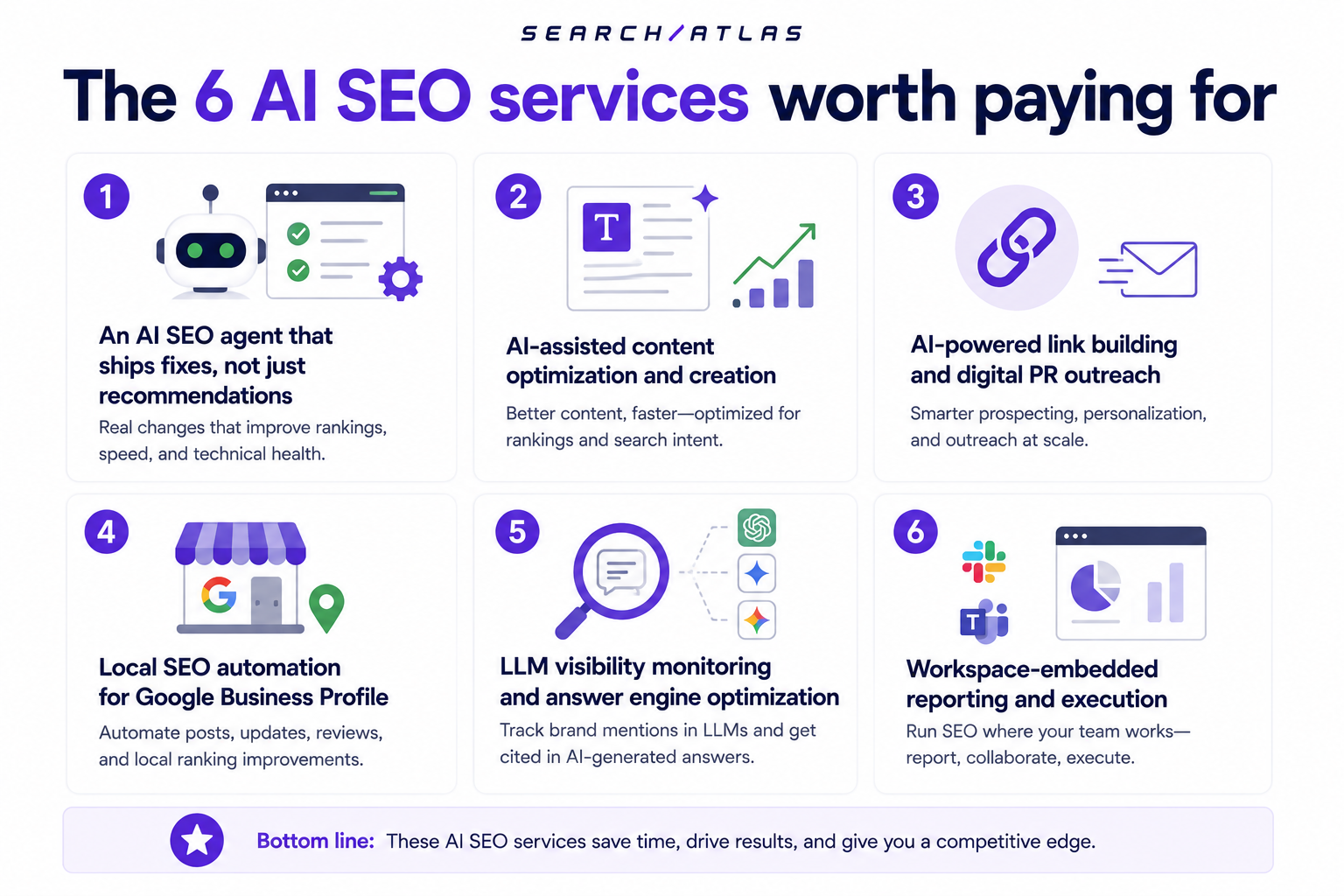
Not every service below needs to come from the same vendor, but an agency or platform that only offers one or two of these is optimizing for the search landscape as it existed a few years ago, not the one that exists now.
1. An AI SEO agent that ships fixes, not just recommendations
The most valuable AI SEO service is an agent that makes the change itself instead of emailing a list of things to fix. OTTO SEO is built this way. Once its script is installed on a site, it audits the domain, identifies gaps in titles, meta tags, headings, schema, and internal links, and deploys the fix directly rather than queuing it for a developer. It learns from Google Search Console data (queries, positions, click-through rates) and from stored brand and business details, then prioritizes changes based on live ranking signals rather than a generic checklist.
This is also where "AI SEO" claims most often fall apart under scrutiny. Semrush's Site Audit, for example, surfaces the same categories of issues, missing schema, broken links, thin metadata, but stops at the recommendation. Someone still has to open the CMS and make each change by hand. An agent that deploys the fix saves the labor a report only describes, which is the difference between a service that speeds up a checklist and one that removes the checklist entirely.
OTTO SEO's own numbers put that gap at around 90% of manual SEO labor saved, with technical and on-page work that used to take months compressed into minutes. A team still keeps the option to review changes before they go live or roll them back after, so the automation does not remove human oversight, only the manual labor.
In practice this covers a specific set of fixes: canonical tags, Open Graph and Twitter Card data, broken and redirected links, missing schema markup, and the internal linking structure connecting a site's pages. Because the system installs through a single script rather than a CMS-specific plugin, it works the same way across WordPress, Shopify, Webflow, or a custom-built site, which matters for an agency running the same audit across dozens of client domains that were each built differently.
2. AI-assisted content optimization and creation
A content-focused AI SEO service should analyze what is already ranking for a keyword and structure new content around the gaps that page leaves open, not just generate generic paragraphs from a prompt. Content Genius pulls live SERP data, builds an entity-weighted keyword map, and scores a draft at the passage level for keyword placement, semantic coverage, and paragraph flow rather than judging a whole article at once.
The stronger versions of this service also grade output against a real rubric instead of a single quality score. Search Atlas runs finished content through Scholar, a 12-dimension grading system covering factuality, information gain, entity coverage, and readability, among others, before it counts as done. That is a meaningfully different check than what a general writing assistant like Jasper offers, since Jasper's templates generate copy without an embedded scoring layer tied to what is already ranking.
A team still needs to understand keyword intent to brief the system correctly, since the software optimizes toward whatever goal a person sets for it. But the heavy lifting of matching structure to what search engines already reward moves from a writer's judgment to a repeatable process.
3. AI-powered link building and digital PR outreach
Outreach automation should replace the spreadsheet-and-inbox workflow most link building still runs on, centralizing prospecting, pitching, and follow-up in one place instead of splitting the work across a CRM, an email client, and a tracking sheet. A capable system filters prospects by traffic, authority score, industry relevance, and region, then automates the follow-up sequence so a campaign does not stall because someone forgot to send a second email.
The AI layer matters most in two specific places. HARO-style automation matches a brand's expertise to live press queries and drafts a response automatically, and a newer category, sometimes called an LLM-aware prospector, identifies which publishers and domains large language models like ChatGPT and Claude actually cite, so outreach targets the sites that influence AI answers, not just the ones with a high traffic number.
That second piece is becoming as important as traditional blogger outreach, since a mention on a site an AI model already trusts can generate a citation even without a backlink attached.
The prospecting side works by filtering domains on traffic, authority score, industry relevance, and geography, then applying spam and quality thresholds automatically so a campaign does not waste outreach on low-value sites. A shared blacklist across campaigns keeps a team from re-pitching a domain that already declined or was flagged, which matters more as outreach volume grows across multiple client accounts running at once.
4. Local SEO automation for Google Business Profile
A business with a physical location or service area needs its Google Business Profile treated as an SEO asset, not a one-time setup task, and that upkeep is exactly what an AI local SEO service should automate. GBP Galactic synchronizes business data across every location, writes editable replies to reviews, generates answers for the Q&A section before a customer even asks, and updates schema markup automatically when a listing changes.
Consistency across every listing is the part that is hardest to do by hand at scale. GBP Galactic connects to data aggregator networks like Data Axle, Neustar, and Foursquare to keep name, address, and phone number consistent everywhere those details appear, since inconsistent NAP data is one of the more common reasons a business's local rankings stall. Paired with the broader category of local SEO tools, this turns a task that used to require a person checking a dozen listings by hand into something the system verifies continuously.
5. LLM visibility monitoring and answer engine optimization
A 2026 AI SEO stack needs a way to see whether ChatGPT, Gemini, Claude, and Perplexity mention a brand at all, since none of that activity shows up in Google Search Console. Search Atlas's LLM Visibility tool tracks visibility percentages, sentiment, and citation sources across those platforms, and benchmarks them against named competitors so a brand can see whether it gets cited and how that citation rate compares to whoever is winning the same query.
This service overlaps heavily with what is often called answer engine optimization, or AEO, which structures content so an AI system can lift a direct answer from it. Building an actual LLM visibility tracking plan means deciding which queries matter, which platforms to monitor, and how often to check, the same rigor traditional rank tracking already applies to Google. Skipping this service means flying blind on a channel that is already sending real traffic and, increasingly, real customers.
6. Workspace-embedded reporting and execution
The newest AI SEO service is one that lives where a team already works, rather than requiring a login to a separate dashboard. Search Atlas Coworker extends the platform's agent into Slack, Microsoft Teams, and ClickUp, so a rank drop, a broken page, or a stalled campaign gets flagged and fixed from inside a chat thread instead of a report nobody opens until the next weekly meeting.
The value here is the loop behind it, more than the chat interface itself. Search Atlas describes this as a sense, detect, propose, approve, heal cycle. The system watches live marketing surfaces, spots where something has drifted from the current strategy, drafts the fix, waits for a human to approve it, and then updates the live page or listing. Nothing ships unseen, but nothing waits for someone to remember to check a dashboard either, which closes the gap between a problem happening and a person noticing it.
How to evaluate an AI SEO agency before you sign
Most agencies now attach "AI" to their service descriptions, so the label alone tells a buyer nothing. A 2026 Forbes analysis of the category found that reliable partners combine traditional SEO fundamentals with entity optimization and technical depth, while the weaker ones lean on the word itself instead of specifics about what the system actually does. Working through the steps below in order surfaces whether the claim is real before a contract gets signed.
- Define the actual success metric first. Decide whether the goal is organic traffic, ranking position, AI citation frequency, or a specific conversion number, since an agency that only reports traffic can hide a lot of stagnation elsewhere.
- Ask what the system executes versus what it recommends. Request a specific example of a change the platform made live on a client's site without a developer, not a screenshot of a suggestions panel.
- Check for technical depth beyond content. A team should be able to speak plainly about schema markup, entity SEO, and crawlability, not just keyword density and blog cadence.
- Request a real case study with dashboard access, not a client testimonial with no underlying data attached.
- Watch for the standard red flags. A guaranteed first-place ranking, a package priced far below the market rate, or a pitch claiming expertise across every channel with no specifics about how any one of them works are all signs to walk away.
How much do AI SEO services cost?
Most AI SEO platforms price on a monthly subscription that scales with the number of sites and the depth of automation a team needs, typically somewhere between $99 and $399 a month for standard plans, with custom enterprise pricing above that for larger portfolios. Search Atlas follows this model, and most vendors in the category price similarly once they move past a single-user starter tier.
Agencies managing multiple client sites often pay per activation on top of a base plan rather than buying a separate subscription for every domain. Search Atlas, for example, charges $99 for the first additional OTTO SEO activation on a plan and $59 per site when an agency buys activations in bulk, which brings the per-client cost down as a portfolio grows.
That per-site model matters more than the headline subscription price for anyone evaluating a platform to run across several client accounts, since a low base price with expensive add-ons can end up costing more than a higher base price built for scale. A free trial, most platforms in this category offer one, is the fastest way to confirm a vendor's automation claims before committing to a monthly plan.
Do AI SEO services replace an in-house SEO team?
No, not entirely. AI SEO services replace the repetitive execution work, technical fixes, metadata updates, outreach follow-ups, but strategy still needs a person who understands the business, its market, and where it wants to compete. Even the most autonomous systems, including OTTO SEO and Search Atlas Coworker, build in an approval step where a human reviews a change before it goes live, because brand judgment and business context are not things a model can fully infer from ranking data alone.
What changes is the ratio of time spent on execution versus strategy, not whether a strategist is needed at all.
Is AI SEO worth it for small businesses?
Yes, particularly for a business without a dedicated SEO hire. A small business rarely has the headcount to run technical audits, write optimized content, manage a Google Business Profile, and track rankings across multiple AI platforms at the same time. Automating the repetitive parts of that workload often matters more for a small team than for an enterprise one with specialists already covering each piece.
The tradeoff is that a small business should still confirm an agency's automation actually deploys changes rather than just describing them, since the evaluation steps above apply just as much to a five-person shop as to an enterprise contract.
What does the future of AI SEO services look like?
The next stage of this category is less about any single AI Overview or chatbot and more about fragmentation across platforms that all answer questions differently. ChatGPT, Gemini, Claude, and Perplexity are gaining and losing share at the same time, and each one weighs citations, entity trust, and content freshness a little differently. A service built for one engine's quirks will keep losing ground as query volume spreads across several.
Advertising is also starting to show up inside AI answers themselves, with a meaningful share of ChatGPT responses now including sponsored content. That changes what "visibility" even means, since a brand may need to earn both an organic citation and consider paid placement inside the same conversation. The agencies and platforms that keep pace will be the ones running technical fixes, content, outreach, local SEO, and cross-platform AI monitoring as one connected system, because treating each of those as a separate purchase is exactly the fragmented approach 2026's search landscape no longer has room for.
The practical takeaway for anyone buying these services now is to stop evaluating vendors by feature list and start evaluating them by what actually ships without a person doing the work by hand. A platform that automates one piece well, technical fixes, content, outreach, local listings, or AI visibility, is still solving yesterday's version of the problem if it leaves the other five for a human to handle manually.
The agencies that win the next few years of this category will be the ones that made that shift early, well ahead of the ones still selling audits as the finished product.