Holistic SEO is a Search Atlas coined term. Holistic SEO treats SEO as one connected system instead of separate technical, content, authority, and UX workflows. Search engines now evaluate websites through combined quality signals, which means weak performance in one area reduces visibility across the entire domain.
The 2025 and 2026 Google core updates accelerated this shift. Google strengthened topical authority systems, expanded E-E-A-T evaluation beyond YMYL categories, increased reliance on engagement signals, and pushed AI Overviews deeper into search results.
At the same time, AI engines such as OpenAI ChatGPT, Google Gemini, and Perplexity AI started selecting sources through entity clarity, semantic structure, crawlability, and trust signals instead of traditional rankings alone.
This playbook explains how holistic SEO works in 2026, how it combines four essential pillars known as the XACT framework (User Experience (X), Authority (A), Content (C), and Technicals (T), and how to execute holistic SEO through Search Atlas tools and systems.
What Is Holistic SEO in 2026?
Holistic SEO in 2026 is a Search Atlas search optimization approach that improves 4 interconnected pillars simultaneously (Experience, Authority, Content, and Technical SEO). Holistic SEO treats a website as a single, interconnected ranking system in which every signal influences overall visibility.
Modern search engines evaluate websites through combined quality signals instead of isolated keyword tactics. Rankings now depend on how well a brand delivers a strong user experience, topical depth, technical performance, authority signals, and semantic clarity across the entire website.
Holistic SEO focuses on improving the complete search experience instead of optimizing single pages for isolated keywords. This approach aligns with AI-driven search systems that evaluate entities, topical relationships, user satisfaction, and brand trust together.
In 2026, holistic SEO connects traditional SEO with AI search visibility, generative engine optimization (GEO), and semantic search optimization. Search engines and AI systems analyze how content, authority, technical structure, and engagement signals work together across the entire domain.
Websites using holistic SEO perform better during algorithm updates because ranking signals reinforce each other across the entire ecosystem. Strong holistic SEO creates sustainable organic growth because technical health, authority, content quality, and experience operate as one unified system.
Why Does Holistic SEO Matter More After the 2025–2026 Core Updates?
Holistic SEO matters more after the 2025–2026 core updates because Google now evaluates websites as complete trust systems instead of isolated pages. Weak signals in content, UX, authority, or technical SEO now reduce visibility across the entire domain.
The June 2025 core update increased the importance of topical authority and semantic depth. Websites with connected topic clusters and original insights gained visibility, while thin content and AI-generated summaries lost rankings.
The December 2025 core update expanded E-E-A-T analysis across all industries, not only YMYL categories. Google now rewards websites showing firsthand experience, expert insights, strong brand signals, and trustworthy publishing practices.
The Google March 2026 core update strengthened site-wide quality evaluation through unified Core Web Vitals scoring. Google now combines LCP, INP, and CLS into one performance signal, which means poor mobile experience or slow templates impact broader rankings during the March 2026 Core Update.
Google’s ranking systems now prioritize source closeness and information gain more aggressively. First-party brands, expert creators, and websites publishing original research outperform generic comparison pages and recycled content.
Holistic SEO now extends beyond traditional search rankings into AI search visibility and GEO. Modern SEO success depends on how well content performs across Google, AI search engines, YouTube, Reddit, TikTok, and conversational AI platforms.
What Are the 4 Pillars of the Holistic SEO Approach?
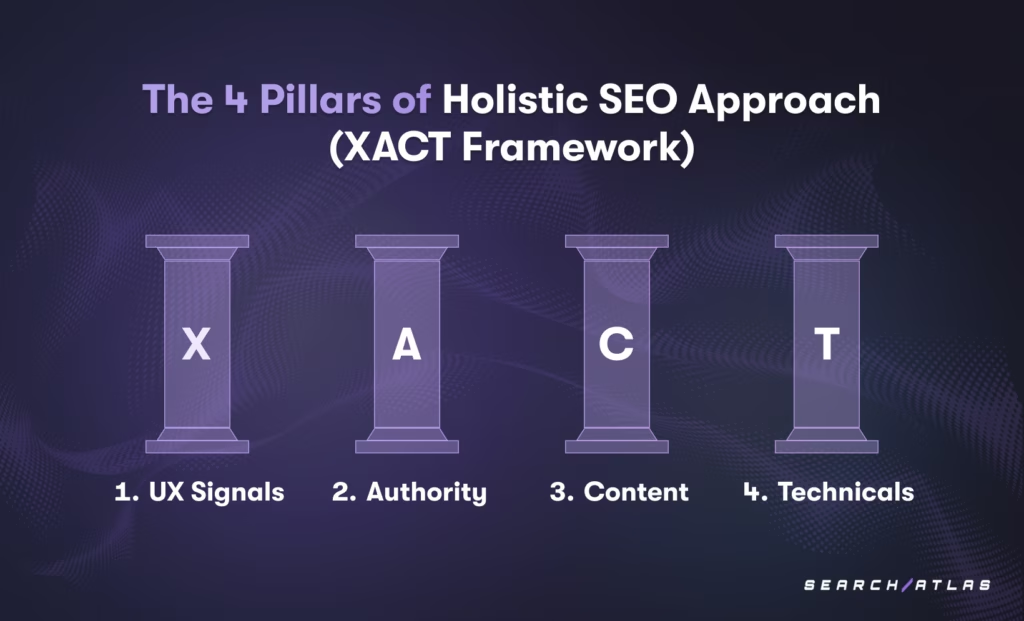
The 4 pillars of the holistic SEO approach are User Experience (X), Authority (A), Content (C), and Technical SEO (T), known together as the XACT framework. These 4 pillars work together as one ranking system that strengthens search visibility, AI search presence, and overall brand authority.
The 4 pillars of holistic SEO are listed below.
1. User Experience (UX)
User Experience (UX) measures how visitors interact with a website before, during, and after visiting a page. UX signals show search engines whether people find a website useful, trustworthy, fast, and easy to navigate.
Strong UX includes fast-loading pages, mobile-friendly layouts, readable design, intuitive navigation, stable page elements, and low friction during interactions. Search engines analyze UX metrics such as click-through rate (CTR), dwell time, repeat visits, branded searches, bounce behavior, and pogo-sticking patterns to understand satisfaction levels.
Core Web Vitals remain a major part of UX evaluation in 2026. Metrics such as Largest Contentful Paint (LCP), Interaction to Next Paint (INP), and Cumulative Layout Shift (CLS) measure loading speed, responsiveness, and layout stability across devices.
Strong UX improves rankings because visitors stay longer, engage more deeply, and interact more positively with the website.
2. Authority
Authority signals measure how trustworthy, credible, and recognized a brand appears across the internet. Authority signals include backlinks from trusted websites, digital PR mentions, expert author profiles, branded searches, reviews, citations, and entity recognition across search engines and AI systems. Authority signals matter because search engines prioritize brands and publishers with proven expertise and external trust validation.
Modern authority goes beyond backlink quantity alone. AI-driven search platforms now evaluate how frequently a brand appears inside generated answers, how often trusted sources reference the brand, and how strongly the brand connects to a topic or entity.
Metrics connected to strong authority signals include high Domain Power, diverse referring domains, natural anchor text distribution, strong branded query volume, low spam signals, and consistent local citation data. Strong authority improves visibility across Google Search, AI search engines, YouTube, Reddit, TikTok, and conversational search platforms.
3. Content Signals
Content signals measure how well a website covers topics, satisfies search intent, and delivers original value. Content signals matter because search engines reward websites that demonstrate expertise, depth, semantic relevance, and information gain.
Strong content signals include comprehensive topic clusters, semantically connected pages, original research, firsthand expertise, entity-rich explanations, contextual internal linking, and consistent content updates.
Modern search systems analyze entity relationships, topical coverage, contextual depth, freshness, and semantic relevance to evaluate content quality. Websites with strong topical ecosystems outperform websites publishing disconnected keyword-focused articles.
Metrics connected to strong content SEO signals include topical depth, semantic coverage, content freshness frequency, internal link density, engagement quality, entity saturation, and keyword breadth across related topics.
Content with proprietary data, testing, expert analysis, or firsthand experience performs significantly better than generic AI-generated summaries or rewritten competitor content.
4. Technical SEO Signals
Technical SEO signals measure how efficiently search engines and AI systems crawl, render, interpret, and index a website. Technical SEO includes crawlability, indexability, schema markup, XML sitemaps, canonical tags, hreflang implementation, HTTPS security, rendering optimization, mobile responsiveness, and clean site architecture.
Strong technical SEO improves how search engines understand content relationships, entities, semantic structure, and page hierarchy across the website. AI-driven search systems rely heavily on structured data and machine-readable content to process information accurately.
Metrics connected to strong technical SEO signals include high crawl success rates, fast server response times, healthy Core Web Vitals scores, strong index coverage, validated structured data, and low rendering errors.
Technical problems such as crawl errors, duplicate pages, broken links, poor rendering, or unstable mobile layouts weaken rankings across the entire domain. Technical SEO matters because weak infrastructure limits the effectiveness of every other SEO signal.
The XACT framework was developed through years of large-scale SEO experimentation, ranking analysis, and behavioral testing led by Manick Bhan and the Search Atlas team. The framework emerged from thousands of real-world SEO campaigns, algorithm tracking studies, and search visibility experiments across competitive industries.
The research showed that sustainable rankings depend on strengthening User Experience, Authority, Content, and Technical SEO together instead of optimizing isolated tactics.
Listen to Manick Bhan discuss the XACT framework and the SEO experiments behind its development in the podcast below.
How to Do Holistic SEO in 2026?
Doing holistic SEO in 2026 means operating SEO as one connected system across UX, Authority, Content, and Technical SEO. The goal is to strengthen every ranking signal together instead of managing technical fixes, content, links, and user experience as separate workstreams.
Holistic SEO shifts execution from fragmented workflows to a unified operating model. Audits, topical maps, content updates, internal links, structured data, authority building, and AI visibility all feed one continuous optimization loop.
The 5 core actions in holistic SEO are listed below.
1. Audit the Full Site Across UX, Authority, Content, and Technical SEO
Start holistic SEO with a full technical crawl, then layer content, authority, and experience signals onto the same dataset. The audit identifies which XACT pillar weakens the full SEO system.
Search Atlas Site Auditor handles this process through a full-domain crawl that runs at 20 pages per second and re-crawls every 7 days by default. Search Atlas Site Auditor returns a Site Health score on a 0 to 1,000 scale that measures indexability, Core Web Vitals, link structure, rendering quality, crawlability, and markup validation in one number.
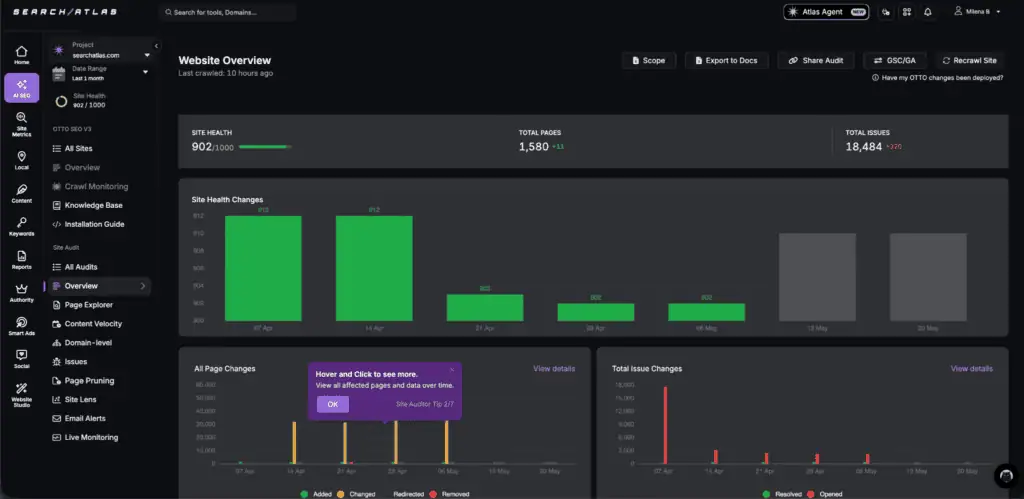
Focus on the highest-impact technical issues first. Prioritize fixes in this order:
- Crawl and indexing blockers.
- Core Web Vitals issues.
- Schema gaps.
- Internal link depth.
- Duplicate or thin pages.
Use OTTO SEO to deploy these fixes automatically across technical SEO, metadata, schema, content, and internal linking through a single CMS pixel without manual implementation.
Pair Site Auditor with Search Atlas Site Explorer for the authority and content layers. Site Explorer adds Domain Power, organic keyword distribution, branded versus non-branded share, Topical Dominance, and pillar-level benchmarking on top of the technical baseline.
Crawl Budget Optimization
Crawl budget optimization improves how Googlebot discovers, processes, and indexes high-value pages. Strong crawl efficiency strengthens every XACT pillar because important pages get discovered faster.
Apply crawl budget optimization in this order:
- Consolidate duplicate URLs with canonical tags and 301 redirects.
- Block crawl traps through robots.txt and meta robots directives.
- Remove low-value archive, tag, and faceted pages from indexation.
- Maintain clean XML sitemaps.
- Fix soft 404s, redirect chains, and server errors.
- Keep priority pages within 3 clicks from the homepage.
- Monitor crawl spikes, missed pages, and slowdowns weekly.
[OTTO crawl monitoring]
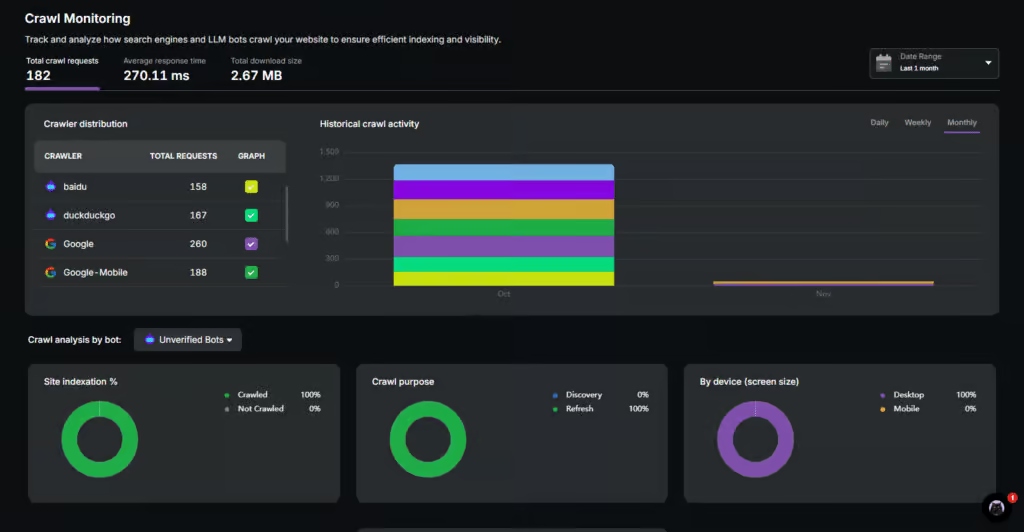
Search Atlas Crawl Monitoring tracks Googlebot, Google-Mobile, Bing, and AI crawler activity directly inside the platform. The tool identifies uncrawled URLs, orphan pages, crawl waste, and mobile-first indexing issues through real bot behavior.
Structured Data Deployment
Structured data makes content easier for search engines, AI Overviews, and LLMs to classify, verify, and cite. Schema strengthens UX, Authority, Content, and Technical SEO at the same time by anchoring every page to a clearly defined entity — the discipline covered in entity schema modeling. Deploy structured data with these rules:
- Use JSON-LD format.
- Match each page to the most specific schema type.
- Use Article, Product, FAQPage, LocalBusiness, HowTo, Review, Person, or Organization schema where relevant.
- Fill required and recommended fields, including headline, image, datePublished, and publisher. logo.
- Add sameAs links to trusted profiles like LinkedIn, X, and Google Scholar.
- Validate markup before deployment.
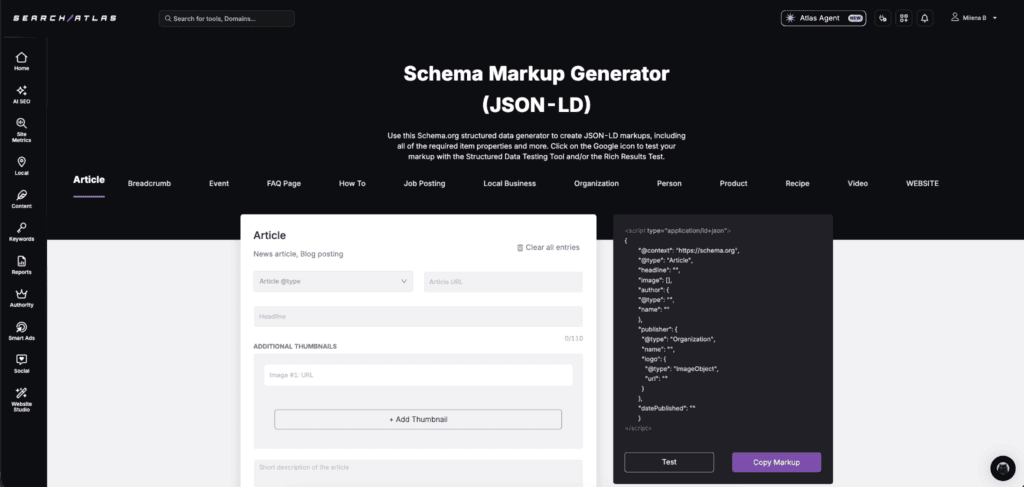
Use Search Atlas Schema Markup Generator to create clean JSON-LD for Articles, FAQs, Local Businesses, Products, Reviews, and Organizations. The tool connects with Google’s Rich Results Testing Tool, which makes validation easier before implementation.
2. Build Topical Maps and Publish Complete Topic Clusters
Topical maps organize pillar pages, cluster pages, and supporting pages around one entity hierarchy. The map defines what to publish, what order to publish in, and how each page connects through internal links.
Run Search Atlas Topical Map Generator on the primary seed keyword. Search Atlas Topical Map Generator turns one seed keyword into a complete pillar, cluster, and supporting content structure using entity mapping, semantic co-occurrence modeling, keyword intent, search volume, and long-tail expansion.
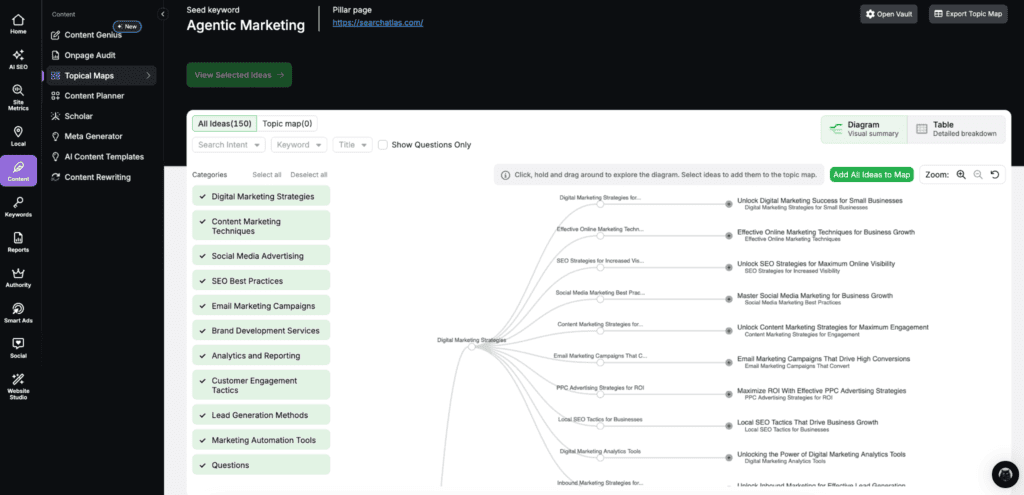
The output includes:
- Interactive topical diagrams.
- Pillar and cluster relationship maps.
- Spreadsheet-ready publishing roadmaps.
Track progress with Topical Dominance. Topical Dominance scores authority from 0 to 100 across 3 layers: Specific Topic, Broad Topic, and Knowledge Domain. The score measures content volume, topical relevance, entity coverage, and publishing consistency — the same signals a topic saturation analysis uses to flag diminishing returns before you overinvest in a cluster.
Topical Cluster Publishing
Topical clusters turn a domain into a semantic authority hub. Google rewards depth, structure, and entity precision because complete clusters make expertise easier to understand.
Apply topical cluster publishing in this order:
- Build the topical map before drafting pages.
- Create pillar pages around core entities.
- Publish supporting pages for long-tail keywords, questions, and related entities.
- Link every cluster page back to its pillar.
- Cross-link related clusters naturally.
- Expand clusters quarterly with new entities and retired outdated subtopics.
3. Produce Intent-Matched Content With Strong Entity Coverage
Holistic SEO content matches search intent first, covers the entity completely, and demonstrates firsthand experience. Volume without coverage no longer creates durable rankings.
Match page layout to the dominant SERP intent before writing. Informational queries need definitions, lists, tables, and FAQs. Transactional queries need product specs, pricing, comparison matrices, and conversion-focused sections. Navigational queries need direct entity pages.
Front-load the answer in the first visible screen. A page that satisfies the query quickly improves dwell time, reduces pogo-sticking, and reinforces semantic relevance.
Strong holistic SEO content includes:
- Author bylines.
- Source citations.
- Original screenshots.
- Proprietary data.
- Real examples.
- Clear entity coverage.
Use Search Atlas Content Genius to engineer content structure around semantic relevance, entity coverage, and search intent alignment. Content Genius applies NLP, contextual clustering, and entity modeling to build machine-readable content that aligns with how Google interprets meaning across headings, passages, and document structure.
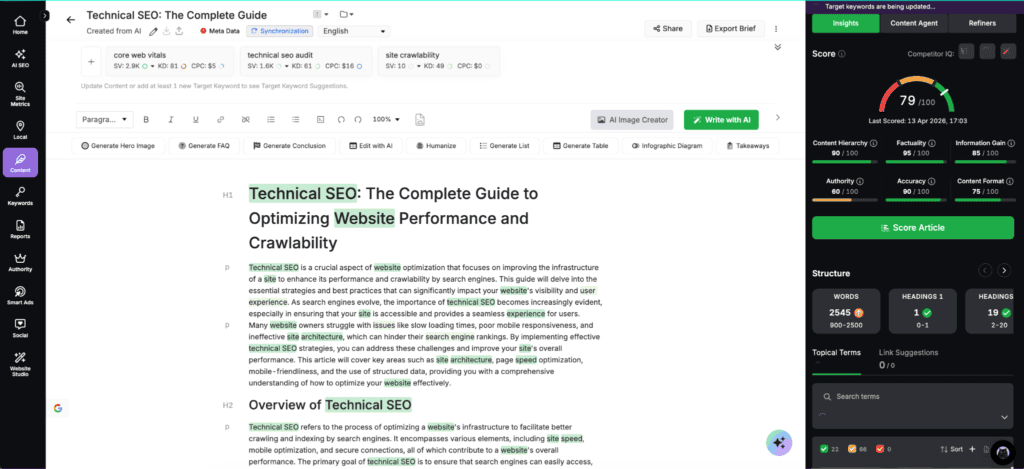
Cover every cluster page in the topical map before adding new pillars. Skipping cluster coverage creates topical gaps that Topical Dominance flags as missing entity weight.
Search Intent Alignment
Search intent alignment means designing the page to satisfy the original query without confusion, delay, or friction. Strong intent alignment improves engagement signals and keeps users moving through the page.
Apply search intent alignment in this order:
- Start with a direct answer, solution, or offer.
- Mirror the dominant SERP structure.
- Use a clean H1, H2, and H3 hierarchy.
- Match CTAs and visuals to the content type.
- Improve speed, design, and mobile usability.
- Remove layout friction that causes abandonment.
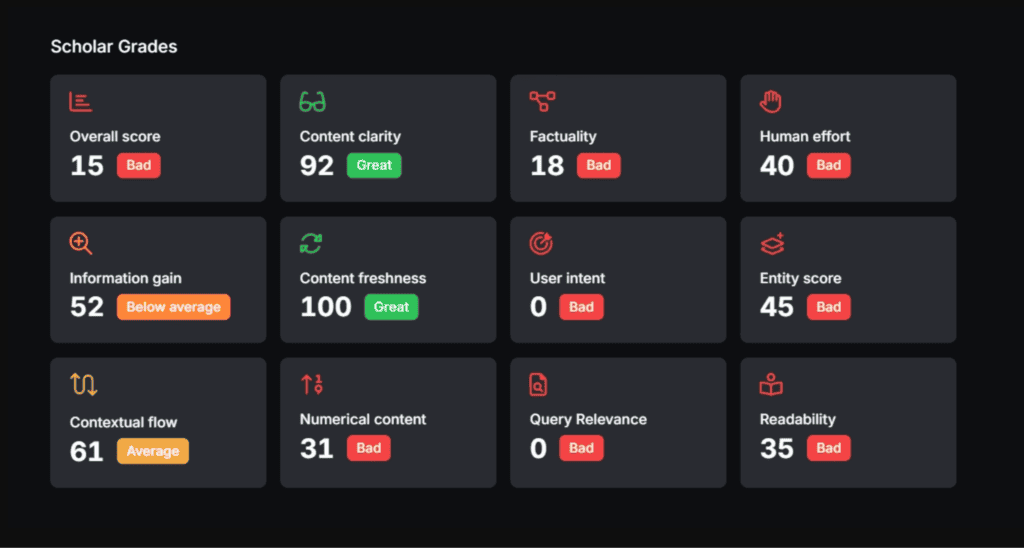
Use Search Atlas SCHOLAR to test intent alignment. SCHOLAR compares content type, structure, clarity, and query relevance against dominant SERP patterns. Low User Intent or Query Relevance scores signal format mismatch.
SCHOLAR evaluates content across clarity, factuality, human effort, information gain, freshness, user intent, entity coverage, contextual flow, numerical content, query relevance, and readability.
Metadata Optimization
Meta titles and descriptions improve click-through rate and reinforce relevance before users reach the page. Strong metadata strengthens UX signals, branded search behavior, and authority recognition.
Apply metadata optimization in this order:
- Write titles that match the actual query intent.
- Use numbers, value propositions, or emotional triggers without misleading users.
- Keep titles between 50 and 60 characters.
- Keep descriptions between 120 and 160 characters.
- Include the main keyword in the title.
- Add a supporting variant in the meta description.
Use Search Atlas Meta Generator to create intent-matched metadata at scale through semantic weighting, keyword intent modeling, and entity correlation.
Evergreen Content Updates
Evergreen content loses visibility when search intent, entity coverage, or competing results change. Updating evergreen content preserves freshness, semantic depth, and ranking stability. Use this refresh cadence:
- Review top-traffic pages every 90 days.
- Review long-tail pages every 180 days.
- Review low-priority archive pages every 365 days.
Apply evergreen updates in this order:
- Add new internal links to and from the page.
- Expand sections with new entities, FAQs, and long-tail variations.
- Refresh metadata to match current SERP intent.
- Update screenshots, examples, and data.
- Re-index updated URLs immediately.
4. Strengthen Internal Linking and Technical Structure
Internal linking distributes authority through the pillar-cluster graph. Every cluster page links back to its pillar, and related pillars cross-link to adjacent pillars. This graph signals topical structure to crawlers and concentrates link equity on important commercial pages.
Apply internal linking in this order:
- Add 3 to 5 contextual internal links per page.
- Use entity-rich anchor text instead of generic text.
- Keep priority commercial pages within 3 clicks from the homepage.
- Audit orphan pages monthly through Site Auditor Page Explorer.
- Expand the cluster graph annually as entities change.
Use Search Atlas OTTO SEO to deploy internal links at scale through a single JavaScript pixel installed on any CMS. OTTO SEO learns priority pages from Google Search Console data, identifies relevant anchor text, and applies links live without developer intervention.
OTTO SEO covers titles, descriptions, headings, content, internal links, canonical tags, Open Graph tags, Twitter Cards, broken links, and indexing through the same pixel. OTTO SEO saves 90% of manual SEO labor and completes months of technical and on-page work in minutes.
5. Build Authority Through Backlinks, Branded Search, and AI Visibility
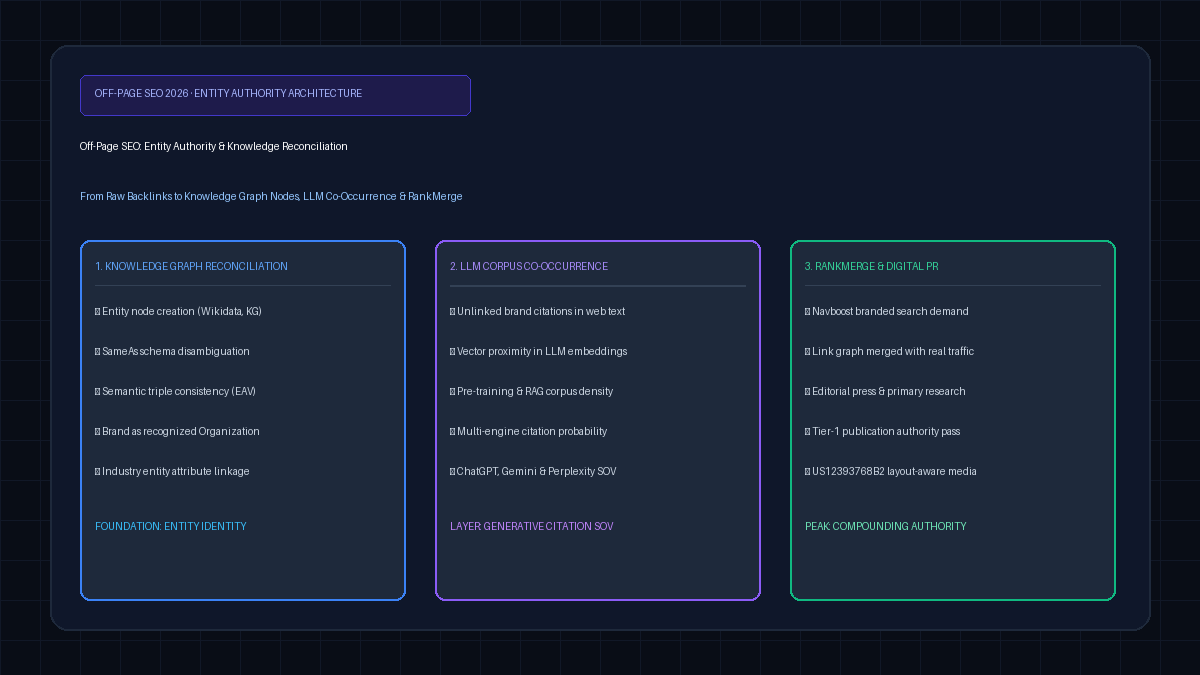
Off-page authority in holistic SEO combines digital PR, branded mentions, topical backlinks, and LLM-aware placements. Authority signals now influence Google rankings, branded search behavior, and LLM citation visibility.
Backlinks remain one of Google’s strongest authority signals. Top-ranking pages carry 3.8 times more backlinks than positions 2 through 10, and 92.3% of the top 100 ranking websites carry at least one backlink. Digital PR ranks as the most effective link-building tactic, used by 67.3% of marketers and rated highest by 48.6% of SEO professionals.
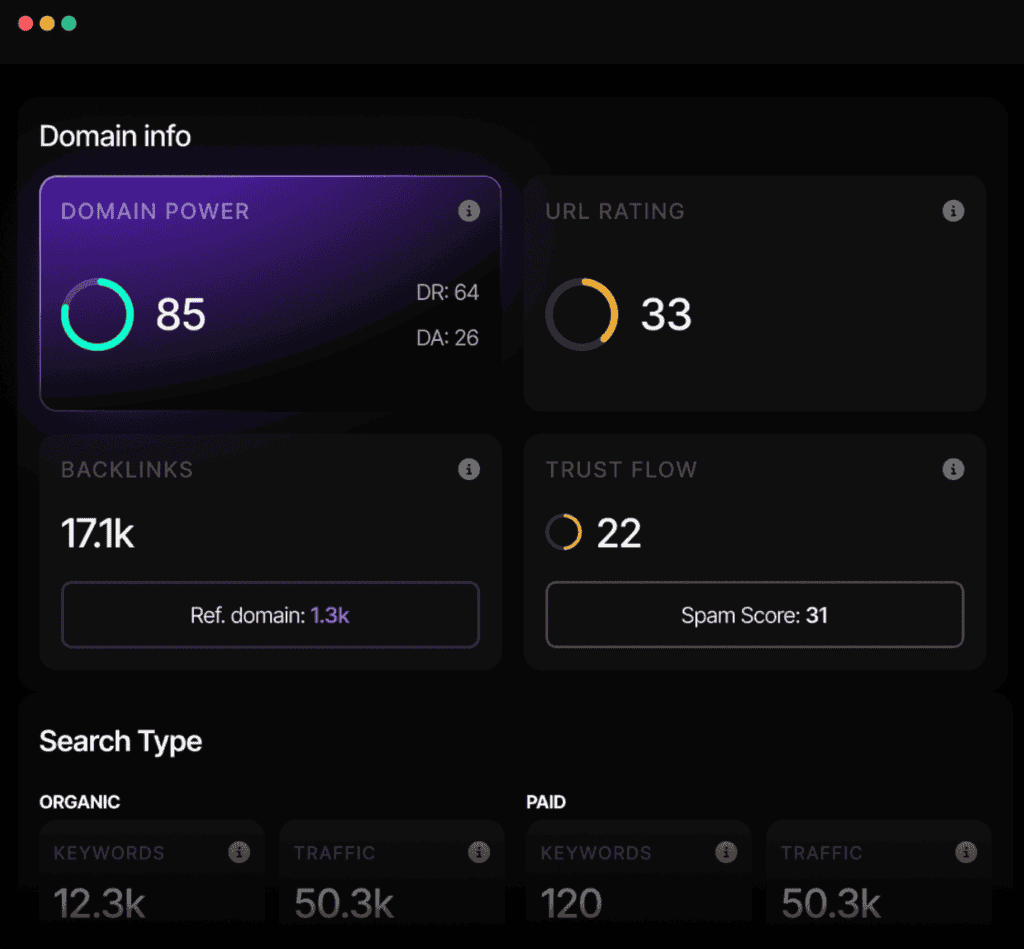
Search Atlas tracks placement value through Domain Power, a 100-point logarithmic authority metric that integrates organic traffic, keyword performance, and ranking distribution across the top 100 SERPs.
Trusted Backlink Acquisition
Trusted backlink acquisition means earning links from authoritative, topically relevant websites with low spam risk. Link equity strengthens every pillar by improving discovery, trust, and domain-level authority, particularly when links reinforce a clearly defined entity — the model behind entity-based link valuation.
Apply backlink acquisition in this order:
- Prioritize semantically relevant domains with high Domain Power.
- Avoid anchor text mismatch between the referring page and the target page.
- Distribute links across topical clusters.
- Prioritize domains close to trusted seed sites.
- Convert unlinked brand mentions into backlinks.
- Reclaim lost or broken backlinks.
- Audit toxic placements quarterly.
Use Search Atlas Site Explorer to evaluate Domain Power, Trust Flow, Spam Score, referring domain history, anchor text distribution, and lost or decaying links. After identifying authority gaps, use Link Laboratory to acquire contextual backlinks from more than 51,000 websites that accept guest posts, editorials, and press releases.
Branded Search Growth
Branded search means users search for a brand with a specific keyword, product, or problem. These navigational queries reflect awareness, trust, and pre-qualified intent.
Apply branded search growth in this order:
- Partner with niche influencers, publishers, and communities.
- Launch PR campaigns, interviews, podcasts, and expert features.
- Promote branded assets through email, social, and paid channels.
- Repurpose earned exposure across channels.
- Launch integrations or product bundles with complementary platforms.
- Track branded queries like “[brand] reviews,” “[brand] vs competitor,” and “[brand] pricing.”
Use Search Atlas Link Building Outreach and Digital PR Tool to find opportunities, customize outreach templates, track communication, and manage partnerships. After placements go live, track brand mentions and branded search growth through Google Search Console data inside the workflow.
LLM Visibility Placements
LLM visibility tracking measures how often brands, products, services, and websites appear inside AI-generated answers. AI visibility now operates independently from traditional Google rankings, which makes platform-level tracking necessary for holistic SEO.
Search Atlas LLM Visibility monitor mentions, citations, and share of voice across ChatGPT, Gemini, Perplexity, and Claude. Search Atlas LLM Visibility tracks AI visibility in real time, analyzes sentiment around generated mentions, and benchmarks visibility against competitors across AI search environments.
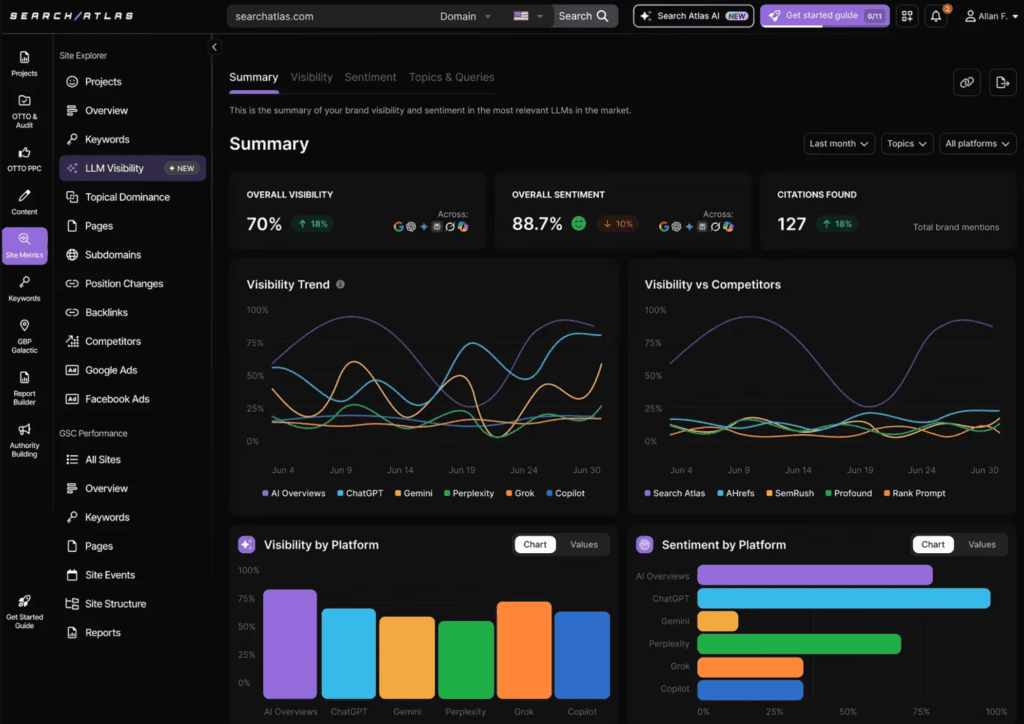
Use these visibility insights to identify which topics, entities, and publishers increase citation frequency across AI platforms. Then reinforce those signals through content expansion, digital PR, branded mentions, and contextual backlinks that strengthen both traditional SEO and AI search visibility together.
How Do You Track Holistic SEO Progress?
Track holistic SEO progress through pillar-level dashboards instead of isolated vanity metrics. Pillar-level tracking reveals which SEO system weakens overall visibility and which optimization lever requires attention next.
Modern SEO performance depends on balancing User Experience, Authority, Content, and Technical SEO together. Strong performance in one pillar cannot compensate for weak signals in another pillar for long. Holistic SEO dashboards organize these signals into measurable frameworks that track overall search health continuously.
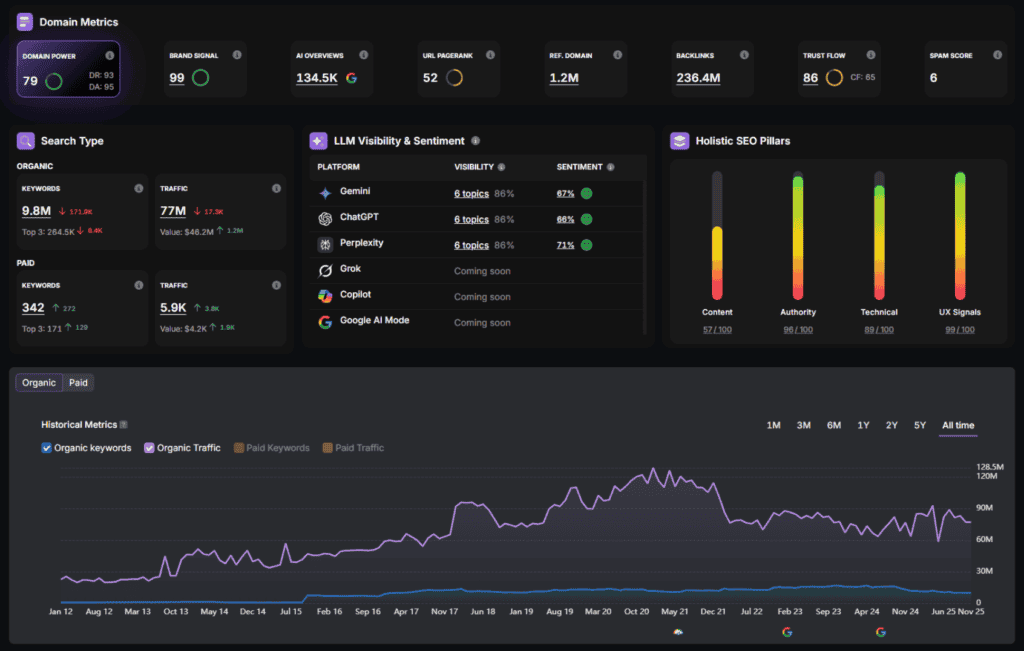
Search Atlas Site Explorer surfaces 4 pillar scores side by side: Experience, Authority, Content, and Technical. Each score benchmarks performance against direct competitors and broader SERP competitors, which makes visibility gaps easier to identify quickly.
Which Metrics Belong on the Holistic SEO Dashboard?
Search Atlas tracks holistic SEO performance for each pillar of the XACT framework. The holistic SEO dashboard metrics are listed below.
- Site Health Score tracks Technical SEO performance.
- Domain Power tracks Authority strength.
- Topical Dominance tracks Content depth and semantic coverage.
- Core Web Vitals track Experience quality.
- Organic clicks and impressions track cumulative SEO growth.
- LLM Visibility Share tracks AI search visibility performance.
Site Health Score tracks Technical SEO performance through crawlability, indexability, rendering quality, structured data validation, and internal linking integrity. Search Atlas measures Site Health on a 0–1,000 scale.
Domain Power tracks Authority strength through backlink quality, ranking distribution, keyword visibility, and organic traffic performance. Search Atlas measures Domain Power on a 100-point logarithmic scale.
Topical Dominance tracks Content performance through semantic relevance, publishing consistency, entity coverage, and topical depth across content clusters. The scoring system evaluates authority across Specific Topic, Broad Topic, and Knowledge Domain layers.
Core Web Vitals track Experience quality through loading speed, responsiveness, and layout stability. The composite score combines Largest Contentful Paint (LCP), Interaction to Next Paint (INP), and Cumulative Layout Shift (CLS).
Organic clicks and impressions confirm cumulative SEO growth across all pillars. Rising visibility combined with stable engagement signals indicates that UX, Authority, Content, and Technical SEO systems are strengthening together.
LLM Visibility Share tracks AI search visibility across platforms such as OpenAI ChatGPT, Google Gemini, and Perplexity AI. AI visibility behaves independently from traditional Google rankings, which makes separate tracking necessary.
How often should the holistic SEO dashboard refresh?
The holistic SEO dashboard refreshes on different cycles depending on the pillar being measured. Technical signals move faster than authority and content signals, which means each metric requires a different review cadence.
Search Atlas Site Auditor re-crawls websites every 7 days by default and surfaces new technical regressions within the same week. Weekly reviews focus on crawlability, Core Web Vitals, rendering problems, structured data validation, broken links, and indexing issues.
Authority and content signals move more gradually because rankings, backlinks, branded search demand, and topical coverage require longer evaluation windows. DP and Topical Dominance typically shift on monthly cycles tied to new content publishing, backlink acquisition, digital PR placements, and semantic expansion across topic clusters.
Quarterly reviews compare pillar-level performance against direct competitors inside Search Atlas Site Explorer. The quarterly review identifies the weakest pillar and rebalances optimization priorities for the next growth cycle.
Annual reviews focus on broader structural changes such as expanding topical maps, introducing new entities, consolidating outdated clusters, refreshing evergreen content systems, and aligning the SEO strategy with emerging search behaviors and AI search trends.
Case Study: Holistic SEO Outcomes From the Search Atlas Dataset
Search Atlas analyzed holistic SEO outcomes across 39,876 websites, 350,159 backlink placements, 21,767 domains, and 368,972 competition-tier domains to measure how technical SEO, authority, content, and AI visibility influence rankings and search performance at scale.
The study, The Real Impact of Automated Technical SEO Fixes on Organic Visibility, was conducted by Manick Bhan and the Search Atlas research team using live deployment data from OTTO SEO, Backlink Research, Domain Power modeling, and LLM visibility analysis instead of synthetic SEO benchmarks.
What Did the Technical Fixes Study Measure?
The technical fixes study analyzed 39,876 websites after automated optimizations were deployed through Search Atlas OTTO SEO. The study measured changes in impressions, organic traffic, keyword rankings, CTR, and average position after technical and on-page fixes were applied automatically.
The research isolated ranking gains connected to schema markup deployment, heading hierarchy fixes, canonical consolidation, H1 optimization, and metadata corrections.
Schema-related fixes produced a 150.5% increase in impressions. Missing heading fixes generated a 114.3% increase. The median website gained 146 long-term impressions, 67 additional ranking keywords, and roughly 2 average ranking positions after optimization deployment.
Large cluster-based websites generated the strongest gains, with median impression growth reaching 2,370 impressions alongside measurable CTR and ranking improvements at scale.
What Did the Domain Strength Study Measure?
The domain strength study analyzed 350,159 backlink placements across 13,002 pages to measure how authority signals influence rankings, impressions, clicks, and keyword growth.
The study compared Search Atlas Domain Power against traditional authority metrics such as DA and DR to evaluate predictive ranking accuracy.
Pages gained 150% more ranking keywords, 275% more impressions, 14% more organic clicks, and a 10.8% improvement in average ranking position after domain-strength-aligned backlink acquisition.
Anchor keyword relevance increased 69.6%, while the correlation between anchor relevance and rankings strengthened from −0.75 to −0.86 after authority optimization. Domain Power’s predictive accuracy increased from 0.419 to 0.559, outperforming DA and DR across all measured page-level outcomes.
How Does Holistic SEO Connect to AI Search and LLM Visibility?
Holistic SEO connects directly to AI search because LLMs evaluate content through entity clarity, topical depth, structured data, crawlability, and trust signals. These are the same outputs strengthened by the 4 pillars of the holistic SEO workflow: User Experience, Authority, Content, and Technical SEO.
Modern AI search systems no longer rank pages through traditional blue-link logic alone. Platforms such as OpenAI ChatGPT, Google Gemini, Perplexity AI, and Anthropic Claude retrieve, summarize, and cite content based on semantic relevance, entity recognition, contextual trust, and information clarity.
How Do Generative Engines Differ From Google for Visibility?
Generative AI engines behave very differently from traditional Google Search results. Each engine retrieves, ranks, summarizes, and cites information through different retrieval and reasoning systems, which means AI visibility requires platform-specific optimization and tracking.
The Search Atlas research study How GPT Results Differ from Google Search: LLM-SERP Overlap Study analyzed 18,377 semantically matched LLM-SERP query pairs to measure visibility overlap between AI engines and Google Search.
The study found that Perplexity AI overlaps traditional Google SERPs by roughly 25% to 30% at the domain level and roughly 20% at the URL level. OpenAI GPT and Google Gemini overlap below 15% at the domain level and below 10% at the URL level.
These differences confirm that ranking well in Google does not guarantee visibility inside AI-generated answers.
Search Atlas integrated these findings directly into the LLM Visibility platform Site Explorer reporting systems. LLM Visibility feature measures how often brands, products, services, and domains appear inside answers generated by OpenAI ChatGPT, Google Gemini, Perplexity AI Perplexity, and Anthropic Claude.
The platform classifies overlap patterns across engines, normalizes URL and domain signatures, and computes visibility overlap vectors between Google and AI systems. The output identifies which SEO pillars require reinforcement to improve citation frequency and visibility across specific AI platforms.
How To Start: The 30-60-90 Day Holistic SEO Plan
The 30-60-90 day holistic SEO plan organizes SEO execution into 3 phases: foundation, expansion, and authority growth. The plan starts with technical auditing and topical mapping, then moves into content production, internal linking, authority building, and AI visibility tracking.
The structure follows how SEO signals actually evolve. Technical improvements appear within weeks. Content and topical authority grow over months. Authority and brand visibility compound over quarters.
Each phase produces measurable outputs inside Search Atlas, which creates a repeatable workflow for scaling holistic SEO systematically.
What Happens in Days 1 to 30?
Days 1 to 30 focus on auditing the website and building the topical map. This phase creates the technical baseline and content roadmap that guide the next 60 days of SEO execution.
Start by running a full crawl through Search Atlas Site Auditor on day 1. The crawl identifies crawl blockers, indexing issues, rendering problems, Core Web Vitals failures, broken links, duplicate pages, and schema validation errors.
Week 1 focuses on resolving critical crawl and indexing problems. Week 2 focuses on stabilizing Core Web Vitals and improving mobile usability. Week 3 focuses on generating the topical map from the primary seed keyword. Week 4 benchmarks: Topical Dominance scores against direct competitors.
This phase produces 2 main outputs:
- A Site Health Score baseline.
- A pillar-cluster topical roadmap.
Search Atlas OTTO SEO begins automated technical and on-page optimization immediately. OTTO SEO deploys live optimizations for titles, meta descriptions, headings, schema markup, canonical tags, broken links, and indexing management without developer deployment cycles.
What Happens in Days 31 to 60?
Days 31 to 60 focus on content production and internal linking. This phase fills the topical map with published content while strengthening semantic relationships between pages.
Start publishing 2 to 3 cluster pages each week, prioritizing clusters with the largest Topical Dominance gaps. Update related evergreen pages alongside new content to strengthen semantic coverage and freshness signals.
Every new page should connect back to its pillar page through contextual internal linking. Add 3 to 5 internal links per page using entity-rich anchor text instead of generic phrases.
This phase produces 2 main outputs:
- Published pillar and cluster pages.
- A connected internal linking graph.
Search Atlas OTTO SEO automatically deploys internal links across the website once new pages are published. The system learns anchor opportunities directly from Google Search Console query data and updates links dynamically across the live site.
Search Atlas Site Auditor re-crawls every 7 days to validate canonical consistency, link depth, orphan pages, and crawl accessibility as the content ecosystem expands.
What Happens in Days 61 to 90?
Days 61 to 90 focus on authority building, digital PR, and performance tracking. This phase strengthens trust signals, branded visibility, backlink authority, and AI search presence.
Start digital PR and outreach campaigns through the Search Atlas Link Building Outreach Tool. Filter opportunities by authority, traffic, niche relevance, category, and geographic region.
Use QUEST PR Finder to identify publishers frequently cited by OpenAI ChatGPT, Google Gemini, Perplexity AI Perplexity, and Anthropic Claude. These placements strengthen both traditional rankings and AI search visibility.
Track backlink quality and placement value through Domain Power instead of relying only on legacy metrics such as DA or DR.
This phase produces 3 main outputs:
- Referring domains and backlinks.
- Brand mentions and digital PR placements.
- A complete, holistic SEO dashboard baseline.
Finalize the reporting workflow inside Search Atlas Site Explorer with weekly technical reviews, monthly content and authority reviews, and quarterly pillar-level competitor benchmarking.
The first 90-day cycle establishes the baseline for continuous holistic SEO growth. Future cycles rebalance priorities around the weakest XACT pillar while expanding topical authority, technical health, and AI search visibility over time.
Holistic SEO FAQ
What Is the Main Goal of Holistic SEO?
The main goal of holistic SEO is to strengthen User Experience, Authority, Content, and Technical SEO together instead of optimizing isolated ranking factors. Holistic SEO improves long-term visibility by building a balanced search ecosystem where every pillar reinforces the others continuously.
Does Holistic SEO Replace Technical SEO?
No, holistic SEO includes technical SEO as one of the 4 XACT pillars alongside UX, Authority, and Content. Technical SEO strengthens crawlability, indexability, rendering, and structured data. Holistic SEO expands further by connecting technical health with engagement, topical authority, internal linking, and trust signals.
Does Holistic SEO Replace Keyword Research?
No, keyword research still matters in holistic SEO, but keywords operate inside broader entity and topical systems. Holistic SEO focuses more heavily on semantic coverage, topical relationships, search intent, and entity clarity instead of isolated keyword targeting alone.
Why Does Holistic SEO Matter More After Google’s 2025 and 2026 Updates?
Google’s 2025 and 2026 updates increased emphasis on site-wide quality, topical authority, engagement quality, and AI-readable trust signals. Websites with strong backlinks but weak content lost visibility, while websites with strong content but weak technical infrastructure struggled to appear inside AI Overviews and AI-generated answers.
How Long Does Holistic SEO Take to Show Results?
Holistic SEO usually produces technical and content improvements within 30 to 90 days. Authority and branded visibility gains compound over longer periods. Technical fixes often move fastest because crawlability, indexing, schema, and internal linking influence visibility immediately after deployment.
Does Holistic SEO Work for Small Websites?
Yes, holistic SEO works for websites of any size because the framework scales through topical scope instead of page count alone. Small websites usually operate with smaller topical maps and fewer cluster pages, but the workflow remains the same: technical health, content quality, internal linking, and authority reinforce each other.
Does Holistic SEO Work for E-commerce Websites?
Yes, holistic SEO works especially well for e-commerce because e-commerce visibility depends heavily on technical SEO, structured data, UX, topical relevance, and authority simultaneously. Product schema, crawl efficiency, internal linking, category structures, and content clusters all influence ecommerce rankings together.
Does Holistic SEO Work for SaaS and B2B Companies?
Yes, holistic SEO performs strongly for SaaS and B2B companies because these industries depend heavily on topical authority, trust signals, educational content, and branded search growth. Cluster-based content, comparison pages, integration pages, and high-intent educational resources strengthen both rankings and AI visibility simultaneously.
What Tools Support the Full Holistic SEO Workflow?
Search Atlas supports the full holistic SEO workflow through connected systems:
- Site Auditor for technical audits.
- Site Explorer for rankings and pillar scoring.
- Topical Maps for cluster planning.
- SCHOLAR for content scoring.
- OTTO SEO for automation.
- Link Building Outreach Tool for authority building.
- LLM Visibility for AI search tracking.
The platform connects every workflow stage into one system instead of separating SEO tasks across disconnected tools.
How Does Holistic SEO Align With Google’s Ranking Systems?
Holistic SEO aligns with Google’s ranking systems because Google evaluates websites through combined behavioral, semantic, authority, and technical signals. The XACT framework organizes these systems into 4 pillars: User Experience, Authority, Content, and Technical SEO.
Does Holistic SEO Help With AI Overviews and LLM Visibility?
Yes, holistic SEO directly improves visibility inside AI Overviews and LLM-generated answers because AI systems prioritize entity clarity, semantic structure, topical authority, crawlability, and trust signals. These are the same systems strengthened through the XACT framework.
What Is the Difference Between Holistic SEO and Semantic SEO?
Semantic SEO improves content through entities, contextual relevance, and topical relationships. Holistic SEO expands further into technical infrastructure, UX, authority, crawlability, and internal linking. Semantic SEO helps pages rank. Holistic SEO helps domains maintain rankings consistently.